Charitable nonprofit workers in the United States, overall, are paid wages that put them roughly on a par with workers in both for-profit businesses and government institutions. Unlike the other two sectors, nonprofits are highly concentrated in a handful of fields and their workers’ wages vary widely between highly-paid fields such as health care and education and traditionally lower-wage fields such as social assistance and the arts.
The average salary of a nonprofit worker drops an average $159 per week when you remove hospitals and high education from the calculations — $1,357 to $1,156, based on 2022 data from the U.S. Bureau of Labor Statistics, the most recent data from the federal agency.
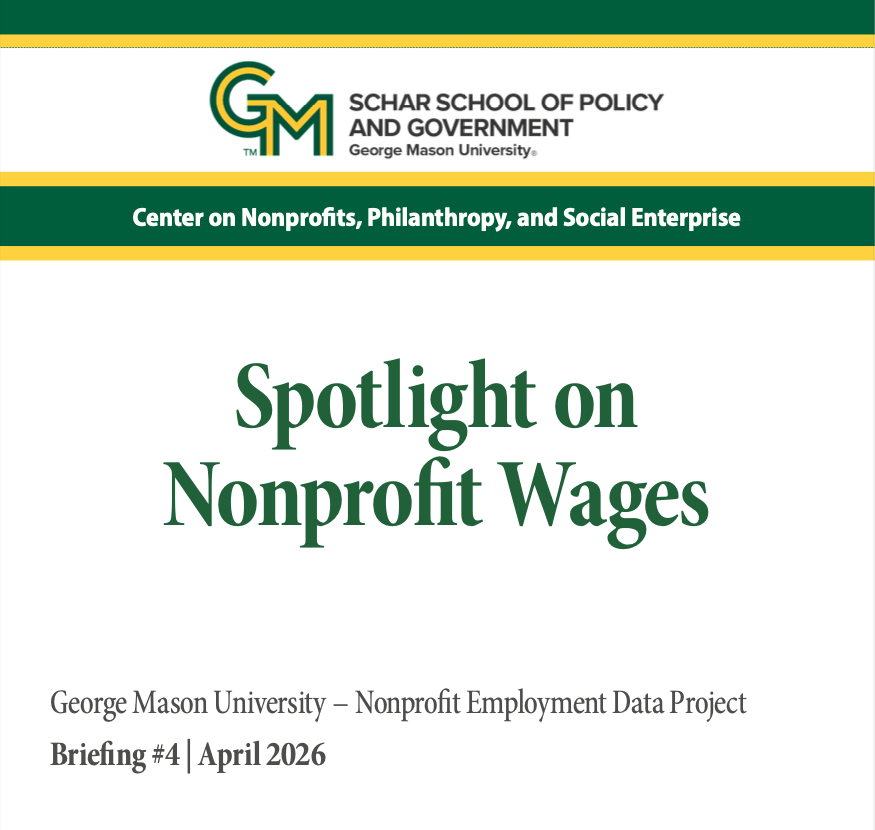
The data is included in a new report, “Spotlight On Nonprofit Wages” from the Center on Nonprofits, Philanthropy, and Social Enterprise in George Mason University’s Schar School of Policy and Government. It is authored by Alan Abramson, Ph.D., and Chelsea L. Newhouse.
This report follows up on the school’s 2024 Nonprofit Employment Report, which provided an overview of national-level data on 501(c)(3) nonprofit employment and wages between 2017 and 2022 from the U.S. Bureau of Labor Statistics’ Quarterly Census of Employment and Wages (QCEW). Drawing on this same dataset, Spotlight on Nonprofit Wages drills down into nonprofit average weekly wages in comparison to wages for-profit companies and government institutions as of 2022, the latest year for which QCEW nonprofit data are available.
“The story really varies from area to area. The sector matters but also program area matters. Geography also matters. It’s a complicated story,” Abramson told The NonProfit Times. “For those in the nonprofit sector, it is important to be aware of comparative wage rates. It affects recruitment. It affects retention.”
The higher-paid fields of health care and education are the largest areas of nonprofit employment, and wages paid to workers in the largest institutions in these two fields — hospitals, colleges, and universities (i.e. high education) — might obscure overall wage disparities. The authors examined whether these large institutions hide broader wage disparities by removing them from the analysis and found that they do. Excluding hospitals and higher education institutions in all three sectors, average weekly wages for nonprofit workers were 9% less than than government workers and 14% less than for-profit workers in 2022.
Hospitals and universities employ nearly 45% of all nonprofit workers — in some cases, highly-skilled workers who earn relatively high salaries, such as hospital and university administrators, doctors, and college professors. As a result, when hospital and higher education workers are removed from the calculation, the average weekly wages of the remaining 55% of nonprofit workers are substantially below the average weekly wage for for-profit and government workers, the data shows.
“Each field is different. It is useful to think of it both ways,” with and without hospitals and higher education, said Abramson.
The challenge right now is the U.S. Bureau of Labor Statistics releases nonprofit data only every five years, even though it is collected along with every other labor silos. “We know how the business sector is doing in a much more timely way. It’s not a matter of collecting data. The data is collected,” said Abramson It’s a matter of getting access to the data that’s already collected, he said.
Led by Center Director Abramson, in collaboration with his Center faculty Dr. Mirae Kim, Ph.D. and Stefan Toepler, Ph.D., the GMU-NED Project is intended to continue and expand on the prior work of Johns Hopkins University’s Center for Civil Society Studies which was led by the now late Lester M. Salamon, Ph.D.
Click here to read the full 14-page report