(Chart Courtesy of Independent Sector)
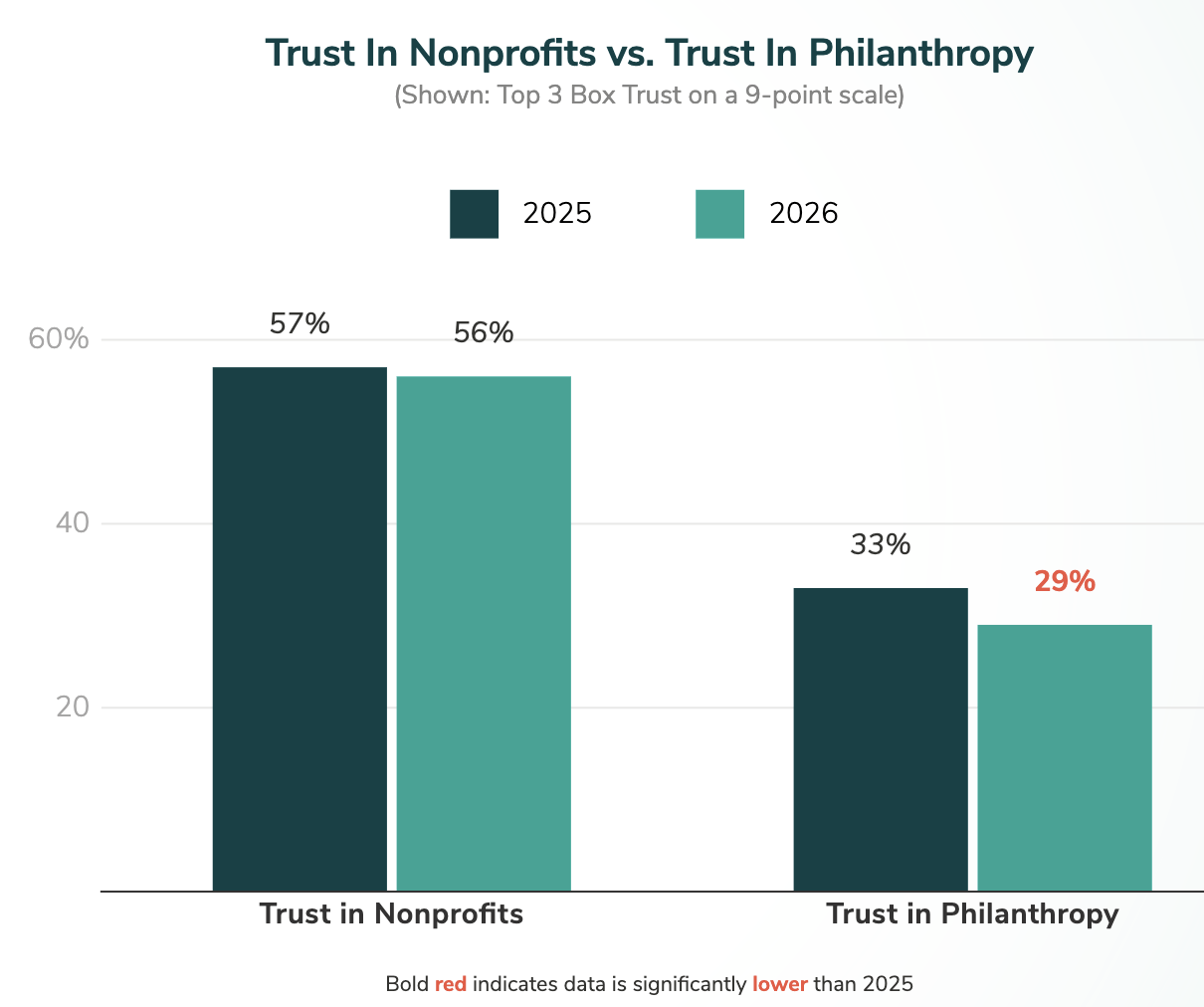
Americans’ trust in nonprofits has remained the roughly the same as last year, but down one point to 56%. It beats overall philanthropy by 27 points, which dropped four points from last year to just 29%.
The perceived independence of nonprofit organizations from profit motives drives stronger trust in their integrity and societal role compared to corporations and government, according to authors of a new report from advocacy organization Independent Sector.
However, public trust in nonprofits’ generative AI use is conditional, driven by familiarity with generative AI but tempered by broad concerns about its risks and limitations, according to the authors of the 57-page report “The State of Trust in Nonprofits and Philanthropy.”
For the seventh year, Independent Sector partnered with Edelman Data & Intelligence to examine how the American public views nonprofit and philanthropic organizations. The 2026 study includes a nationally representative survey of 3,000 U.S. adults and politically representative online focus groups with a margin of error of 2%.
Two online groups were fielded during the course of three days this past April, one containing 22 self-reported Democrats, and the other containing 22 self-reported Republicans.
“As Americans struggle with economic challenges and political divisions, their trust in nonprofit organizations to deliver for their communities remains higher than any other sector of society,” said Akilah Watkins, Ph.D., president and CEO of Independent Sector. “Our new research shows that this high level of trust is largely driven by transparency and direct engagement: When Americans feel that they have a role in and insight into a nonprofit’s work, they are more likely to trust that organization to deliver on its promises ethically and effectively.”
The new research shows that connection is an essential part of trust. “Americans want to see how organizations use their funds and feel the impact of an organization in their communities,” said Watkins. “As Americans’ perceptions of government and corporations have worsened, nonprofit organizations have the opportunity and responsibility to invite more Americans to take an active role in their communities as nonprofit volunteers, advocates, and decision-makers.”
Human service organizations were the most trusted nonprofits, remaining at 67% year-over-year followed by animals and wildlife at 61%, down a point from last year. In fact, seven of the nine categories experienced declines with civic organizations taking the biggest hit at a 4-point dip.
Respondents were asked about trust in nonprofits and then 10 other categories, three of which were local, state and federal government. The military led the 10 categories but was 12 points behind nonprofits.
“Of all the subtypes of nonprofits where trust was measured, only one category (civic organizations) saw a statistically significant decrease in trust. Like the number for overall trust in nonprofits (57% in 2025, 56% in 2026). The shifts in sentiment were otherwise within the margin of error, denoting stability rather than a meaningful change,” said Kevin Miller, director of research at Independent Sector. “There were also some significant positive changes in a couple of other sentiments about nonprofits overall.” These changes include:
- Confidence in nonprofits to pursue specific activities including civic engagement increased from 2025; and,
- Belief that nonprofits are making things better in America increased, while belief that corporations or the federal government are doing so decreased.
“Trust in philanthropy did show a decrease larger than the margin of error,” Miller acknowledged.
Nonprofits had some bipartisan appeal. The data showed 64% of people who self-identified as Democrats had trust in nonprofits and 58% of self-identified Republicans.
Nonprofits dropped two points when it came to honesty (67% positive) and for keeping promises (67% positive). Nonprofits gained points year-over-year when respondents were asked if nonprofits have a positive impact on society and that they are good at what they do.
For the purposes of the trust research, philanthropy is defined in three categories, with the knowledge that it doesn’t encompass the totality of giving or generosity especially by individuals, according to a spokesperson for Independent Sector.
Corporate philanthropy refers to some of the ways in which companies achieve a positive social impact through strategic and generous use of finances, employee time, facilities, or their own products and services, to help others in the community and support beneficial causes. Companies usually do this through corporate foundations.
The next questions were about private foundations. A private foundation is an independent legal entity that is formed solely for charitable purposes. Funding for a private foundation generally comes from a single individual or a family.
The questions that followed were about high net worth individuals who are engaged in philanthropy. These include multi-millionaires and billionaires who donate large sums of money, property or other assets to good causes with the broad goal of promoting human welfare or environmental protection.
Go here to see the full report … https://independentsector.org/wp-content/uploads/2026/07/Trust-in-Nonprofits-and-Philanthropy-Report-July-2026.pdf