(Photo Courtesy of Pexels)
The tension in the executive suites at nonprofits is palpable when it comes to financial health, operational challenges, and technology priorities. That tension is tangible especially when it comes to revenue, technology infrastructure and artificial intelligence (AI).
There’s also a stressed staff. Data in a new report from Momentive Software shows that 92% of organizations with revenue between $500,00 and less than $10 million have just one full-time person to handle all financial and accounting responsibilities.
The data is included in “Rebuilding the Trust Economy: The 2026 Nonprofit Trends Report.” The study was conducted by Wakefield Research for Momentive Software. The firm quizzed 500 nonprofit executives online across five mission categories: Arts, Culture and Humanities; Education; Human Services; Health/Healthcare; and, Environment and Animals, none of whom are clients of Momentive Software.
Three key trends emerged from the data: Donor trust is the sector’s defining priority and its hardest challenge; AI usage is nearly universal, but board support determines who benefits in practice; and, revenue is growing, yet the operational infrastructure to sustain it isn’t.
What stands out in the data for Momentive Vice President Tirrah Switzer is “the consistency of the pressure across mission categories, organization sizes, and revenue levels.” When compared to 2025, “one of the things, I think, aligned with the last two years, was we’ve gone through some massive changes in the landscape politically, economically,” she said. Last year was all about recovery from lost revenue and this year is diversified income, she explained.
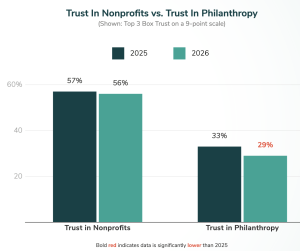
Respondents highlighted trust from donors, but not necessarily in the general definition of trust.
Building donor and stakeholder trust ranked as the single most-cited organizational priority for the year ahead – more than technology upgrades, AI adoption, and donor acquisition. Nearly nine in 10 leaders (89%) said it’s harder to earn today than three years ago. The gap is not awareness; it is execution. Trust erodes through operational failures such as cash flow challenges that delay program delivery, compliance issues that disrupt operations, and donor relationships that end without clear explanation.
When given 10 priorities for the next 12 months, increasing revenue came in seventh at 46% with building trust topping the list at 66%. New revenue streams was dead last at just 34%.
The data also show:
* 36% of organizations experienced cash flow challenges or liquidity constraints during the past two years; and, 33% lost a major donor or funder relationship;
* 34% faced increased scrutiny or compliance requirements from auditors, funders, or regulators; and,
* 51% rely on impact reports and outcome data as part of their trust-building strategy, while 45% proactively communicate how funds are used.
Board involvement with AI adoption policies and placing restrictive policies on its use might hurt fundraising. Of those responding, 91% are already using AI in some official capacity. And, 88% of respondent leaders believe organizations that don’t adapt to AI within the next two years will struggle to compete for donors.
At organizations where boards strongly support AI, 59% use it extensively and 92% of those with strong support saw revenue growth during the past 12 months. At organizations where boards support AI with restrictions — the position held by 57% of respondents’ boards — just 14% use it extensively and revenue growth drops to 81%. Board support is the primary variable separating organizations that benefit from AI from those that do not, the data shows.
Only 29% of respondent nonprofits use AI extensively. Most common uses for AI are communications tasks such as drafting emails, newsletters, and social media content. AI is used for collecting and analyzing donor data at 36% of respondents’ organizations with 20% using it to predict donor behavior.
Staff anxiety regarding AI came in last (22%) when discussing barriers to use. Security/privacy concerns topped the list at 49%, followed by cost, lack of trust, lack of training and ethical concerns.
Conventional wisdom is that young staff members would be AI evangelists. That doesn’t appear to be the case. Leaders age 45 and older are more committed to operationalizing AI than younger ones, the data shows, with 95% pushing for total adoption versus 90% of leaders younger than 45. In fact, younger leaders were more cautious when it comes to extensive use 27% to 31%, financial planning 22% compared to 31% and strategic decision making 18% versus 28%.
“This research puts hard numbers on what nonprofit leaders already know,” Ravi Venkatesan, CEO of Momentive Software, said via a statement. “Nonprofits are growing and taking on more complexity, but doing it with fragmented systems that were never designed for where they are headed today. The cost of that gap shows up in limited AI impact, an operational burden that falls on small, overstretched teams, and donor trust that’s harder to earn each year. The organizations that sustain their growth will be the ones that treat technology infrastructure as a strategic investment, not an operational afterthought.”
The complete report can be found here … https://momentivesoftware.com/research-study/nonprofit-trends/