When it comes down to it, preliminary estimates of charitable giving by GivingUSA are just that: estimates. When initially released in June, much of it is based on projections and econometric data, coupled with the latest Internal Revenue Service (IRS) data — which can lag two years. The giving estimates get revised not just once but twice.
The amount by which estimates are revised can depend on how much the IRS revises its estimates. When there are dramatic changes to the IRS data and/or economic data, there can be a change in Giving USA estimates. Between 2007 and 2016, preliminary estimates by Giving USA have averaged within 1 percent of final numbers.
The increased standard deduction that took effect under the Tax Cuts and Jobs Act (TCJA) was expected to decrease the number of taxpayers who itemize, from about 45 million to some-where between 15 million and 20 million. It’s still too early for a definitive answer on just how much of an impact that had on the 1.1-percent decline in individual giving (3.4 percent when adjusted for inflation). What’s more certain is that with fewer itemizers, there will be less data from the IRS.
The roughly 16 million taxpayers who are expected to continue to itemize were responsible for an estimated 75 percent of the $221 billion deducted by individuals in 2015, the latest data available. That figure comprised 60 percent of individual giving. American Enterprise Institute (AEI) projected that about 20 million taxpayers would continue to itemize, estimating $296 billion in giving from individuals in 2018, with itemizers accounting for $221 billion.
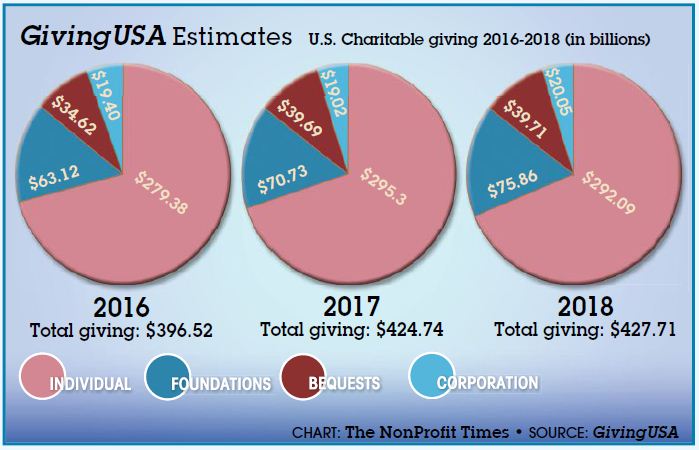
Charitable giving in the U.S. was estimated to be $427.71 billion in 2018. That was up from a revised total of $424.74 billion in 2017, which originally was estimated to be $410.02 billion.
One of the strengths of GivingUSA’s methodology is its flexibility, according to Una Osili, Ph.D., associate dean for research and international programs and a professor of economics and philanthropic studies at the Lilly Family School of Philanthropy at IUPUI. Having building blocks like the Philanthropic Panel Study (PPS) will be important, she said.
The PPS represents non-itemizers and will become even more important with the new shift in data. GenerosityForLife.org visualizes and analyzes data from the PPS, which tracks giving and volunteering by more than 9,000 individuals and families, and the factors that influence those practices, such as employment, health and marital status, throughout their lives.
“The percentage represented by those two pools [itemizers and non-itemizers] will shift around a little bit,” said Jon Bergdoll, a statistician at the Lilly Family School of Philanthropy in Indianapolis, Ind. “The actual data underlying that will be adequate for them,” he said.
Revisions are a standard feature of GivingUSA, typically made as more up-to- date data become available. “That’s a strength of the methodology, when there’s more timely, recent data, those initial estimates are updated,” Osili said. In the past, when revisions have been higher, preliminary numbers by IRS or other entities have been revised upward or downward.
“In this case, it’s not unprecedented that there are revisions, but what’s not clear is going forward government data will be far less representative of all U.S. donors. That will present a challenge going forward for the IRS data,” Osili said.
The latest revision to 2017 data, which will be revised a final time in 2020, was outside the norm. That’s because individual giving for 2016 as reported by the IRS was significantly greater than would have been expected based off preliminary IRS estimates used for 2016 individual giving. “This difference would seem to be anomalous, but our team is now more carefully watching the differences between preliminary and final IRS individual giving data to see if this was a one-off or if this is a trend,” according to a spokesperson for the Lilly Family School.

Two areas constituted almost half of the $14 billion upward revision to 2017 giving data in this year’s Giving USA report. Bequests are always erratic and difficult to predict and were revised from $36 billion to $40 billion, which is not outside the norm or unexpected. Foundation giving as reported last year by the Foundation Center (now Candid), had a larger-than-average revision, from $67 billion to $71 billion.
Bergdoll described it as a sort of “perfect storm” for revisions of the 2017 numbers. “Bequests are always kind of finicky,” he said. It’s not unusual and largely dependent on whether one or two mega wealthy people died and left money to charity. That alone was not enough to be too concerned but they will keep an eye out for everything going forward, he said.
Big revisions usually occur because of underlying revisions in the government data. Among the largest revisions in recent years was around the Great Recession “It’s worth noting, even when we did have those revisions, that was a moment of self-reflection where we improved some things here and there, made ourselves more flexible, taking into account these big underlying shifts, being a little more proactive,” Bergdoll said, to prevent another 2009 style revision.

Giving data for 2009, initially estimated in 2010 as a 3.6-percent decrease, was revised downward some more, to 6.5 percent in 2011. Revised data from the IRS showed larger-than-usual decreases in itemized giving. At the time, several variables were added to GivingUSA’s basic model in forecasting household giving to capture the impact of the Great Recession which seems to have led to larger variations in the data. The forecasting model was refined to better capture the effects of economic volatility on giving, using a combined approach that incorporated for the first time preliminary estimates of giving from the IRS.
“We’ve been collecting this information. We have had a handle of who’s an itemizer and who’s a non-itemizer. The change will be in the aggregate number,” Bergdoll said. “We will continue to study this as we have more data, we have the non-itemizer and itemizer component built in,” he said. “We have to study that closely depending on how the data unfold.”
The shift in taxpayer status and tax incentives will have an impact but the economy also will play a primary role in giving estimates. Households give when they have security, whether it’s job wages and/ or a growing stock market.
“It’s a very important factor we’ve tried to stress: 2018 was a complex year. Because we had a strong economy, holding everything constant would have boosted giving,” Osili said. “But then we had tax reform as well as more volatility at the end of the year when giving decisions are typically made,” she said. “So you have a combination of three factors, sort of competing in some ways. It’s hard to define the impact of tax reform,” she said.
“It’s worth noting, going forward, any downward shift changing from itemizer to non-itemizer will not affect what will be replaced in 2019,” Berdoll said, adding that there won’t be another 20 million taxpayers next year switching from itemizing their taxes to claiming the standard deduction.