Nonprofits exist because people like us see massive global problems and think, “We can fix that.” We garner billions of dollars in giving every year from individuals who quite literally buy into our optimism and capacity for changemaking.
And we exclude vast swaths of people from any opportunity to invest, because they don’t act like the donors we already know.
Imagine if 2023 is the turning point, the year that the fundraising profession bands together in a unifying shared obligation: a democracy of giving. It’s the calling that can unite us across missions, a commitment to the people and communities we profess to serve. A charge to diversify our donor support.
Let’s step back and understand how we got here, to this place of homogenous donor files. While we have an ever-growing menu of donor acquisition channels available to us today, medium and large nonprofits acquired most of their current-day donors with direct mail, using strategies that have been meeting our definitions of success for decades. Direct marketers are savvy, building on the knowledge and data of what has worked best in the past. Learnings from every acquisition test go into the construct of year-round programs, brick over brick, erecting skyscrapers of new donor appeals using what we know has succeeded in bringing in new donors, and dollars.
“Two truths: We can and must do better. And, it won’t be easy.”
Our traditional offline channels now live alongside all variety of omnichannel presence. But who among us has not been asked to justify new investment by comparing cost to acquire and lifetime value to our own status quo?
A primary measure of success continues to be our existing threshold for donor value. While we make in-roads and recognize the nuanced strengths of channel diversification, are we doing enough to meaningfully engage non-traditional givers in the opportunity to invest in our missions?
The challenge lies in the inherent tension between a commitment to acquire and retain more diverse donor support, and the commitment to maximize immediate net revenue. When everything your current program is built on has to be reconstructed for non-lookalike donors, there is a price tag — a cost to develop new strategies, explore new channels, test new messaging. There almost always will be a near-term decline in return on investment as we learn our way into new audience interest and relevancy.
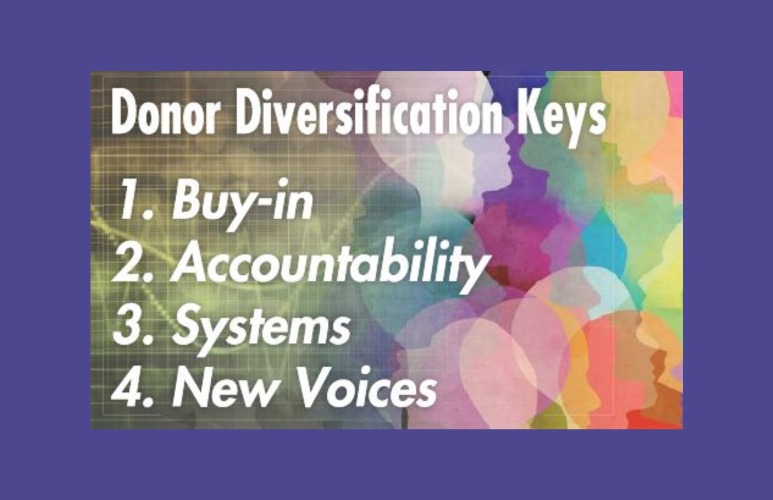
What does it take to meet the challenge? There are four key components to meaningful donor diversification.
Number 1: Buy-in. Believe this is important and have the insight and vocabulary to articulate the imperative. There are two strong cases to be made. The first is long-term sustainability. The demographics of this country are changing. Individuals and households do not look the same as they did 10 and 20 years ago, and we are nowhere close to a new normal. If you continue on a path of seeking out the people who look and behave like your current treasure chest of generous givers, you are intentionally limiting your future relevancy.
The second strong case is living our values. When we primarily attempt to acquire donors who have high likelihood of responding just like our current donors, we are actually saying that we want donors who behave like white people older than age of 55. Consider whether that aligns with your values, and your organization’s values.
Number 2: Accountability. The inherent tension noted earlier will remain for the foreseeable future. If the chief development officer, the CFO, and the CEO are not measured on key performance indicators specific to donor diversification, any effort to move the needle will not be successful. Bottomline budget will always win if that is the primary measure of success.
Build the scorecard. Speak the commitment aloud to key stakeholder groups including staff and funders. Show progress and be candid about challenges. Create the internal framework for decision-making when one objective, like diversity, conflicts with another, like fundraising efficiency. The development team alone can only take this so far. Creating shared accountability ensures that this is a team sport.
Number 3: Systems. Once you define what donor diversity means to your organization, you need adequate (at minimum) data management systems and protocols. If you’re relying on zero party data, how are you collecting it and is it something your donors will want to share with you? Consider that a question that is entirely appropriate from one organization might seem quite invasive from another. Where and how are you storing data, and do you have proper protections in place for sensitive data? (Failure to comply with new data privacy laws in the name of donor diversity is still … noncompliance.) Every experienced fundraiser knows that data management can become the quicksand that drowns the whole initiative if you let it. Start with the baseline you can measure today. You will set much better goalposts when you know your starting point.
Number 4: Representative Voices. The people best equipped to determine how to engage non-traditional donor audiences are probably not the experts at your strategy table today. Acknowledge that you don’t know what you don’t know. And then start talking to people who do. You are not, repeat not, building strategies that assume that any demographic category of individual will all behave the same. Begin with high level appreciation of generalities but beware of any approach that masquerades as the one-size-fits-all solution. That’s what got us here in the first place.
During the past two years we have grown fluent in the language of equity and a culture of belonging. There’s much work ahead to disassemble existing frameworks and rebuild for intentional inclusion, across nearly every social construct. By definition, the social impact sector should lead on this front. But we won’t solve the world’s most persistent challenges with the donors we already know.
We can fix this.
Shannon McCracken is CEO of The Nonprofit Alliance in Washington, D.C. Her email is smccracken@tnpa.org