(image from https://cof.org/generosity-builds)
The year was 1736. A year earlier, French sailor and shipbuilder Jean Louis was dying. He had made New Orleans his home and was determined help, even after he was gone. He bequeathed funds specifically for a hospital for his neighbors, who established the Hospital of Saint John, which is believed to be the first charity hospital in the United States.
Renamed Charity Hospital, it eventually grew into six medical facilities with a bed count of 2,680. Along the way there was a fire and other challenges until in 2005 Hurricane Katrina wiped it all out. It reopened in August 2015 as part of University Medical Center New Orleans.
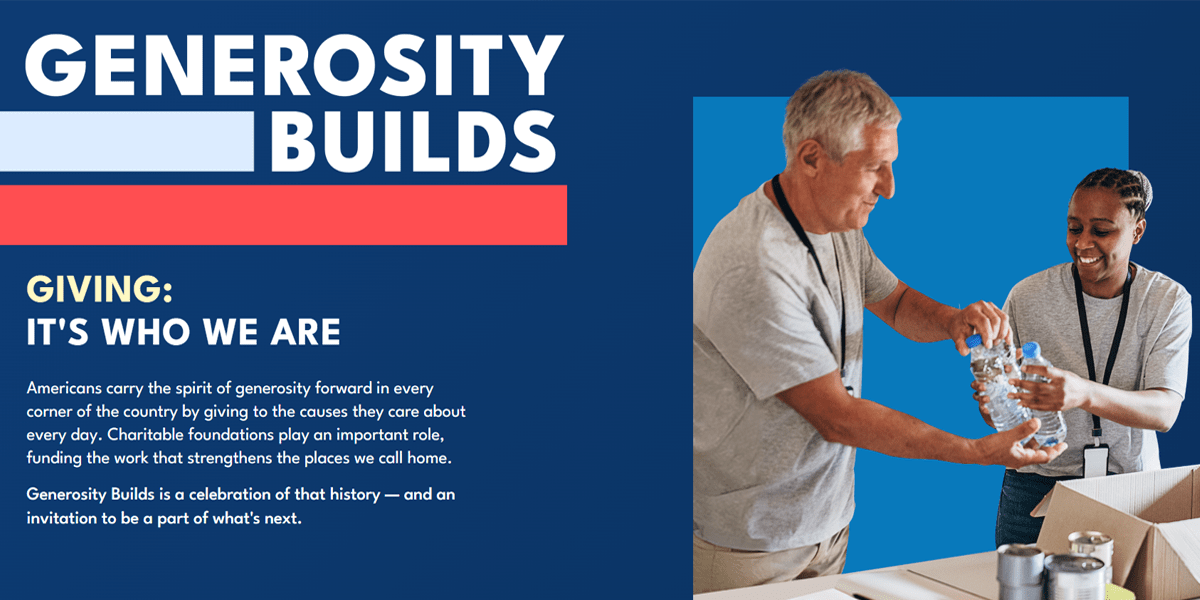
It is that type of generosity that the Council on Foundations is helping nonprofits around the country to highlight as part of the nation’s 250th birthday. The project is titled “Generosity Builds.” It is a sector-wide storytelling campaign that highlights the ways charitable foundations show up as a nonpartisan force for good. Leveraging America’s 250th anniversary, the campaign makes a coordinated, public case for philanthropy’s contributions to American life.
The initial rollout includes a website with an interactive story hub featuring, stories from more than a dozen foundations with more added more to come every month, a social media toolkit to help foundations get involved, and other social/digital activations by the Council on Foundations team.
Example of stories written for the launch include:
* Arizona Community Foundation — The world’s first food bank was founded in Phoenix in 1967, and that legacy runs straight through to ACF’s hunger-relief work today, including a recent statewide effort that mobilized millions to food banks across Arizona to feed the one million Arizonans are at risk of hunger, up as much as 20% in the past year as food prices climbed.
* Heroes’ Village — Gulf Coast Community Foundation (Sarasota, Florida) Sarasota’s first affordable housing complex built entirely for veterans — 20 Marines and others who served, in permanent homes, for as long as they choose. It started with a conversation between donors and the foundation in 2020 and became a $3 million public-private project. One resident applied from his VA hospital bed and was approved in a month: “I didn’t have any place to go.”
* A Running Start for Battle Creek’s Kids — W.K. Kellogg Foundation (Battle Creek, Michigan) In 1930, Will Keith Kellogg started his foundation in his hometown because he believed in his neighbors. Nearly a century later, that conviction drove a $51 million commitment to Battle Creek’s public schools — and kindergarten readiness climbed from 15% to 50%, surpassing the national average.
* A Homegrown Solution for Rural Food Access – Bush Foundation (Northeastern North Dakota) When grocery stores started disappearing across rural North Dakota — roughly 20% in five years — five small towns built their own answer: a cooperative that pools purchasing power and uses climate-controlled grocery lockers to keep food accessible. Launched with a $200,000 Bush Foundation grant, it’s now a model other states are studying.
Council On Foundations President & CEO Kathleen Enright believes getting these types of stories into the public will help blunt some negative stories being pushed. “It’s about helping neighbors, boundary spanning,” she explained. Enright wants to get to “opinion leaders with decision making powers” to show them “what would be lost and what can be gained” if the sector was not operational.
To join in, go here for a preview of the website/story hub and here for the social toolkit.