(Photo via public domain)
“EMMARAC is not going to take over. It was never intended to take over. It was never intended to replace you. It’s here to free your time for research. It’s here to help you. There’s going to be more work here than ever before. They’re putting on a few more girls. I hope they’re as good as you are.”
*****
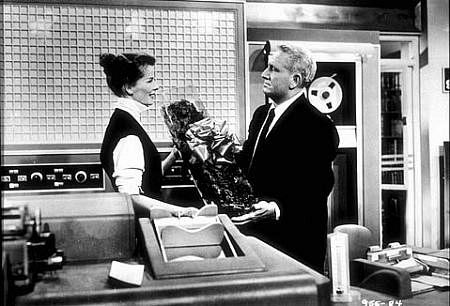
The year was 1957, the dialog from the movie “Desk Set” starring Spencer Tracy and Katharine Hepburn with an all-star supporting cast. He was a computer engineer, she a head research librarian for a television network. EMMARAC was a computer that was fed information cards and ended up filling a good portion of the research office.
The buzz and fear around the network went on for weeks as the plan for EMMARAC was put in place. It turned out more jobs were added — a happy ending after they figured out why EMMARAC sent out pink slips to everyone, including the president of the network.
“Desk Set” was in monochrome. We’re now seeing tech play out in cutting edge full color of 8K and 7680 x 4320 pixels.
The recent artificial intelligence gold rush was not the first consternation during the past few decades when it comes to technology. There was the Y2K coding scare that caused people to believe the world would shut down at midnight going into the Year 2000. It didn’t. Remember when email was going to put direct mail and other forms of solicitation out of business? It hasn’t.
In fundraising, it wasn’t too long ago that donor information was kept on index cards and then rudimentary spreadsheets. Now there are constituent relationship management platforms where information from those index cards has swelled into hundreds or thousands of datapoints, depending on the system, when fresh data is imported and from where it is obtained. Fundraising is yet another system that no longer needs to be fed cards.
When it comes to jobs, there were 64.1 million people working during the “Desk Set” year of 1957. Put another way, 37.4% of the 1957 population was employed. That grew to the estimated roughly 163.6 million this past September 2025, or 47.7% of the U.S. population. Job numbers swelled as the population did, from 171.5 million Americans in 1957 to 342.7 million now. The Y2K nothingburger birthed tens of thousands of tech jobs. The economy expands and contracts and the workforce will adjust to progress.
Now comes artificial intelligence, AI to its pals. The economy and workforce must and will adjust. It will propagate even though the news screams of the rising unemployment rate among new college graduates. Growth in certain tech industries, including cloud, web search and computer systems design slowed down toward the end of 2022 as ChatGPT was released, according to data from J.P. Morgan Global Research.
There is a shortage of fundraisers, but that has little to do with technology and more to do with the stress placed on them by board members. They demand fundraisers find new donors, as well as get those donors they have now to give more in a challenging economy. AI will enable harried fundraisers to do more, and on a larger scale, identifying untapped donor populations and tailoring appropriate asks of donors – i.e. multi-millionaires will not be asked for $50 donations.
Technology has changed journalism, too. There was a typewriter, then word processor with which, oh my, you could change words without retyping a page. Then came “dumb” display terminals attached to a mainframe that was in an air-conditioned room on which you could even move sentences and full paragraphs. A writer could easily spike and rewrite a lede that was awful.
Next came personal computers and the cloud. Many daily newspapers have gone the way of the steam engine, with both still operating but only in a limited number of areas. Technology has changed the speed of news, just as it has the speed of fundraising and everything else.
A subject for a larger debate is whether the technology is democratizing philanthropy, power and influence for the greater good or is placing too much power in the hands of the so-called Magnificent Seven of Alphabet (parent company of Google), Amazon, Apple, Meta Platforms (parent company of Facebook), Microsoft, Nvidia and Tesla. There’s also the issue of donor privacy and the disclosure to donors of how research is done and data derived.
There will be pain as the nonprofit sector adjusts to AI. There are plenty of stories of staff members not being called back to work after COVID shutdowns. The sector had pivoted to greater use of technology and their jobs were no longer available or the staff didn’t have the skills to evolve with the jobs.
The challenge for nonprofit executives is to find a way to repurpose and reskill the staff who are being moved out of outmoded or newly obsolete positions due to the technology. Budgets will need to be adjusted, as transitioning to a new position should not come with it a decrease in compensation and benefits.
There’s another cautionary note. It’s garbage in and garbage out with AI. If the information available is incorrect or biased, the system will create issues. The other matter is asking it to create letters to donors that suddenly sound very generic. It will take a watchful human eye to detect issues.
Sometimes it is hard to remember that technology is really about people. People were needed to correct EMMARAC’s termination notices to everyone. Humans have outlived rotary telephones and VHS tapes, although film companies such as Fuji are reopening their film divisions as young adults are looking to create photos better than what they get on their phones.
Humans will outlive AI and what comes after it, finding an avenue to co-exist during each’s lifespans – right, HAL?