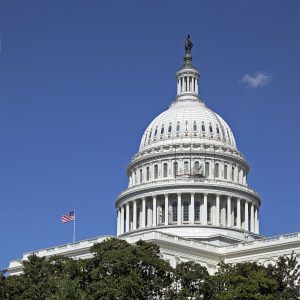
The charitable sector in the United States was the focus of a highly partisan hearing of the House of Representatives’ subcommittee “Delivering On Government Efficiency” (DOGE) titled “Public Funds, Private Agendas: NGOs Gone Wild.” Three of the four witnesses were testifying to what they consider waste and potential fraud of federal money awarded to nonprofits.
The questioning mostly targeted immigration funding and climate and environment spending such as Green New Deal programs. There were repetitive partisan statements from both Democrat and Republican subcommittee members regarding leaders and personnel at organizations that might have had connections to the administration of former President Joseph R. Biden. An investigation of some of the Biden executive orders which were allegedly signed via autopen and whether the former president knew they were being signed was discussed.
The subcommittee, headed by Rep. Marjorie Taylor Greene (R-GA 14), includes seven Republican representatives and five Democrats. The three witnesses invited by the Republican members were Mark Krikorian, executive director of the Center for Immigration Studies; Daniel Turner, founder and executive director of Power the Future; and Scott Walter, president of the Capital Research Center.
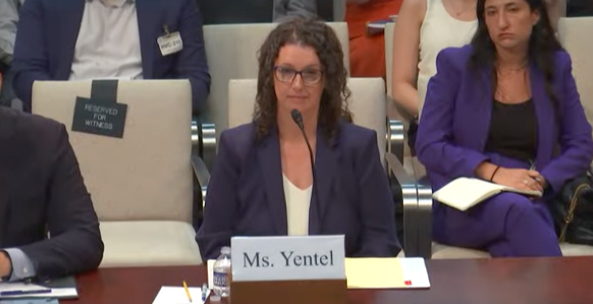
Diane Yentel, president and CEO of the National Council of Nonprofits, was invited by the Democrats and listed on the subcommittee’s website as a “minority witness.”
Krikorian testified regarding a partnership between “United Nations agencies and non-government organizations (NGOs).” Krikorian testified that during the Biden presidency the partnership “established aid waystations all along Latin American illegal migration routes, and it encouraged and facilitated at least 10 million foreign nationals from 180 countries to cross the U.S. southern border during those four years – at U.S. taxpayer expense.”
Krikorian cited the Center for Immigration Studies’ own research and investigations as its proof of the data. A tag line on the organization’s website described the organization as “Low-immigration, Pro-immigrant.” Most of Krikorian’s testimony regarded the United Nations and U.S. funding to the United Nations and then to NGOs.
He testified that the “UN-NGO operations were often justified as providing a humanitarian safety net to those who would travel.” But they amounted to “coordinated, well-funded assistance designed to undermine U.S. immigration laws,” he said.
In Colombia, the Center for Immigration Studies team members found what Krikorian called “small storefront ‘villages’ of NGOs” in territory controlled by the “Clan Del Golfo paramilitary organization (also known as the Gaitanist Self-Defense Forces of Colombia), which is responsible for transporting much of the cocaine brought into the United States.” He claimed, admittedly without evidence, that “at the very least, the NGOs could not possibly have operated in these areas of northwestern Colombia without this drug-smuggling paramilitary group’s permission, in full knowledge that this criminal organization of 6,000 men under arms was reaping massive illicit profits from the human smuggling.”
Switching to the “Green New Deal” grants and federal funding, Power the Future’s Turner attacked small or new organizations receiving the money and Biden administration appointments of people who approved grants and funding.
Turner spoke of staff from an environmental group who joined the U.S. Environmental Protection Agency (EPA) “to direct $27 billion in green funding. For context, $27 billion is larger than the budgets of the Departments of Treasury, Interior, and Commerce.” He argued the staff member was in charge of those funds but “went through no confirmation process, and his decision to direct tens of billions to organizations of his choosing had no Congressional oversight.”
The NonProfit Times was not able to verify the allegation.
Much of the environmental statements from subcommittee members centered on former Georgia state representative Stacey Abrams, who was referred by multiple committee members as a Democrat and two-time candidate for Georgia governor.
Abrams was an advisor to Power Forward Communities which received $2 billion. “With only $100 in the bank this group received $2 billion. Yes, it is legal to create a nonprofit, get IRS accreditation, and apply for and receive government grants,” Turner testified. “But it is fair to question the process and demand transparency.”
Capital Research Center’s Walter testified that most Americans “don’t think of the nonprofit sector as the plaything of billionaires and politicians. Yet all too often, that is the reality of our non-governmental organizations, or NGOs, for two reasons. The first reason, he said, is that more than 35,000 nonprofits receive most of their money from government, not citizens. “Second, many NGOs serve the big government political agenda that fights to centralize power in Washington for the benefit of the left’s preferred political party.”
The National Council on Nonprofits’ Yentel quickly made the point that 92% of nonprofits in the United States have budgets of less than $1 million, with 59% having budgets of $50,000 or less.
“The work of charitable nonprofit organizations throughout the United States improves lives, strengthens communities, and bolsters the economy. From hospitals to libraries, churches to food banks, from veterans to school children, and artists to researchers, nonprofits serve rural, suburban, and urban communities throughout America,” she told the subcommittee. “Nonprofits touch and benefit all Americans throughout our lives.”
Yentel testified as to how some members of Congress are attempting to villainize charities. Yentel and several members of the subcommittee pointed out how many of the witnesses were involved with the controversial Project 2025, which pushed an ideologic point of view regarding charities and government support.
Several of the subcommittee members did not ask Yentel any questions. Those who did ask questions focused on the politics of the environmental and climate organizations and her compensation. One subcommittee member cited the compensation of the National Council of Nonprofits’ previous president and CEO, implying she was paid as much. Yentel, who was repeatedly cut off by questioners, did say that there is transparency, and that her compensation is publicly available.
She empathized that it would be illegal for the administration to pull the tax-exempt status of a nonprofit based on ideology, as has been threatened.
“Weaponizing the power of government to silence dissent and undermine individual choices threatens democracy. Such actions are counter to the freedoms guaranteed to us in America, including the freedom of association and freedom of speech,” said Yentel. The actions by the current administration and some members of Congress “set a dangerous precedent that would allow future administrations to attack nonprofits they disagree with. A strong, independent civil society is essential to our democracy; undermining it weakens us all,” said Yentel. “Every American is threatened when the government uses its power to punish those with different viewpoints, and every person in America should object when an administration or Congress attempt such actions.”