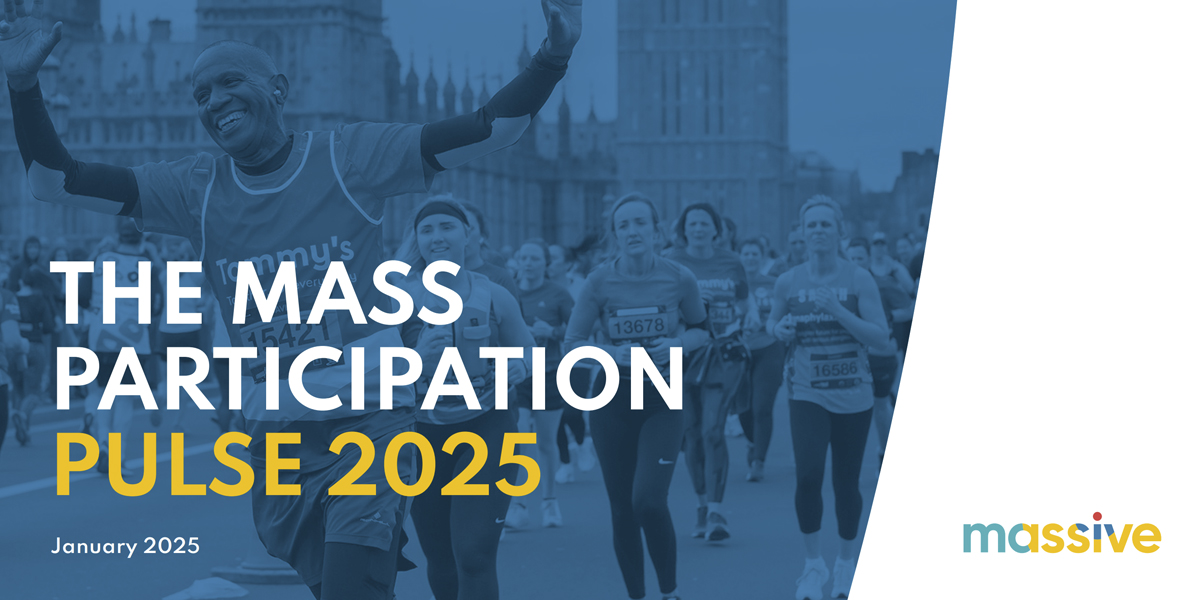
Image from wearemassive.co.uk
Participation in large special events in England and Ireland has not only rebounded but last year surpassed 2019 pre-Covid numbers. Participants are younger and often have not been involved with running or other events.
Event organizers are attracting new audiences to take part in events, with more than one-quarter of people polled having taken up events since 2022. These new event audiences are younger, well-educated, relatively wealthy and more likely to be female than existing event participants.
People are spending more on events and apparel, travelling further to take part and signing up earlier than at any time since the pandemic. The participants are more positive about the events they take part in with a doubling in the percentage who feel that events offer good value for money.
That’s some of the data in a new report “Mass Participation Pulse 2025,” compiled by the agency Massive, with operations in England in London and Leeds.
Data from more than 11,000 participants was compiled for the report. Participants put more value on the basics of toilet provision, clear signage and ease of getting to and from event sites than almost any other element of the event experience, the response data shows.
What’s changed is that in 2023 there was the emergence of a new generation of mass participation event participants, and based on results for 2024, the trend seemed to be accelerating. The percentage of people who have started taking part in events in the past two years or less more than doubled since the last Pulse report.
The data for 2023 showed that only 9% of respondents had been running, swimming, or cycling for two years or less. That number jumped to 26% for 2024. The average age of respondents fell from 49 to 44. Overall, those younger than 35 made up almost one-third of responses. Data from event entry platform Let’s Do showed the fastest growth was the 20 to 29-year-old age group.
Participants who identified as female made up almost two-thirds (65%) of the younger than age 35 group, meaning the average age of the female event participants was six years lower than the average age for those identifying as men (41 vs. 47). Additionally, 32% of all our female respondents had been taking part in events for less than two years, compared to only 20% of men, Massive’s data showed.
Participants are smart and financially stable. Running attracts people with higher-than-average levels of household income, with 76% reporting income levels more than the United Kingdom median and 23% had household incomes more than £100K. They also rank higher than the UK average for having a degree-level qualification, with 78% of females having a degree or higher qualification versus 64% of men.