DCM Associates is a proud sponsor of The Best Nonprofits To Work For. Click the two links below to view each brochure for more information:
2022 DCM Executive Nonprofit Leadership Search Brochure
2022 DCM Institute for Transformational Nonprofit Leadership & Board Performance
Multiple communication methods fueled transparency
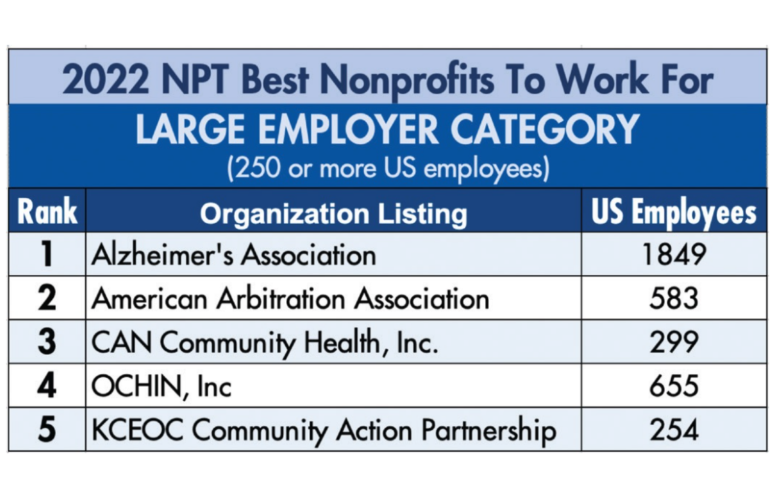
Paul Dole, president & CEO of KCEOC Community Action Partnership in Barbourville, Ky., was modest and reserved but not surprised that the organization took a spot in this year’s Best NonProfits To Work For. These things are becoming routine.
KCEOC was recognized with the Community Action Award for Excellence in 2015. The Award for Excellence is modeled on the Malcolm Baldrige National Quality Award program, which defines the best practices for organizations within a common sector. In the field of Community Action, these best practices are encompassed by 35 Standards of Excellence. The award is overseen by a national Excellence Commission composed of leading executives in the field of Community Action.
Getting ready to compete took a couple of years but the bottom line was communication. “The management team and everybody came together and decided we need to tell our story,” said Dole, who has been with the organization 47 years, 42 of them as CEO.
It wasn’t just coordinating staff. It also involved more than 100 active partnerships and businesses, he explained.
“The larger the organization the tougher it is to communicate. We strive to improve with employees all the time,” said Dole. “Any time there is something new in their field we share with everybody,” he said. Newsletters and social media have been a big help.
Then came COVID and that communication turned into innovation. The organization never closed but clients could not go inside. “It was like a Sonic drive-in. People pulled into spots, texted the number and we went out to them. We installed a drive-in window,” said Dole. Ultraviolet (UV) equipment through the air circulation was installed and there was plenty of personal protective equipment (PPE).
Mission is important but pay is vital, too, and KCEOC does lose some staff to better paying jobs, recently in the fast food industry where some place like McDonald’s can pay $15 an hour.
Larger organizations are challenged when competing in the annual NPT’s Best NonProfits To Work For. Scores are calculated in eight broad areas with multiple sub-categories. Those categories are Leadership; Culture and Communications; Role Satisfaction; Work Environment; Relationship With Supervisor; Training, Development and Resources; Pay And Benefits; and, Overall Engagement.

Large nonprofits, those with 250 or more employees, didn’t do well compared to smaller organizations. Large organizations tied with others in Work Environment and Pay and Benefits and that was it.
Managers at all of the large nonprofits making the list reported that their organizations employ formal programs and/or practices to actively recruit and/or retain employees of varying ethnic and cultural backgrounds. That was also true at 78% of large organizations that did not make the list. The average across all sized organizations was 72% for those on the list and 61% for those that did not make the final cut.
Just 59% of those on the list from all categories answered in the affirmative to the question asking if the nonprofit employs any formal programs and/or practices to actively recruit and/or retain employees who may require accommodations for their mental or physical limitations? It was 80% of nonprofits making the large list and 56% of those that didn’t make the cut.
Merely 60% of those in the large category winners have ongoing diversity training versus an industry average of 80% and that same number have a Diversity, Equity and Inclusion (DEI) task force of one sort or another.
Benefits tended to be better at large organizations, with 80% of large employers paying at least 75% of medical coverage. However, it drops to 40% for dependents but that still exceeds industry average across all sizes which sits at 29%.
Large organizations were right at the industry average of 40% for offering a block of paid time off (PTO), instead of breaking it up into sick days, vacations, etc. Asked if the nonprofit allows employees additional PTO for community service activities/volunteer work, the response was affirmative at 80% of large organizations with the industry average being 68%.
Remote work skyrocketed when the pandemic hit, going from 14% at larger organizations prior to March 2020 and jumping to 80%. Managers at 63% of large organizations report the number was still 63% as of late 2021 when the data was gathered.

Full or partial leave for birth or adoption was available at 80% of large organizations and only 44% of those that did not make the final rankings. The affirmative response was 76% industry-wide of those making the list. None of the large organizations offered financial adoption assistance while it was 28% across honorees of all sizes.
An employer-sponsored Employee Assistance Program (EAP) which might provide counseling for marital, parental or financial problems, and/or assistance for specific conditions such as substance abuse, smoking and gambling was unanimous at large organizations making the list with the industry average being 86%. Even large organizations not making the list provided them at 92%.
The staffing buzz in nonprofits is “The Great Resignation.” At the American Arbitration Association (AAA) in New York City, the turnover rate is up a whopping 28% to, wait for it, just 7%.
There was a concern people would leave as offices remained closed. “The longer people are out, they’re curious to find out what’s out there,” said Eric Dill, senior vice president at AAA. The separation might fuel general anxiety and give a small push to make a change due to physical relocation or a perceived better opportunity.
As this story was written, AAA leaders were eagerly shooting for an early March office reopening. “I’m a little old school. People need to have personal interaction to build culture,” Dill said. With 28 offices in 19 states and roughly 650 employees, there already are “a lot of employees who will never meet,” he said. “There’s an underlying culture of the experience in their offices,” said Dill, who worries about permanent telework. He admitted when it came to closed offices, “Nobody expected it to be this long.”
He said 90% of employees are vaccinated against COVID-19. “When you think about 650 different risk profiles, there are varying extremes of how people feel about masks, etc.”
Dill described communications during the pandemic as “very transparent” and realized when decisions were made remotely, “not everyone is going to agree.” He said a benefit to the communication and keeping the turnover was that people knew each other. “They had that shared experience. It’s not like they hadn’t worked together before.”
AAA has been implementing internal resources and an online learning management system for professional development. “Obviously, external development is somewhat limited,” said Dill. “Zoom meetings have generally been good but not the same as in-person.”
The focus has been on business literacy, balance sheets, and financial wellness. The organization was able to exceed its training hour goals. AAA pays for many continuing education programs and professional certificates. Content on the learning management system also was updated.
Due to its government contracts and the associated regulations, AAA has long had in place affirmative action plans and the team could be considered 48% diverse, according to Dill. “We have paid attention for a long time. We are not late to the game here,” he said.
Getting everyone involved was key to success at the Alzheimer’s Association in Chicago. Work groups were established and staff could apply “to be engaged on a topic they find important to them,” explained President Joanne Pike, DrPH. There is also a talent development task force which goes from hire to retirement.
Pike said the organization probably will “not go to a hard back in the office date.” Decisions will be made with where staff needs to be while monitoring for work/life balance. The organization had a “community lean into from pandemic,” she explained, and implemented virtual tools people have gotten used to, such as ALZ Café and the virtual water cooler, where casual conversations can take place.
Retention efforts have been paying off, there was a decline in turnover to 14.1% for fiscal 2021 and it is trending below that for Fiscal 2022, Pike said.
DEI is an “immersive” experience. The DEI rollout involved rethinking bias and talent management. Consultants and facilitators were brought in for workshops.
A common thread through the large organizations is the extra effort to communicate. “For larger organizations, it’s tough to communicate. We strive to communicate with employees all the time, said KCEOC’s Dole.
As one of the original 23 Community Action Agencies formed in 1964 after President Lyndon Johnson declared a “War on Poverty,” KCEOC’s staff and the people they serve are core to its mission. “We don’t terminate employees for an immediate offense without details. We strive to keep all employees in place and always continue to remediate performance,” said Dole.