Active bequest management is the best way to honor your donors’ wishes and increase your organization’s planned giving revenue. But what is bequest management? The short answer is that bequest management is the exercise of basic financial responsibility.
Just as having a detailed understanding of your own income and expenses is the key to financial wellbeing, a detailed understanding of every matured bequest is the key to prompt and complete receipt of the intended gift. All too often bequests are subject to interpretation, delay, dispute, and outright denial. These devils-in-the-details can also occur without an organization’s knowledge or opportunity to respond.
A few issues that often arise include: trustees’ excessive fees or delayed distributions, financial custodians’ withholding of funds, heirs’ interventions, competing amendments, vague or ambiguous language, incapacity and undue influence – not to mention plain old mistakes.
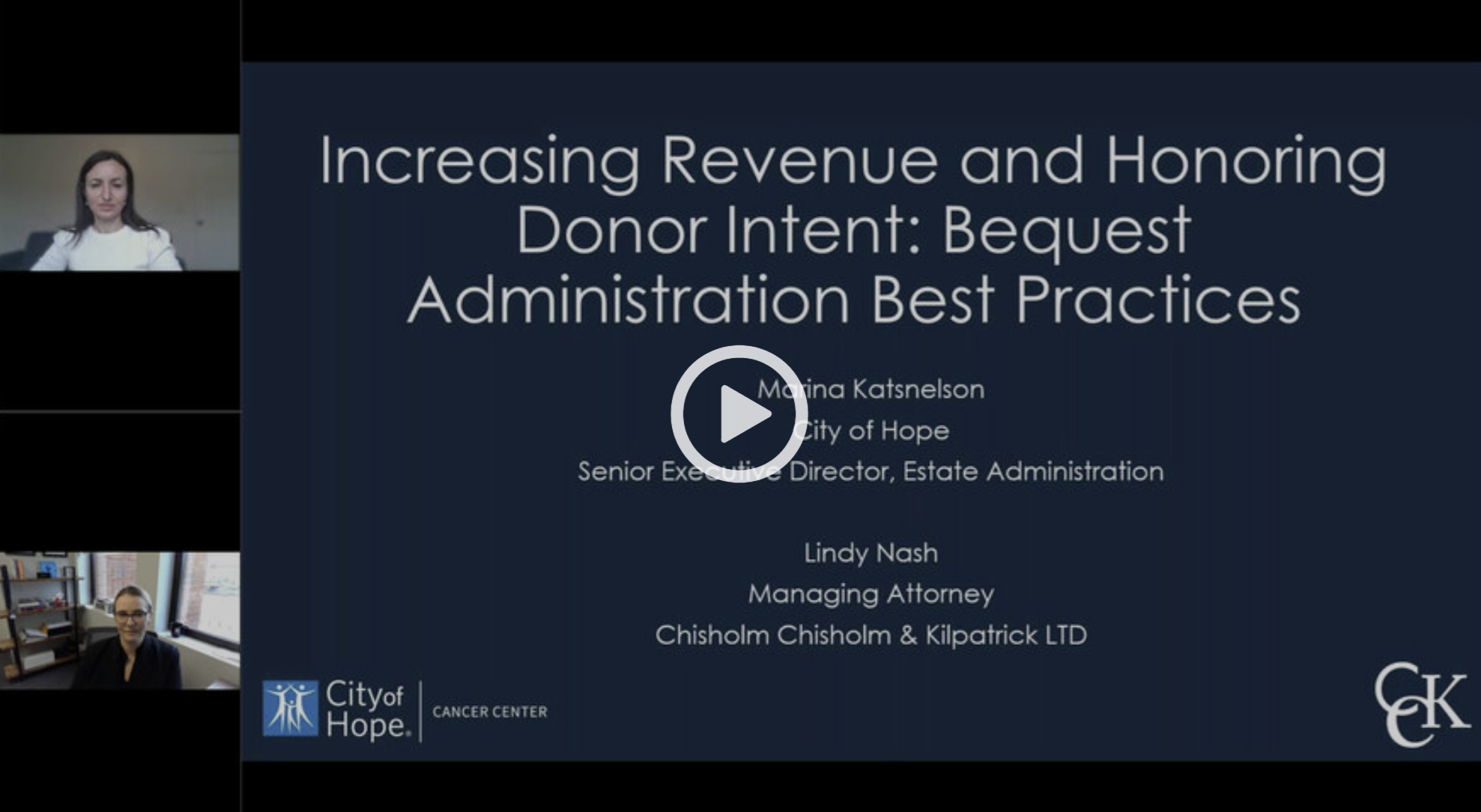
All of these issues can be remedied with a disciplined and detailed bequest management program. This webinar will walk through bequest administration best practices to ensure that your organization is being the best steward possible and receiving the donor’s complete gift.
Takeaways:
* Receipts & Releases: Important to read, there is vital information contained. How to read, edit, make sure your organization is not assuming any dangerous risk.
* Beneficiary Designations: How to complete the lengthy documents, avoid opening an inherited IRA.
* Difficult Executors: Tips & Tricks on working with difficult executors and trustees. How to get their attention and what to do if they are not responsive.
* Review Accounting: A walk-through review of what questions to ask.
Speakers:
Lindy Nash
Managing Attorney in the Bequest Management practice at Chisholm Chisholm & Kilpatrick
Lindy Nash serves as a Managing Attorney in the Bequest Management practice at Chisholm Chisholm & Kilpatrick. Her practice focuses on representing national charities and non-profit organizations in fulfilling the wishes of their charitable donors while maximizing gifts and minimizing any administrative burden. She supervises a skilled team of attorneys and paralegals who advocate for nonprofit institutions as beneficiaries of matured bequests. Lindy received a BA from Connecticut College in Psychology and Sociology. She then went on to Suffolk Law School where she received a JD.
Lindy is passionate about charity work. She currently serves as the Vice President of Programming for the Planned Giving Group of New England (PGGNE) and was recently elected to the Board of Directors for the National Association of Charitable Gift Planners. She is also the Immediate Past President of the Board of Trustees at the Providence Animal Rescue League (PARL).
Marina Katsnelson
Senior Executive Director, Estate Administration City of Hope
Marina Katsnelson currently serves as the Senior Executive Director, Estate Administration at City of Hope. In this role, Marina oversees the estate and trust administration program, which includes managing probate and trust litigation, handling gifts of complex assets, and facilitating realized bequests to City of Hope. Marina also oversees the management of the life-income program and works closely with City of Hope’s institutional partner, TIAA Kaspick.
Prior to joining City of Hope in 2021, Marina managed estate administration at The Nature Conservancy for eight years. During her time with The Nature Conservancy, Marina regularly provided expertise to fundraisers on estate planning questions, oversaw litigation matters, and worked on complex real estate gifts that included devises, conversation easements, and retained life estates.
Marina received her law degree from the University of San Diego School of Law and became a member of the California State Bar in 2009. She worked as an attorney before starting her non-profit planned giving career more than 12 years ago. Marina has significant experience with estate & trust administration matters and has previously given presentations at the Western Regional Conference, as well as to the Southern and Northern California Planned Giving Councils.