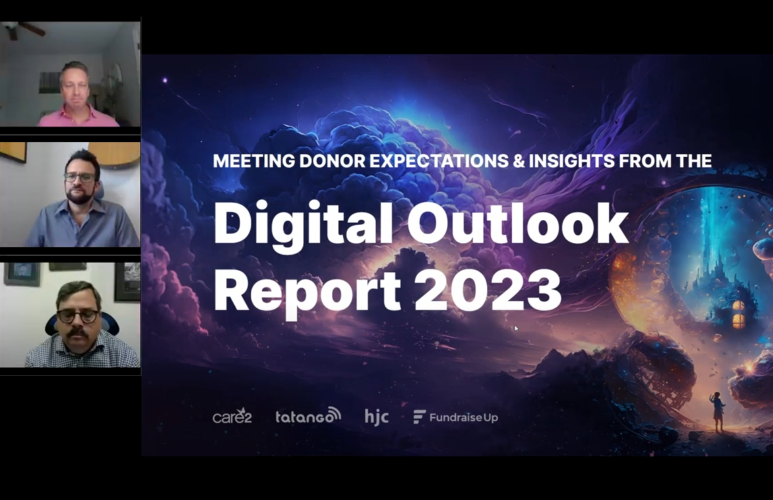
COVID has accelerated the digital space in a way that makes it a bigger challenge than ever before to meet donor expectations. How can your nonprofit organization keep up? One way is to join us in this one-hour, interactive webinar that relies on the 7th annual Digital Outlook Report to provide the data, results, and case studies for a stimulating conversation on how nonprofit organizations big and small can thrive in the ever-changing digital world.
Join us as we explore the key new digital trends and channels that nonprofit organizations are grappling with and how organizations can best leverage limited budgets and challenging human resources to be successful.
Panel:
• Mike Snusz – Director of Nonprofit Customer Experience (Tatango)
• Michael Johnston – Founder and CEO (HJC), Board Member (Resource Alliance)
• Salvatore Salpietro – Chief Partnerships Officer (Fundraise Up), Board Member (Asia Wild)
Moderator:
• Paul Clolery – Editor-in-Chief (The NonProfit Times)
Meeting Donor Expectations: Insights from the 2023 Digital Outlook Report
Good afternoon, and welcome to Meeting Donor Expectations: Insights from the 2023 Digital Outlook Report.
I’m Paul …, I’m the vice president of editorial director at the non-profit Times. And we’ve got an exciting panel talking about all elements of fundraising and digital, and bless you haven’t been reading the papers lately. Yesterday, the Giving USA numbers came out and they were startling. seven, the donors in 20 21 or 20 22 were down 17. billion dollars, that’s billion, with a B?
So anything that not fundraisers can do to bring about what bring more people into the arena, bring more dollars into the process, is going to be critical to the recovery of the non-profit sector for this year. And digital was going to be the backbone of I’d like to introduce a few of the panelists. First, I’m gonna throw it to Mike Johnston.
My friend of 2627 years, who is the president and founder of H J.
Signum Media in Toronto, and who has been the, at the forefront of non-profit, fundraising, and digital.
For as long as I’ve known him, he’s worked with some of the biggest non-profits out there when it comes to digital transformations. Are going to introduce everybody.
Sure, yeah, I just fell off, sorry, I hope I’m completely back. And I’m sharing my screen. So I’m Mike Johnston been a digital fundraiser for over 20 years, and obsessed with making digital connect to all that we do in the social, good space. And have loved connecting the dots through seven of these digital Outlook report And super happy to be here. Kick it over to South.
Hi everybody. My name is Sal.
… yourself saves time for everybody Chief Partnership Officer fundraise up on the board of a non-profit. These are wild.
Worked in the non-profit space as well for a while in the digital marketing and happy to be part of this report and to speak to everybody tonight.
Everybody, I’m like, Snooze on what to tango where a broadcast text messaging company, I’m celebrating my 20th year in the fundraising industry.
Started off at a cancer foundation in my hometown of Buffalo, New York, and excited to be with you here today.
Cool.
And just to say that care, too, has been a partner in this, Eric cannot be here today, But they have some great content inside the report. And so we’ll be taking over for error today and filling in, and just to say, along the way that This is a team effort today, I had fallen off for, for a minute, So I know Darryl has got the deck in the background, and our team is ready to go. If anything goes wrong. So let’s, let’s jump right in.
Maybe we should do something, make it go wrong, So let’s see what you guys can do. So, let’s jump in. so, that the wonderful thing about the report this year, is that there are six authors.
And so, for us, in an ever changing digital world, there are six reports that you can go back to. And really have a historical context of what’s remained the same.
What’s changed. Because I think the more that you can look back and make sense of where we’ve come from, the more you can make sense of where we’re going.
And so, if you get a chance to go to digital book report dot com and not just grab the new report, but be able to go back in time, I think it will help everyone make sense. So, we don’t fetishize new, bright and shiny things.
But we make sense of what’s the ebb and flow of technology in our sector.
And so, oh my gosh.
I mean, tsao did a great job of bringing our AI generative and supported graphic artist to make the look and feel of the report, and I think having an AI generated report is appropriate considering what’s on everyone’s mind right now in the digital space. So, not only is it great material, but darn it. It looks good, too. So, the visuals Are the AI generated, not the words. Mike had to actually write all those words out. That’s correct.
So, so, so let’s look at, and this is important.
When we decided to do the digital outlook report for the first time, we said, look, we’re not just going to talk about click through rates and conversion rates, and the likes.
We’re going to look at what we would call the building blocks of digital for non-profits, and that means human beings, technology, tactics, and more so. So that’s what you’ll see in this report. We start to get at the building blocks, and one building block is people, human beings.
And so for the last seven reports, we’ve looked at how, just how are people being found How our organizations competing to get people on board and And do they even have digital that stat?
And so you can see here now after it’s grown, now, 80% of the organizations who filled out the report have a digital, dedicated person.
You might not be that organization, but just to say, as digital becomes more important, more more organizations are making that commitment to a fully digital person.
But there are challenges in our sector, And so you can see here that 45% of organizations claim the entry point of digital staff. Consists of existing, of course.
So even for the 80% who are full-time staff, it’s been people who’ve been in the organization and shifting how they pay attention to which channels.
And you can see the challenges here. Acquiring non-profit proven digital workers is still an incredible challenge.
Volunteers become staff. I mean, you have to be creative and where you find people.
Finding them in the commercial sector is a heck of a challenge, of course, but that’s where a percentage of organizations are finding their digital staffing, and then just new graduates from university and college.
So, let’s, let’s think now of no matter where they come from, what are the qualities we’re seeing that make digital staff successful? And a number of years ago, I went to Is it or sharp visitors Sharp, founded, the four Seasons hotel chain.
So, for an organization that has great customer service, I wanted to ask, hey, how do you hire for success? And he said, we don’t hire based on prior knowledge of the hotel industry.
We hire for attitude, banner’s, ability to problem, solve, ability to engage with the customer, and so, the technical skills are absolutely important for digital, but what kind of overarching criteria do you have?
Because you can train skill sets on Google Analytics, and Google Grants, and adwords, and Facebook, but are you thinking about the kind of people that are coming in to be your digital staff?
And I just wanted to pick up on this absolutely key human resource issue of where will you find new people to come onboard for your digital staff?
And for us, we’ve learned over the years, and we see it baked into the report as well, That building a pipeline with local colleges and universities is key.
Because when we have personal experience, when we go into a college, and we talk to two year certificate program, people who are taking digital marketing, they’ve never heard of the non-profit sector.
But once we spend an hour or two talking to these prospective graduates, they say, maybe that’s where I’m going to take my newfound digital skills and bring them over.
So are you building a pipeline with local colleges and universities to compete for great talent that are graduating with digital skills?
And another thing that we’ve seen in the report and I wanted to personify it in one organization, is the majority of organizations in this study have found it difficult to retain staff. That’s true in the commercial sector. It’s true in the non-profit sector.
It’s true outside of digital as well, but you can see here here.
Here’s Susan G Komen trying to be as competitive as possible with the offerings to digital staff and non digital staff of working hours that are competitive per week and per day.
The ability to work anywhere.
A lot of people pick up on this shut down for two weeks, separate from holidays. And, we see, across the board, in our study, that professional development budget is increasing as an important competitive differentiator to get great digital staff.
So, there are all of these tactics to find people the kinds of people you need to look for.
But what’s still holding back organizations when hiring and retaining 100% our study? And no one’s going to be surprised here, Salary, So how do we compete for that in a, against the commercial sector that can pay more?
The second bullet is part of it, How do we have hybrid in office and out of office and virtual workplace opportunities that can compete to keep digital staff?
And how do we find and invest in as much as we can in the professional development budget? Not only because you want to find and retain staff, but because digital is moving faster than any other channel.
If I hired a direct mail staff person, I can give them four books that have been written over the last 40 years, and that’s going to cover 90% of their practitioner ship.
It’s not true in the digital space. So, constant professional development in an ever changing digital environment is super, super important.
Like, let me just jump in there for a second. Times, we do a story every year, I guess it’s, We’ve been doing it for 12 years or so, the best non-profits to work for and, what we’ve seen steadily over those dozen years or so, is the increasing the budget for professional development, whether it didn’t go or otherwise.
And, whether it be internal or external, Some of the best non-profits, whether they be small, medium, or large organizations, are coming up with, whether it be digital learn, whether it be learning, online learning, a musical.
But, yeah, the best non-profits right now, or expanding their professional development.
Education, no matter where it is in the system, they’ll call to retain someone through professional education and professional development is peanuts to the cost in losing them and having to replace them.
Not only in your recruitment and your effort and time, but once you hire that new hire, you’re not gonna get results out of them for 3 to 6 months. I mean, Which is not on them, That’s just the way it is, right?
They train up a couple months to get your head around it, figure it out, and you start producing tangible results Months later. So, the cost to, you know, have a $5000. Go to conferences, budget and take some exams and get CFRA credits.
Is way lower.
Danielle overhead on having to replace somebody because you don’t do that.
Yeah. I love that. So having the internal staff that can move into digital, and if somebody has worked on direct mail, and they’ve done segmentation and ROI, some of those skills are applicable to the digital channels, doing digital ads in text messaging.
So, you may need to educate them, like Mike said, on the channel and on the content, that they may have some of those skills that might be there, professional development piece that keeps them at the organization.
Yeah, that’s great. I love all of those contributions here, guys, and one thing I’m gonna pick up on and connect back to is it or sharpen, the four Seasons.
He said that, professional development budget for them is completely controlled by the staff person.
So they don’t, they’re given autonomy over their budget for, for training. So that means you get $5000, you can do what you want with it.
Part of it can be a flight somewhere. Part of it can be seven books. Part of it can be a subscription.
They control their professional development budget, so the more autonomy you get people.
We found, the more loyal they are, the more they spend their money wisely. The more they feel valued as staff. So, autonomy, professional development budget, too.
That’s exactly right. All, every one of the people, we’ve talked with the story, he said, You’ve got a budget. Here’s your five grant.
Do what you want, but it has to be tangible.
Yeah, that’s right. Cool.
So, today, I’m going to shift over, we’ve been asking for quite a number of years, moving from the building block of staff to the building block of strategy.
So, 78% of the organizations we polled have a written digital strategy.
I would say that is higher, then of course the pan non-profit aggregate, in part, because this is a digitally focused survey, bye many organizations are starting to say we need something that strategic, it’s digitally focused, and it’s rising over time.
So that’s not to say a large minority are still not struggling, because they are, and you can see that on this page. And there’s still a small minority who don’t have one at all, but we see it rising over time.
Here is a March of Dimes organization in North America that created a digital strategy.
You’ll, you’ll have the access, of course, you’ll, you can see all of this in that recording and, or you’ll have access in a PDF to take what you’d like from this, but I want to tell you that this digital strategy was written 20 years ago.
So organizations that are farsighted got far ahead, but I think this is absolutely essential for organizations to be successful.
They can’t they cannot ignore the strategic imperatives around digital and need to make a digital strategy themselves. And people have been doing it for a long time.
So when we think from strategy to tactics, I’m going to shift gears now.
And And just to remind us like yeah, yeah. Yeah, everybody can do strategy.
And so along that point, Omar General Omar Bradley from the Second World War. An American General said strategy is for amateurs.
Logistics is for professionals, so the tactical execution.
And so for a lot of this report now, you know, we’re talking about the things that are on the ground that are important to be successful for digital and we’ll dig more into that.
It’s not to say strategy doesn’t connect to the details, but like Bradly is saying, the details make us successful.
So what’s standing in the way? So for thinking about logistics, what’s getting in the way of executing that digital strategy for the March of Dimes?
And, absolutely, number one is just a lack of training, right? Expert skill sets.
And the capacity side is not surprising, but it’s connected back to what Paul was saying.
What Mike was saying, what Sam was saying, right? Professional development, training, and retaining and making who you have better, is connected course to execution, and it’s the thing that’s holding organizations back.
You can see other important things over time, right? Proving ROI, right, to get more budget, to get more support for digital.
Yeah.
No.
Coming up with content, right, in an ever changing environment online and different in every channel from YouTube to Tiktok to whomever is a heck of a challenge.
I think it’s always going to be there budget constraints, but we see it lowering in the last study, I think, post covert as digital has accelerated and proven, it’s absolutely essential role through Cove it in so many different ways in society.
I think that’s broken the ice on more budget per digital. And then, of course, technology shortcomings.
We started this two years into the study, called, Less of a Challenge. Now, you can see even years in the past, there could be more technology offerings on the table. But I just love to hear anything commentary wise from Mike. Even Paul, our facilitator, or sell about these challenges.
Actually, one of the things I’d like to jump in, and one of the numbers, I found startling that between 2015 and 2023, the need to prove ROI internally has declined So it doesn’t become ingrained that people just accept it now as part of the order of the process, and you don’t have to prove yourself every day.
Hmm, hmm, hmm, hmm.
I mean, for me, and I can all jump in, and, Absolutely, Paul. That’s what’s happening as, as the digital channels, becoming more respected and more central to a lot of activities.
It doesn’t have to repeatedly prove itself, so I think that’s part of that dynamic. Yeah.
So So you you saw the the percentage declining in finding the right technology, right?
Finding the right platforms has as a top challenge and it’s decreasing because I think ecosystem is growing of technology platforms that can help digital.
But along with new platforms come adjunct technologies and chat GP T is something that has appeared.
And so to help you today, I want you to write down I want you to scribble this down and think about it a way to help.
Think about adopting new technology might be from the homage Say the Amish why the heck with the Amish be Masters of New Technology. So, on the right-hand side, I want you to write in the chat box. Yvonne … is an Amish inventor, what did he invent? I’m not gonna look at the text answers, I’ll keep going but I’m gonna give you NaN. Guys, what is this?
And? Paul, if you could read them out or anyone else, I’ll hold off. Is anyone putting an answer? What what did this omission Venter come up with? What is this device doing?
five or 3? 2 1?
It’s golf.
So, it is a piston to kind of gas engine, golf, hole cutter.
Does that make sense?
Why would they make, everyone was probably earnestly thinking, oh my gosh, it’s a fence post here. It’s sort of farming related note. It’s the first time I saw that, it was a, It was a machine operated butter, churn that’s, I’m still not sure.
So, we, there’s a download for everyone today here. You can see in the bottom right-hand corner, Really an Amish inspired technology assessment tool as new things like chat G P T. And, oh, my gosh. So many other technologies appear to help non-profits how do you test it properly? How do you exercise moderation, restraint And put those sort of social and organizational limit. So, download that.
And, and think like the Amish, the next time you’re thinking about new digital technology.
And so, let’s take a look at chat GP tea and put on the Amish Lens.
But just think this through.
Whoops.
What are the kinds of things we can do in a safe, proper environment?
On the right-hand side, you could take your mission information and put it into a separate repository, not into the general large language processor.
And AI models can better deploy information on your mission when people ask for it.
We’ve seen it with hospitals, and, and research, medical research.
You could take donor analysis and surveys and ask, Chat G P T, to create personas and target audience analysis to better understand who your constituents are. We’ve seen that happen.
So also interesting.
And then last, you can see in the bottom right-hand side, fundraising: that’s a peer-to-peer fundraising event where we’ve asked chat G P T to create segmentation, creative and strategies for different age subsets.
So just take away what are the smart protective ways that chat G PT, can play a role.
And you can still control the environment, so taking that Amish idea yeah, and back on that DBT I find, I’m sure all of us here, we get like, Brain lock, right. You just, like, you’ll get the ideas flowing, Norm.
I’ll open a Word document, It’ll sit there for a week before I break the ice and start typing.
What I’m doing now is I’m going into …, and I’m saying, spinning up a draft of this, welcome letter, or this major donor, thank you letter, or whatever it might be. And it will just give me I’m a traffic go, all, right?
At least it triggers ideas and it starts getting me moving, and I can just now kind of back into it from there. It really saves a lot of time.
It reduces my personal procrastination.
Perfect pumping.
Absolutely.
So I’m going to hand it over to Sarah to talk about platforms, what we’ve what we’ve seen in our study over time.
So we’re going to talk a bit about online fundraising in the digital digital’s grown and that means more people are getting online and how they’re getting to those channels are now more digital than they were offline. There’s fewer events, your Canvas. There’s more text to give more e-mail, more web.
So looking at Online Revenue Streams and diversifying.
No, sorry, for about 20 years, or, you know, for the history of the donation form, it’s been credit card.
And then PayPal, and something like half of non-profits don’t even offer PayPal, it’s an option.
That’s radically changed, because now we have other ways to give Apple Pay Google Pay Venmo crypto.
And those aren’t just ways to get those are new donor demographics.
Those are new segments of humanity that will give if you have these things available.
Um, know, if we provide these different payment methods, I fund raise up, we have a platform that’s going to dynamically choose which payment methods to show. So, you don’t want to give them choice overload. But you want the big ones there, you want the main ones, especially the meetup with your donor base.
They unlock new demographics, one major non-profit that we worked with, added Apple Pay, and a modern giving experience.
And their 25 to 45 demographic, which was historically their lowest giving segment, became their top guineas segment, right, So it wasn’t that according to their belief they didn’t want to give. They said 45 and plus give to us, 25 to 45 do not get.
That wasn’t the case, they don’t want to give, the way you are, making them give through the experience that you are asking them to get through. It doesn’t resonate with them, it doesn’t connect with them. So you can see, you know, from 22,009 there’s been an explosion of payment methods all vying for Market Share, all of them valuable to different demographics, and the stats there on the On the right are showing different payment methods in order of acceptance or offering. So that’s pretty critical that we want to offer all of those things.
There’s the report showed another interesting thing, and this is probably net’s out to exactly what I’ve experienced.
So one in four, non-profits, When you click Donate, it’s going to a new tab.
With some domain that doesn’t match the website. It’s going to A give dot something dot whatever. It’s going to something that might be a long string that has nothing to do with the brand.
And this is critically critical popal, right.
I mean, with any donor demographic.
The one thing you’re looking out for is unscrupulous when actors and the number one rule that anybody if you if you Google how to tell something is a fraudulent link.
It’s going to say, check the domain that it matches the company, right?
And if it doesn’t, that’s probably fraudulent.
And we have one in four non-profits that have their donation form, their transaction experience there, place where they’re given credit card information on a domain that doesn’t match, and that significantly hurts revenue.
It does and we’ve seen this in AB testing with that when you have them in your environment, on your website, on your domain. You build trust with your donor.
Solidifying brand recognition, and you’re making that donation process convenient, and they’re not having to jump around to a new tab.
Figure out where that tap went, pop up, blocker needs to be the same, whatever it might be, right?
And by doing this, also, you reduce reducing the risk of scam online scams, and the overall level of security that your donors have. And it may, it might be implied, it might be real, but it’s certainly what they’re seeing.
So that’s a bit there on the donation form in that domain issue.
So if you don’t have your donation form on your domain, let’s talk about how you can get that, take that conversation internally. How can that happen?
Almost half of non-profits, 44%, are not taking advantage of Google Ad grants.
And if you know what Google Ad Grants are, I hope you’re using them.
If you don’t, this is 10, $11,000 a month, Actually, $10000 through Google, a month, and I think Bing and Microsoft is now offering about 1500 bucks a month as well.
In free ad spend, right, that’s $120,000 a year in ad spend. That you might need an agency to help you manage that ad spend, Right? like you would if it were real money.
But it’s a big chunk of revenue to increase awareness and revenue for your non-profit.
You know, some of the numbers here are our stocking rate of 1% of organizations started using the grant, since the 2020 report, an 11%.
So we need more Take advantage of what happens if we don’t, is these companies that are offering these benefits, are going to take those things away. We saw what happened with Amazon smile. We see that happen with a few other spheres, where if it doesn’t get adopted, it gets scrapped. So really worth taking advantage of the Google Ad Grant.
It’s free money, do it.
And then as far as using being, Mike, I don’t know if you have comments on being. I have done some actual research on data, and I’ll let I’ll let you get in here in a second, if you have some comments.
We saw that the average gift size was something like 80% larger on donors that use Bing.
Microsoft Edge, right, And why? Why is that? Right, I have some inferences from that data that I can share.
Microsoft Edge is your default browser on a new laptop.
You’re 45, 50, 60 plus, they’re buying a new laptop. They’re just opening it using Microsoft entry, that’s when it came with and they usually have deeper pockets.
So if we can advertize on Bing, we’re also advertising to a demographic that is deeper pockets and more likely to give, and therefore, using Bing Ads for remarketing and retargeting is pretty spectacular, I’d say.
It’s, it’s, it’s, it’s a base that’s not touched nearly enough.
So let me jump in. There are two things, one, I think you hit the nail on the head with the older donors, direct mail. Older. Donors have always been the backbone of direct mail.
Well, now they’re getting new laptops that are not really as technically savvy as you guys are. And they’re taking the browser there, and that’s what they’re using.
So we see a transition, while direct Mail is still king, the older donors are now going online, they’re using those types of tools and their deep pockets that you were talking about. We do have a question from outside. So the graphic on this slide, on online revenue streams, and diversifying looks like data from a survey.
Who was being surveyed, who was surveyed for this?
That’s the stuff.
Mike, you have the overall numbers. It was it was in the hundreds if not thousands of non-profits to participate. I mean, over 600, and some organizations fill that out. The majority of people who fill this out were from North America. We, we can send a follow up the non-profit times, want to on the size of the organizations, and the type of the organizations. Some of that information is at the start of the report that you can download.
So that would be the place to start.
We’ve got some of that information at the very beginning, But it is a range of small, medium, and large non-profits. The majority of them are in North America, but there are some people from the UK and elsewhere at non-profits.
So about 627 organizations fill that out.
Right, yeah.
So being, start targeting, I’m being advertized on Bing, like I said, they offer some free ad spent for you, if you want to use it, you can look into that.
Um, Mike, you you, these are some examples from some campaigns that you have. Great upsell. So so just something that’s come out of nowhere as well, and I think just being nimble, and being omnivorous and all channels, I think, makes digital more successful.
So in this case, this is an animal welfare organization BCS PCA and and they took a step back and they said look, we want to find more male ticket buyers for our charitable lottery. And they decided to use read it for the first time, and I’m not sure If that’s an attractive ad with that snarling dogs.
But it seemed to work for mail ticket buyers.
And they, they just, they just grew the overall number of ticket buyers who were male, and the overall, they made the pie bigger by just testing a new channel and digital.
So, I think just the takeaways be nimble, and, and pilot, and test all areas, all digital channels, for different purpose.
And so, when we look at jobs clearly, Michael Johnston doesn’t have a dog, because that dog was not sterling. It was like, that’s a husky.
and I’ve got dogs, that’s not fair, but my mindset pretty cocker spaniel, so continue on.
Continuing on. So the other thing that’s come up in the study is just the rising role, and at least focus on influencers in 20 23 and beyond for digital and non-profits.
So seeing it, influencers as ambassadors for the organization to to drive results through their large followings From time to time, social media takeovers, by campaign, with influencers and then you can see in the bottom right-hand side, of course, that E gaming industry, I just took a look at the numbers 20, 22 gaming revenue was $184 billion. So a considerable constituency that influencers are clearly in the middle of.
So big number, overall fundraising budget for digital is up 12% in our study for, for the coming year, 20th number.
Would we want to be, Or is that on track with the 12 moving division? Yep. 12% from from the the last year, we did that study. So asking people about their budgets.
So, we asked people, how much more you spending in your coming budget on digital, and they said it was at 12% increase to digital.
In their budget down, some higher, some lower.
to me, quite frankly, everyone listening in that, that might even be lower than I would have expected coming out of covert but economic instability.
Hyper inflation, for a year or so, maybe made us more careful, But it is rising.
I agree with that.
So, I’m going to hand it over. We’ve been exploring SMS texting. And I’ll hand it over to Mike to take it over from here.
Great, Thanks, Mike. So, in this year’s report, four out of five organizations either have a texting program or plan to start one. And so, we see momentum increasing with number of non-profits launching a text messaging program. And one of the reasons if you crunch the numbers from the last couple of eminent benchmark reports, as many people are now opening non-profit text as open e-mail, and I know e-mail rates are sort of inaccurate, or are not able to really see with the Apple update last year. But how are non-profits using text messaging? And the answer is, they’re using it in a lot of the same ways that they use direct mail and that data, use e-mails.
They’re using it for fundraising, events, retention, giving days, and engagement. And there’s not a lot of examples out there. So we have some great examples to share with you here.
Do you want to go to the next slide? one of the reasons why Texting has become more popular is not only are 99% of text open. If you look at your phone, you likely don’t have any unread text at the moment.
But within three minutes, 90% of those texts are opened. So there’s immediacy. And there is the ability to get in front of your constituents quickly.
If there’s breaking news, if there’s a timely event reminder, there’s a critical fundraising campaign deadline. Text messaging is going to get you in front of your constituents and donors faster than any other channel, and get their response, and get their attention and engagement, usually within a few minutes, for the vast majority of the audience.
So back in February, I woke up and saw the terrible news in Turkey that the earthquake happened having my breakfast at 8 0 AM.
By 1 0 PM, I received this text from whatever, revert to tango customers, asking for support.
And if you know, if you’ve done the research on emergency giving and what happens, there’s a initial spike, a surge in generosity that the organizations that get their messaging out first are the ones that bring in the most money that can do the most good that raise the most money for the victims of whatever tragedy has happened.
So when I received this text, it was before any other e-mail that I had received. And the immediacy of that was one of the reasons that this we do a lot of donation tracking at to Tango in terms of amount raised from from texts that have been sent. And this is one of our highest performing text messages, in terms of ROI over the past six months. And it was because they were able to get this text message out very quickly. They took content, they had from e-mail. They were able to repurpose it into a text. They were able to get in front of their donors and constituents very quickly, and the ROI and the money they raised from it really did a lot of good in terms of sending those donations over to the victims.
Another example if you do a giving day this was an example of March of Dimes. They did a giving day last year and use text messaging for the first time. And not only do they raise 32% overall more in terms of dollars raise, but what I found most interesting is that 10% of gifts directly came from a text message. So I received a text message, I clicked on the link, I went to the donation form of the organization, and gave a gift.
And historically, if you look at how much money is raised online from e-mail, it’s around 14 to 15% every year. And so for this particular campaign, the amount of money raised from text messages, approach the industry benchmark for what is raised from e-mail. And we’re seeing that more and more that The gap between what is raised from e-mail and what is raised from text messaging is closing. And there’s the ability to raise money. You know, Paul mentioned that the Giving USA study that just came out, individual donors being down. So this is a supplemental channel that actually works really well with e-mail, instead of competing with it.
Mike, Something you said, just hooked up my ears for years and years and years, it was only to 8, 8 to 12% for online giving. Now, it’s like 10 to 15%, 12%, something like that.
So, this, the, but, if that, those numbers remain steady and you now have a percentage of people who are given by text, that’s nearly doubling, the online response is I, am I understanding that correctly.
Yeah, you’re introducing a new channel into what is digital mobile, and we know, you know, what is raised from e-mail, we know is what is raised overall from an online perspective, but. Yeah.
I think as more data comes out, I think that we’re going to see that it has the ability, as digital continues to increase, text has the ability to push that number up and accelerate the growth that we see an overall online amount raised, and it’s a holistic approach, and we’re we can tie this back to some of the earlier slides around mobile, get payment methods, right?
Where we talked about Apple Pay, you’re getting a texture on your phone, right?
I’ve got Apple Pay Google Pay already on, like, don’t make me go upstairs and get my credit card.
So if I take care of express payments, where I have it on my mobile device already, and we’re tying that into our giving experience, your text program is going to be that much more successful. So it’s really, everything feeds everything in this ecosystem. It’s incredible.
Funny, when you guys really drive traffic to the Donation form, it used to be 13, 14 years ago. You would text the keyword, and you would donate through your phone carrier, but now Text messages drive you to the donation form that you have that integrates with your CRM that all of the information is housed. So, everything comes in. You’re able to thank and respond, and hopefully retain those donors, because it is going through your main donation form.
Like jobs.
So, I think you referred to it once when we were chatting as the non-profit paywall, where, if you don’t have these processes in place, donors will abandon, That’s how I try to get to Stonewall electrode.
But, but I think Sal was right, that, that if we are smart enough to combine these pieces together, then Paul, that I think you will see a rising percentage overall from digital. Because if digital’s properly co-ordinated and we make it easier for impulsive and emotional and timely giving that, and then, yeah, the role of digital will continue to increase. It’ll accelerate.
Yeah, this is an example. exactly of that makes, These are two texts that were sent December 30th and 31st of last year, and if you look at the text texts, can look more like e-mail now than they used to. This is a multimedia text where it can have an image.
The example on the left was December 31st, it was a countdown clock that played directly within the text. You can play short videos within the text. So text is really beginning to look a lot more like e-mail and we see that when you do have the multimedia elements That increases the ROI of text, about 30%, but those timely campaigns, when you’re getting in front of people, late December, giving tuesday, back to school campaign, whatever it is, an awareness day. Those are the ones that looking at the ROI and the texts that raise the most money.
Those ones that have the time, since its sensitivity, we see do raise the most, have the highest ROI in terms of non-profits when they’re reaching out and using those elements that work at other channels that work in direct mail, work and e-mail.
Example, in other use cases, events, we all know what happened with … and the decline in event participation. So using Text to reach Out, to Recruit, and re take some of those team captains, some of those labs participants, but then also using text like you do, e-mail and using Automated Welcome Series, and Coaching countdown series to Drive fundraising, so a lot like e-mail but just not having e-mail deliverability hurdles, making sure you’re getting in front of people very quickly to complement what you’re doing on other channels.
Then the last example, I think, is one of the most important, you know, text messaging can raise money, it converts. But if we look at the Fundraising Effectiveness Project and what they studied with donor retention over the past six years, it’s gone from 47% down to under 42% donor retention. And it’s, it’s getting worse. It’s not getting better. And part of that may be that when you thank report back, and ask donors to give again, if you’re relying on channels where the message may not get through or make it open, may not get opened, like e-mail, then they may not receive those. They may not feel that their their gift made an impact or was reported back.
They may not get renewal. Appeals are thanked properly. So text is one of those that compliments e-mail and direct mail, and make sure that these critical donor retention communications get in front of our donors. So they understand each critical step of the donor retention process, and hopefully, that can get us to a better place with donor retention and sort of reverse the trend that we’ve seen in the industry the last 6, 7 years.
So, I’m going to hand it over to sow, just quickly take a look at e-mail list building and advocacy, some of what we’ve seen in the in the study over to you, so?
Yeah, for sure.
So deliverability is critical on your e-mail lists, you know, on our surveyed there in the chart, you can see what are people doing to maintain e-mail hygiene so that you’re not sending e-mails to dead e-mail addresses that will ultimately impact your deliverability rate?
So, if you are sending, let’s say 100,000 e-mails out and 3% of them bounce back because they haven’t opened the e-mail three years, and that e-mail address no longer exists. That’s going to count against you.
And other e-mail servers will listen to this rating, this deliverability rating. And they’re going to say, hey, these guys don’t clean their lists. Let’s be extra sensitive, and maybe not deliver that e-mail.
So, you know, using a tool like mail flow mail, tester, spamhaus, these things can let you check what your parent rating is, and you can even clean data and remove all of your on deliverables. At a minimum, you should be looking to remove inactive, right? Send those people an e-mail once a year and make that an e-mail that specifically talks about reactivating them?
If they haven’t opened or clicked on something in a while, don’t send them every single newsletter, it’s going to ultimately damage your overall deliverability rating.
So, that’s important to keep You’re your e-mail data hygiene clean and I’m, I’m, I suppose my same would apply to text messaging and if you’re collecting a portfolio of non phone numbers, you want to make sure that they’re going to be deliverable at least tend to have more efficient spending there.
Yeah, It’s a It’s a good point. And there’s not really the deliverability hurdles that you had with with e-mail with texting. So, but you’re absolutely right. People who haven’t opened an e-mail. At six months, 12 months haven’t taken inaction. It’s important to be selective or suppress them altogether.
For sure, for sure. So we look here, we have 44% of non-profits use inbound marketing for lead gen. What is inbound marketing, right.
That’s, uh, for me, I’d say about five years ago, was a new concept.
And I discovered HubSpot, I think, HubSpot, maybe some imbalance terminology, their conference, they have annual, these are inbound, 2023.
But this is really creating content that’s going to bring people to your website. That isn’t necessarily an ask.
So, practice how to keep bid’s, you know, from watching TV too much.
Content that gives value, but doesn’t ask them for something, and then you cultivate those relationships and get them to become donors at a later time.
So, inbound marketing is important.
These are some other ways of inbound, right, and engaging ways, Mike, that that, that we’ve seen work, quizzes, surveys, and things like that.
Here, we see three examples in social media ones, you know, offering to get your free flower seeds, right? That’s gonna get more clicks then please give 20 bucks.
In the middle one, we’re looking at a decal that a non-profit would give away, you’re gonna get brand awareness and you’re getting some value and you’re probably, exponentially more likely, and I’m sure there’s data on this, to get a donation from somebody who has the sticker than someone who doesn’t.
And this.
This is the, the, the motion here.
It’s it’s give things away that are going to create a better relationship through quizzes, through fun, things, through useful things that bring some value. Anything to add here?
No. That’s exactly right.
I think we see more and more in the digital space, either combining the terrestrial offline and the online for engagement, and in this case, with care to example, just to build on this quiz, part that, quizzes deepen the understanding of the mission.
Quizzes get people’s attention. It gets them engaged. It can teach them a wee bit, it can play on emotion, and it makes them much more likely to be converted to donors, to renew and to be loyal. So we see quizzes playing a big role, and this is just a fun piece around digital lead gen, about thinking outside of the box. We’ve seen Hospital Foundation say, hey, the hospital has free Wi-Fi, why doesn’t the foundation sponsored the free Wi-Fi, because we have a million people going through the hospital, every year. And so, you can see, on the right-hand side, a host community hospital in Toronto.
We’ve seen it work with Cincinnati Children’s Hospital, Cambridge Memorial, Veterans Related Hospital, and hundreds of others in North America have done the same.
So so digital engagement, and lead generation is something that’s being innovated and thought about more and more in the digital space. And we see that in our survey work.
So I just wanted to wrap this up, and then I have some questions.
What are some of the big picture, things, things we’ve seen in this survey.
We asked people, are you doing digital acquisition more of, or are you retaining your digital folk’s instead of spending for new?
And I think we’re seeing people are saying, some of us want to grow and some of us want to maximize net revenue and we’re seeing about 50, 50.
But no matter, it’s 50, 50. You’re saying, Well, that doesn’t help me. Am I supposed to think about growing more, Or am I supposed to get more value out of my existing file and digital?
And I think it’s, the piece on the right is where there’s date of smoke.
There’s business fire meeting, I, you need to go and take a look at your data to understand whether you should be investing more in digital acquisition, whether it’s more on digital retention. So look at your numbers and see where the leaky holes in the bucket are and then make decisions.
And for a lot of organizations, they’re trying to put their digital fundraising on one piece of paper.
And so, on the left-hand side, south-west Airlines created the balanced scorecard. Now in the middle, you see universities like Towson University in Baltimore.
Trying to put it all on one piece of paper and then a hospital on the right-hand side, trying to put their digital fundraising, all of its strategy and tactics back to Omar Bradley, all in one place.
And so, we’ve seen in our studies over the last number of years, that more and more non-profits are saying, No matter what I do, or my digital channels need to be diversified.
And we see that digital is becoming a multi locale whether that’s thinking about Bing, whether that’s using red it, whether that’s using YouTube, whether that’s using all of these channels, more and more are being combined.
And one thing, I absolutely have to tell you, that this is an example of a rehabilitation hospital in Denver, Colorado, and more and more, when you ask people big gift questions online, they tell you everything.
Because like Paul was saying, like Sarah was saying, older age subsets are now doing more and more of their life activities online.
Here’s a survey that Craig sent out, Digital Survey, 790. People told them everything about their relationship.
Their intimate story, 149 people said, I’ll make a major gift, 28 people said, I’m leaving a gift in my will and 15 people said, I want to talk about leaving a bequest.
Come and have coffee and donuts with me from one little digital survey.
So major gifts and large gifts are now connecting to direct response in a digital sense.
You’ve got to include that in your strategy.
And we see that, and so we asked people what influences that they think will have the biggest impact on digital going forward.
It’s back to this start, Everyone, talent wars.
And we gave you some insight on how organizations are trying to compete in those talent competitions for digital, non-profit staff.
Lack of investment is still a challenge. How do you prove the point and get more?
Technology proliferation, whether it’s chat GVT or more technology platforms.
We gave you the Amish Assessment tool to help you, and then, with AI and machine Learning, we showed you three practical ways that people are using it.
But there’s lots more for us to investigate.
And so, we also asked tried to collect up these keys to unlocking digital’s potential people matter.
Right?
Careful planning, digital on one piece of paper. How do we simplify for staff or board members, whether they’re in fundraising or not?
And then new things appear quickly.
How are we ready and that connects back to people mattered, right? The better trained, the more fluent and comfortable our digital staff, the more they’re ready to be flexible. And then, don’t leave any money on the table, back to sales, point that so many organizations are not taking up, being, or Google’s offer grants for digital marketing.
So, with that, uh, thank you for hosting us, and everybody, download the report, and maybe there’s some quick questions.
Yes, we do have some questions, and being the moderator here, I’m going to interject one of mine.
I think with Sal who said some you get an e-mail from somebody and they haven’t responded in a year or so you send them a reactivation, note saying, we haven’t heard from you in about a year, you really want to remind somebody that they, that you’re there off your radar, instead of rather than making a fresh pitch saying, Hey, you ignored us for a year.
Well, the content that reactivation can be, anything that drives to that message. It doesn’t have to explicitly say, Hey, you’ve been ignoring us or where you where have you been?
It can be something that says, We’d love to offer you this repack of flower seeds, right? And you put that in the subject line or you have a decal we’d love to send you, because you were a donor last year.
So, it doesn’t have to necessarily be something that caused them out for ignoring you, but it can be extending an olive branch to them in search, essentially, fritos fix something.
Paul, that, that, that builds the relationship. You know, it can be seen that maybe acknowledging, If you don’t want to hear from us via e-mail, here are some other ways to connect with us, and, you know, having that soft approach, and we noticed you haven’t opened an e-mail, and maybe this isn’t for you. And here’s some other ways that you might want to connect with us. That maybe more if you’re more of your alley and can be, can be a way to maybe maybe get the relationship getting re-engage and maybe get the relationship in a better place.
There are a couple more questions from some of the registrants.
You’ll note that I was amused by makes reference to all the digital Plan being on a piece of paper, but that’s It’s, it’s a saying.
Like this question for you like, with 10 DLC regulations put up barriers will 10 DLC regulations put barriers to texting analogs to e-mail deliverability challenges?
Yeah, so let me let me give a couple of definitions there. This is a texting question, 10 DLC refers to a 10 digit phone number, like you all have on your cell phone, that text may come from. So, if it comes from area code in a 10 digit number, that is 10 DLC.
So the question is, are the phone carrier is going to put up barriers to e-mail deliverability or deliverability similar to to e-mail?
What I will say is that And we offer both shortcode, which is a five digit or six digit number and 10 DLC that text can come from, and I will say that the 10 digit numbers do have a lower deliverability rate than the shortcode that 5 or 6 digit numbers. Because there’s a longer vetting process.
When you text from a 5 or 6 digit number, like 12345 the phone carriers review your application. They look at your organization closer, they understand what kind of text you’re going to send. And so, when you go to Send text, more of those do get delivered. There’s a higher deliverability rate. The 10 digit numbers you can start texting pretty quickly. There’s not as much vetting so I don’t know if there’s going to be any sort of any sort of deliverability challenges. We have a compliance team. I’m happy to take that one offline and run it by them or whoever asked that question if they want to connect with me offline.
And here’s a question with regard to IRAs, and I would think that this also applies to donor advised funds each year. I have a fairly large IRA distribution I need to spend. When I click on it just donation button. There’s no mechanism for this. I end up writing checks if I can. I’m not sure.
I’m alone in this, so are their mechanisms for distributions from IRAs and from donor advised funds through text?
Techs, know, there are tools out there now, one is called Daff Widget, that’s a little plugin you can put on your website. The real player in this space now that has emerged is a company called Chariot.
That is facilitating donor advised fund giving that’s seamless and pain and pain free for the non-profit.
And, and the average gift sizes are massive.
So, um, more as more non-profits catch up on this digital deficit and start plugging those holes, we will see ways to mitigate those kinds of issues at ease.
All right, Thank you very much, guys, that the Digital Outlook Report is available at digital outlook report dot com.
So if, and we will have the slides available for you, and we will be e-mailing them out to you tomorrow, I believe. Thank you, gentlemen, for this. For your time and for the data and for answering some of the questions, I’m …, Vice President, Editorial Director of the non-profit times. Please go to the non-profit times dot com to check in on other webinars we’ll be doing soon. And to read the news every day. Thanks so much, guys. And have a Good day, everyone.