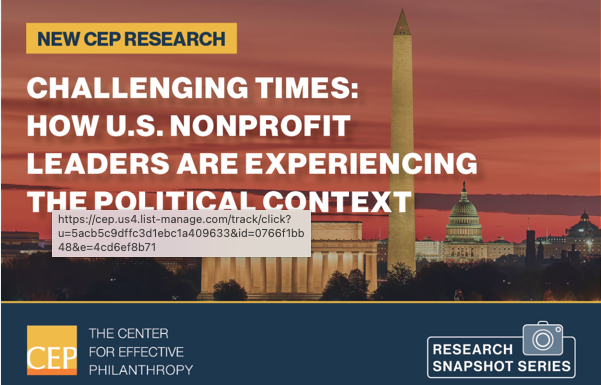
An overwhelming majority of nonprofit leaders (70%) report that the current political climate is creating a generally negative impact on the nonprofit sector and another 19% don’t know what the future might bring.
Leaders who believe the political climate will have no impact on their organizations came in at 7% and 4% think there will be positive impact. Half of the respondents (50%) think political divisions in the U.S. will impact their organizations’ work. The report was released the morning after President Trump’s address to Congress during which a member of Congress was removed from the event.
The Center for Effective Philanthropy (CEP) surveyed 585 nonprofit leaders from February 3 to 21. The Trump administration’s actions and policies have included halting all federal funding in a now-rescinded order in late January, attacks on diversity, equity, and inclusion (DEI) via executive orders, and stated policy that suggests that “many” nonprofits “are engaged in actions that actively undermine the security, prosperity, and safety of the American people.”
Although the attempted funding freeze has been halted by the courts for now, many nonprofits still have not been able to access their funding and face considerable financial uncertainty. CEP cited the nonprofit Candid’s data that 30% of nonprofits receive some government funding. Urban Institute reports that nine out of 10 nonprofits with budgets of $10 million or more receive some government funding, according to the study’s authors.
The study, which includes a nationally representative sample from CEP’s Nonprofit Voice Project, found that:
- 85% of nonprofit leaders cited ways in which the political climate is already negatively affecting their organization’s work, and 94% believe it is very likely to negatively affect their work in the future;
- Leaders most frequently cite (71%) the outcome of the 2024 U.S. federal elections and the current administration’s changes in federal government funding (62%) as drivers of negative impact;
- More than 60% also expect that shifts in state and local funding, often a trickle-down effect of cuts at the federal level, will create challenges when it comes to their ability to carry out their organization’s missions;
- About half also cite political divisions within the U.S. as a key challenge impacting their work.
“Nonprofits are doing amazing work in communities across the country and this data makes clear that the current political environment is making their already difficult jobs harder,” said CEP’s Vice President, Research Elisha Smith Arrillaga, Ph.D. “If we want these vital organizations to continue to serve our communities in the way that they do — providing shelter, food, childcare, elder care and filling in so many of the gaps in all of our lives that no other services can — then we need to support their work.”
Among the most pressing concerns that nonprofits note are decreases in and uncertainty about funding. Results showed 65% of nonprofit leaders noted this concern, and more than half also note they are concerned about their funders’, both government and private, changing priorities.
Nearly half of nonprofits – 40% – also note concern about the well-being and safety of staff or those the organization serves.
“In this challenging context, it’s crucial that the individual and institutional donors communicate their support to the organizations they care about – and provide as much support as they can,” said CEP President Phil Buchanan.
Most nonprofit leaders surveyed report that they had not, at the time of the survey, received communication from their foundation funders, or that only a few of their funders had communicated with them about current challenges. The majority — 77% — indicated that they would like to see more communication from funders about the implications of the political context. In their comments, many noted they would like to understand how their funders are feeling, that they want their funders to understand “how our clients are being affected,” and that they want funders to be consistent and committed, and to “communicate that commitment,” according to the report authors.
Nonprofit leaders say they would like their foundation funders to “be consistent with their funding and communicate that commitment.” Some leaders express a desire to understand “how are our funders feeling about the political climate” and in turn, want funders to “have an understanding on how our clients are being affected.” Other leaders would appreciate the opportunity to be connected to new potential funders or to other resources such as, “information and resources for digital safety and legal expertise.”
For more information on CEP’s work, including its research, assessments, advisory services, and programming, visit www.cep.org.