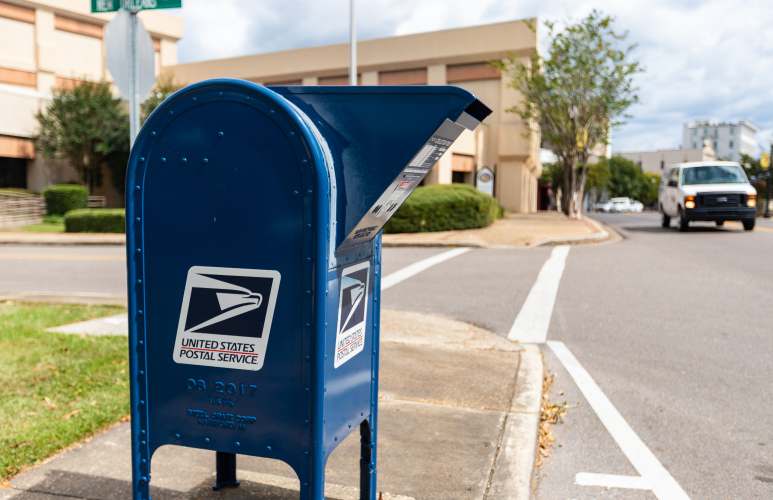
The idea to fully privatize the United States Postal Service has been in the news lately as the current administration has expressed an interest. I believe that it is extremely unlikely that the government will or should fully privatize, or transfer from government control and ownership to private enterprise, USPS anytime soon.
It’s good that more people are focusing on the impossible financial position our mail service is in. However, spending time and resources on fighting the risk of complete privatization draws attention away from realistic solutions.
There are several major barriers to fully privatizing the Postal Service.
Barrier 1: USPS is a money loser with large unfunded financial obligations
All close observers of USPS know that it is a long-time money loser. Credible forecasts done for the Alliance of Nonprofit mailers and others show that the most likely prospect is for continuing annual losses averaging $7 billion. They showed that no realistic rate increase or growth in packages can close the widening financial gap.
The Postal Service also has multi-billion-dollar financial obligations to its retirees for government pensions and health insurance that the agency has no means for paying. These unfunded liabilities are on the order of $120 billion out of a total of $400 billion.
Why would private enterprise want to own such a loser? Of course, it wouldn’t.
A recent paper by investment bankers at Wells Fargo acknowledged that the private sector would not be interested in providing the expensive universal mail obligation to every address and would not take on the pension and health benefit obligations.
The two chances that the bankers cited to make money out of the USPS were raising the prices of package delivery and monetizing the agency’s real estate holdings. But to privatize, the government would have to be left holding the bag on universal mail delivery and unfunded liabilities.
The Wells Fargo bankers said in their February 27 report titled “USPS Privatization: A Framework:”
Restructuring – >$400b of pension and healthcare liabilities need to be addressed (RISC report).
- Our sense is these liabilities would likely be moved to another entity (likely to the U.S. taxpayer where they arguably are now) since potential buyers and/or investors would be reluctant to assume such a large legacy liability, but could be addressed through a parcel sale/IPO or real estate monetization.
- Potential separation of mail and parcel businesses if privatization would entail only a portion of the USPS.
- Address the Universal Service Obligation (USO), which currently requires mail to be delivered to all US addresses six days a week. This provision would be a challenge for a third-party operator to profitably move mail and packages.
- Separating mail and parcel effectively answers the USO question and losses could be underwritten through some form of real estate portfolio monetization.
Barrier 2: Congress would have to make major changes to the law
Postal law updated in 1970 and 2022 makes it clear that USPS is an independent establishment of the executive branch controlled by up to nine presidentially-appointed governors. The agency is required to deliver six days a week to every address with packages and mail going through the same network.
As divided and focused on other issues as our Congress is, these types of major changes to postal law seem unattainable. Perhaps this realization is why the current administration seems to be losing interest in the full privatization of USPS.
Barrier 3: Members of Congress care most about service to their constituents, especially in rural areas
The only way that universal service can continue to all addresses in the U.S. with diminished and declining mail volumes is through government subsidization. The thing that members of Congress care the most about is the biggest money loser.
Congress voting to eliminate or greatly diminish rural mail delivery seems impossible. Perhaps that is why the investment bankers are looking to the government to continue the service while privatizing packages and real estate.
The Delivering for America experiment has proven that packages cannot make enough profit for USPS to cover the losses caused by universal mail delivery.
Barrier 4: Postal unions
The USPS employee unions have made it clear that they will fight any privatization attempt.
Over 600,000 postal union members are a political force to be reckoned with in every state and Congressional district. The Postal Reorganization Act of 1970 gave the unions very powerful collective bargaining rights with mandatory arbitration by panels of three people.
Beyond their well-established bargaining and political power, the unions demonstrated in the first six months of Louis DeJoy’s tenure of Postmaster General that their full support is necessary to achieve any significant operational changes. The subsequent Delivering for America plan has been very friendly to the employees and their unions.
Partial postal privatization would help
While complete privatization will not happen in the current environment, partial privatization would help. Indeed, USPS has been a great example of a public-private partnership for the past 50 years. This comes in the form of work-sharing in which pricing incentives encourage the private sector to presort, co-mingle, co-mail, and drop-ship many types of mail. Packages also have been entered deeply into the USPS system for years.
Unfortunately, in recent years USPS leadership has actively pulled back on work-sharing. It also has been reducing the other type of public-private partnership that works well: outsourcing. A great example is the transportation of mail and packages where there are scant benefits from a government monopoly.
Efforts to improve USPS efficiency and make it once again financially viable should focus on the effective privatization of the “middle mile” between the entry and final delivery of mail. The expansion of work-sharing incentives could make greater efficiency and better service happen. Outsourcing targeted support functions such as transportation and processing also would allow a renewed Postal Service to focus on its core mission and improve service while significantly reducing long-term liabilities.
*****
Stephen Kearney is executive director of the Alliance of Nonprofit Mailers. He worked for the United States Postal Service in several senior roles for 33 years before joining the Alliance of Nonprofit Mailers as executive director in 2014.