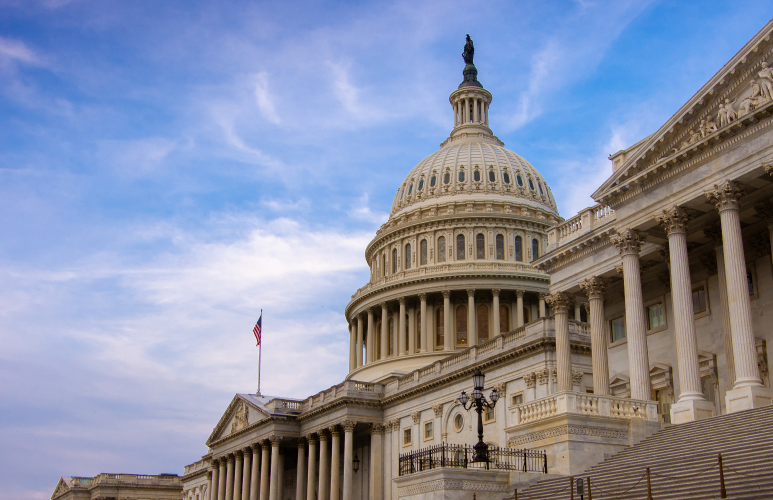
(photo from Deposit Photos)
The U.S. House of Representatives, in the dark of early morning hours today, approved the budget reconciliation package that if the U.S. Senate goes along will change the charitable sector’s ability to fund vital services while probably adding to the stress on the nation’s safety net.
At roughly 2:30 a.m. early today, the Speaker of the House Mike Johnson (R-LA.) moved a procedural resolution to allow the vote. By a vote of 215-214, the legislation that passed and moved to the U.S. Senate that would tax foundation endowment investments, added a 1% floor for charitable contributions made by corporations and allows the corporations to carry forward the tax benefit for five years. It extends excise tax on executive compensation for all employees earning $1 million or more.
It was mostly a party line vote with three Republicans defecting. Reps. Thomas Massie of Kentucky and Warren Davidson of Ohio voted against no. House Freedom Caucus Chairman Andy Harris of Maryland voted “present.”
The bill is 1,116 pages, had 42 amendments, and allows adding $4 trillion to the federal debt ceiling, which is already 124% of gross domestic product (GDP). In a posting on social media site Bluesky, former Labor Secretary Robert Reich called the legislation “Robin Hood in reverse.” He wrote that “Republicans are facilitating a massive transfer of wealth to the richest Americans while making cuts that would rip away healthcare and food from millions of people.”
The Nonprofit Alliance, Charity Navigator, the Association of Fundraising Professionals and the United Philanthropy Forum issued a joint statement shortly after passage. “While the organizations appreciate the inclusion of the above-the-line charitable deduction for non-itemizers, they highlight that the bill relies on nearly $50 billion in new and increased taxes on the charitable sector to pay for other tax cuts.”
The statement went on: “The organizations warn that these changes would significantly reduce resources available for charitable work at a time when federal funding cuts have already caused more than 14,000 nonprofit job losses since January 2025. They look forward to collaborating with congressional leadership throughout the process to further expand giving incentives with proven records of success.”
The bill includes an excise tax based on investment income of private colleges and universities that is tied to the number of students. That means:
- 4% in the case of an institution with a student adjusted endowment in excess of $500,000, and not in excess of $750,000;
- 7% in the case of an institution with a student adjusted endowment in excess of $750,000, and not in excess of $1.25 million;
- 14% in the case of an institution with a student adjusted endowment in excess of $1.25 million, and not in excess of $2 million, and;
- 21% in the case of an institution with a student adjusted endowment in excess of $2 million.
The legislation includes a progressive excise tax structure on net investment income ranging from 1.39% for foundations with less than $50 million in assets to 10% for those with more than $5 billion. Nonprofit financial experts estimated the foundation excise tax changes alone would increase taxes on private foundations from $805 million to $3.71 billion annually.
Language that would have allowed the U.S. Secretary of the Treasury to strip a nonprofit of its exempt status without due process was not in the final bill. It added back in a small tax incentive allowing non-itemizers who take a tax deduction. The language in the bill restores half of what had expired in 2022, down to $150 and $300. Also removed from the legislation prior to going to the House floor was a provision reclassifying name/logo/royalty income as subject to the unrelated business income tax (UBIT).
The legislation would also create a 1% floor for charitable contributions made by corporations and allows the corporations to carry forward the tax benefit for five years and it extends excise tax on executive compensation for all employees earning $1 million or more.
Depending on who is doing the calculations, as many as between 13 million and 14 million Americans might lose access to healthcare either through new Medicaid restrictions or expiring subsidies for health insurance through the Affordable Care Act marketplace. That will put stress on local healthcare access.
“Let’s be clear: This bill is designed to reduce Medicaid rolls, not because people no longer need care, but because they’ll be tripped up by red tape,” said Nicole Lamoureux, president and CEO of the National Association of Free and Charitable Clinics. “Work requirements and constant eligibility redeterminations have been shown to push people out of coverage, regardless of need. At the NAFC, we represent the net below the safety net — clinics that receive little to no federal funding and rely on local volunteers and leaders to care for over 1.7 million patients each year. This legislation doesn’t just shift costs — it shifts consequences onto those least able to bear them.”
According to Katie Smith Sloan, president and CEO of LeadingAge, an association representing nonprofit and providers of aging services, “If enacted, the policies in the House-passed bill will have a devastating impact on millions of older adults and their families who rely on Medicaid and Medicare for health care and long-term care and services, and on our nonprofit provider members who serve them.” She said that LeadingAge will continue to work with the Senate to oppose the House’s “purposeful removal of at least 10 million people from their health insurance, cutting $500 billion from Medicare, and the slashing of $800 billion in federal Medicaid funding to states–actions that will shred the health safety net for older adults and ultimately drive up healthcare costs.”
She called the bill “cold-hearted legislation that will have ugly consequences, essentially eliminating for vulnerable people the support they rely on, leaving them with few options. The Medicaid and Medicare programs, and the aging services infrastructure they support, help older Americans age with dignity, not desperation. They must be protected. We urge the Senate: do not follow in the House’s footsteps.”
Many nonprofit umbrella associations are posting battle plans for their members. The National Council of Nonprofits posted its members should contact U.S. senators to oppose new or expanded taxes on foundations and nonprofits, and limits on charitable donations as a “pay for” for the bill, and support and expand tax incentives for charitable giving, including adding the Charitable Act, introduced by Sen. James Lankford (R-OK), Sen. Chris Coons (D-DE), Rep. Blake Moore (R-UT), and Rep. Chris Pappas (D-NH) to create a non-itemizer tax incentive for charitable donations to nonprofit organizations.
According the NCN, the top targets for lobbying should be Senators Shelley Moore Capito (R-WV), Bill Cassidy (R-LA), Susan Collins (R-ME), Mike Crapo (R-ID), James Lankford (R-OK), Dave McCormick (R-PA), Mitch McConnell (R-KY), Lisa Murkowski (R-AK), John Thune (R-SD), and Todd Young (R-IN).
The NonProfit Times will be updating throughout the day.