Anyone working in the nonprofit space is fully aware there is staff and executive burnout, an atmosphere of fear, stress, and low morale, increasing signs of financial distress, and more difficulty raising funds from both government and foundations. There have been difficult decisions to cut staff and expenses to keep the doors open.
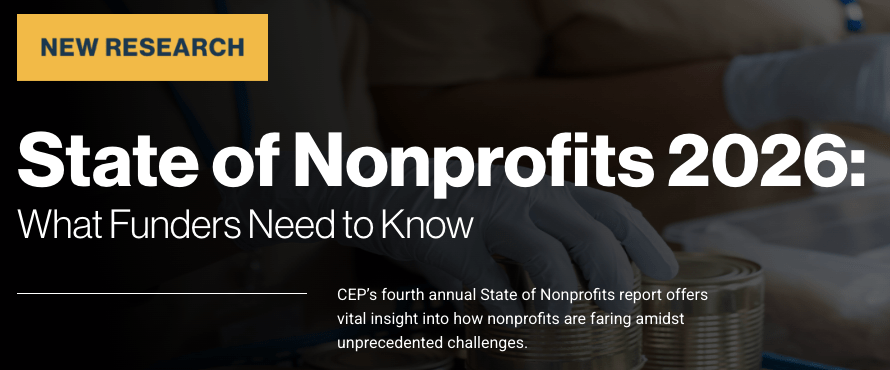
These emotions and actions are no surprise. The Center of Effective Philanthropy (CEP), via its Nonprofit Voice Project panel of executives, is documenting the issues and released findings it the new report State of Nonprofits 2026: What Funders Need To Know.
“Most leaders indicate that the current context poses a significant threat to their organization’s continued existence and ability to provide essential programs and services,” Phil Buchanan, president of CEP, told The NonProfit Times. “I think our survey results are incredibly sobering. I hope that we’ll see more individual and institutional donors stepping up because I think the sector is under attack.”
Survey responses are from 380 nonprofit leaders participating in CEP’s Nonprofit Voice Project, a nationally representative panel of U.S.-based nonprofits that receive at least some foundation funding. In this fourth annual survey, the authors took the pulse of nonprofit leaders to understand the pressures they are facing, and how those have changed since January 2025.
“Some have called this a ‘war against nonprofits,’ and the data bears that out – it’s working,” according to CEP Vice President-Research Elisha Smith Arrillaga, Ph.D., who co-authored the report, along with Ellie Buteau, director of Research Projects and special advisor on Research Methodology and Analysis and Seara Grundhoefer, senior analyst, Research.
“The sector cut nearly 29,000 jobs in 2025 alone, more than five times the prior year. But that’s not the number that keeps me up at night, according to Smith Arrillaga. Candid (the nonprofit data organization) “estimates 2.8 million nonprofit jobs are now at risk if government funding continues to erode. That’s not a workforce statistic – that’s the infrastructure of American communities. These are the organizations that catch people when every other system has failed them. When they close, there is no backup. Foundations and communities cannot wait for this to stabilize on its own,” according to Smith Arrillaga.
The responses show:
- Increased Demand For Services. Nearly three-quarters (73%) of respondents reported that their organizations are experiencing increased demand for services and 65% reported concern about the well-being and safety of those they seek to help. Nonprofits of respondents provide services in sectors such as housing, food, childcare and education, elder care, workforce training, healthcare, and more.
- Burnout Is Getting Worse. Nearly 90% of leaders reported some level of concern about their own burnout, with 46% admitted their own burnout has very much been a concern, up from under 30% in 2025. One quarter of CEOs now believe burnout is significantly impacting their staff, as compared to the 17% who rated burnout as significantly impacting their staff in 2025.
- Atmosphere Of Fear, Stress, And Low Morale. More than half (56%) said the current context has contributed to lower staff morale and heightened levels of stress and fear.
- Staff Sizes Are Shrinking. Just short of one-third (30%) of respondents reported a reduction in staff size, most of these by more than 10%. Almost half cited staffing as their organization’s biggest challenge.
- Government Funding Cuts Led To Reduced Services. Organizations that experienced financial cuts from any government funding source since January 2025 are more likely to have reduced the services they provide. Nonprofits that lost state or local funding are also more likely to have reduced services and staffing.
- Harder To Obtain Funding From Foundations. Almost 60% reported that since January 2025, it has been harder to secure foundation grants compared to the past. More than 40% reported they have seen reduced funding from their existing foundation funders. Some said that the behavior and/or practices of their foundation funders have actively contributed to instability in their organization’s funding streams.
- Increased Financial Difficulty. Two-thirds (66%) of respondents said they have concerns about their organization’s financial stability. During the four years since CEP began the annual survey of nonprofits, the proportion of respondents reporting a deficit increased from 22% to 39%.
- Cutting Back To Survive. Nonprofit leaders are considering the following actions: refraining from staff cost increases (postponing raises, freezing hiring (46%); drawing from their reserve funds (44%); and, reducing their programming or services (34%). Many leaders described laying off staff, capping wages, skipping cost of living raises, and cutting expenses “to the bone” to keep providing programs and services.
- Adapting For An Uncertain Future. Alongside cutbacks, 88% are considering pursuing funding from new funders, and some are either making or considering larger changes, such as changing the composition of their board (61%), starting a joint collaborative fundraising effort with other nonprofits (49%), sharing operations (36%) and even merging with other organizations (17%).
It has been one crisis after another for executives in the human services area. “We’ve been in what I would call crisis management mode since the pandemic. There hasn’t really been a return to a baseline since then for us,” said Robin Peacock, executive director of the MEND Hunger Relief Network in Orange, New Jersey.
“I think the challenge now is there’s a lot coming out of D.C. that is pulling us away from pure program execution and requiring more coordinated communication, information sharing,” said Peacock. “We’re trying to keep up and stay on top of all the changes and understand and communicate how they’re affecting community members ultimately. And that level of the work has changed.”
Peacock described the shift in the work. “I think being a trusted community resource is becoming more of the priority in terms of how we’re executing day-to-day in the current environment,” she said.
Trust is an element that came up in the survey responses. One significant area of need, according to the respondents, is that foundation funders should pay close attention to community-rooted cultural infrastructure that supports healing, workforce pathways, and civic belonging.
The authors wrote: “… access to the arts is not a peripheral concern but a vital tool for addressing social isolation, intergenerational trauma, and limited economic opportunity. Communities need long-term investments that go beyond short-term programs or one-time events and instead strengthen local institutions that are trusted, place based, and led by people who understand the cultural and historical context of the region.”
Collaboration between organizations strengthens trust, increases visibility and participation, and enabled organizations to remain agile and responsive “while maintaining program quality despite staffing and funding constraints,” according to the authors.
Executives are pursing support from new funders and donors. It was the top response to actions being taken at 88%. Engaging with existing funders and donors was 77% and refraining from planned staffing cost increases come in at 46%. There were 13 action items executive were doing to raise more and spend less. Executives were not asked if they had or were considering raising fees.
Nothing is safe from analysis, including board composition. The data shows 20% of respondents said changing the board’s composition has been done with another 41% saying it is under consideration. Beginning a joint collaborative fundraising effort was reported by 14% of respondents and is under consideration by 35% of respondents.
Leaders are concerned that people aren’t paying enough attention or that there’s a kind of fatigue or almost like normalization going on,” said Buchanan.
“I know philanthropy can’t fill the gaps of federal funding cuts. I’m not saying that it can, but that doesn’t mean that there aren’t steps that that can and should be taken to make sure that the most vital organizations and communities don’t stop operating,” said Buchanan. “It’s hard for people to stay in crisis mode indefinitely. That’s what I’m worried about.”
Buchanan described comments from a community leader in a medium-sized city. “They were getting audiences of 40, 50 donors at briefings they were having a year ago about what was going on in their community and now they’re getting five, six people showing up.”
Peacock’s comments were similar to Buchanan’s description. “The reality for us is there’s no one waiting in the wings to step in and do this. If we’re reducing, if we have to reduce programming, it’s fewer people who have fresh food access in our community. There’s no one else coming in to help,” she said.
To see the full report 38-page report, click here.
Register here to attend CEP’s webinar on the data, click here