A phrase in the hiring process is “routine background check.” It’s sometimes a deal-breaker in the procedure. What is found often can be scandalous.
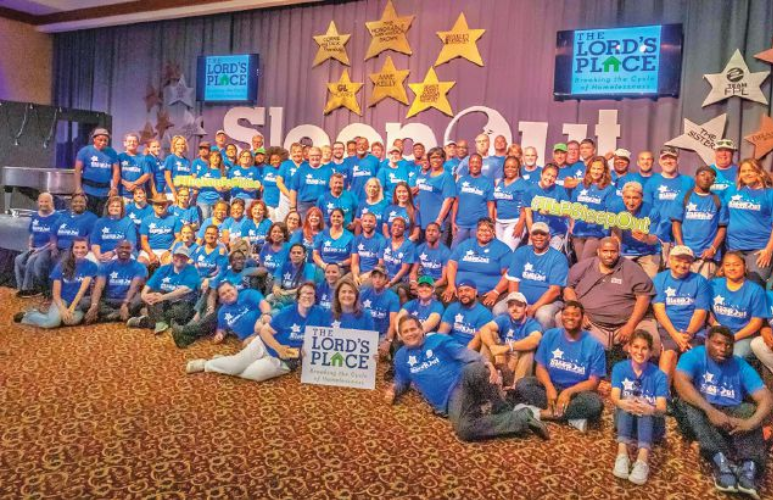
At The Lord’s Place in West Palm Beach, Fla., it would be shocking if the background check came up clean. The organization works with formerly incarcerated individuals to help them assimilate into the community. It also provides homeless services and job training.
“We are pretty sensitive that the workforce be a mirror of the community,” said Diana Stanley, chief executive officer. The point is to “really look at making certain that lessons in life are a launching pad for the future,” she said.
The Lord’s Place finished No. 11 overall and No. 7 in the medium-sized category of the NPT 2020 Best Nonprofits To Work For. “We always hire the best person and are always conscious of what our profile looks like as an agency,” Stanley said.
When it comes to individual work re-entry, applicants go through a process with outside agencies to get the person approved. Depending on the position, having been incarcerated is not a barrier.
The Lord’s Place has “peer specialists who may have lived experience and here they are, they have rebuilt their lives,” explained Stanley. Working one-on-one with clients “is the special sauce of the workplace,” she said.
That develops loyalty to the organization. Several of the honorees of medium size, such as The Lord’s Place, turned to clients or those who might be clients to provide services and fulfill mission.
Organizations participating in the annual NPT Best Nonprofits To Work For are divided into three groups – small (15 to 49 employees), medium (50 to 249 employees) and large (more than 250 employees). Medium-sized organizations often didn’t fare as well in the Employee Benchmark section of the data as their smaller and larger winners.
For example, when asked if they understood the long-term strategy of their organization, 93 percent of employees at medium-sized organizations said that they did understand. However, it was 94 percent at large organizations and 95 percent at small organizations. Of medium-sized organizations that made the list versus those that did not, the split was 93-86.

The same held true when asked whether they had confidence in the organization’s leadership. While there was a 92-80 split in those that made the list and those that did not, medium-sized organizations trailed small ones by 2 percentage points. The gulf was much larger when it came to pay and benefits. While 87 percent of employees at medium-sized honoree organizations were approving of the compensation, it was 91 percent at small nonprofits and 92 percent at large organizations.
Workers at medium-sized nonprofits tend to like their bosses at 93 percent versus 88 percent at organizations that competed and fell short. It was 94 percent at small organizations and 91 percent at large nonprofits.
Employers were asked a different set of questions and, again, the performance of medium-sized organizations was un-even compared to large and small organizations. The chief executives at medium-sized organizations on the list were in the job, on average, slightly longer than those that did not make the list in the category at 9.4 years versus 9.2 years.
Medium-sized organizations that made the Best Nonprofits list are more likely to provide healthcare to both full-time and part-time employees than small or large organizations at 37 percent versus 20 percent and 33 percent, respectively. Medium-sized organization are also more likely to pay 100 percent of the premium at 48 percent versus 47 percent at small organizations and just 17 percent at large organizations. It goes to 81 percent for medium-sized organizations that pay at least 50 percent of the worker’s premium. The numbers plummet when it comes to paying for dependent medical coverage. It’s 70 percent that pay at least 50 percent in the medium category and 65 percent at small nonprofits on the list. It’s 100 percent at large organizations that made the 2020 cut.
Methods of onboarding staff vary. At The Lord’s Place, there is a program where staff follow around others to get the feel of the place. At the Legal Aid Society of the District of Columbia (LASDC), staff attorneys go through mock trials and staff perform mock intake interviews.
“The interviewing process is the most important after cover letter and resumé,” said Eric Angel, executive director of LASDC. Staff members “really enjoy the people they get to hang out with in the workplace because they help change the trajectory of people’s lives” in a more positive direction,” said Angel. The nonprofit finished No. 16 overall and No. 9 in the medium category.
As any good lawyer would be, Angel is skeptical of applicants with 100 percent good references. It is more important for staff lawyers to do an opening argument in mock case. It is done so the applicant “can get a real scene of what the job is actually like, what it is like to be a legal aid lawyer,” said Angel. It’s the same concept for the mock intake interviews, he added.
Wages and opportunity are what keeps turnover low at the Association for Vision Rehabilitation and Employment in Binghamton, N.Y., which landed in the No. 9 spot overall and No. 6 among medium-sized organizations. “There is very little turnover. People are content with their positions,” said Meghan Mitrus, human resources manager.
The nonprofit pays more than the minimum wage, unusual for such rehabilitation and training organizations. According to President and CEO Ken Fernald, an estimated 70 percent of people who are blind or disabled are not in the workforce. “Employees here get a job and a good job,” Fernald said.
One of the organization’s programs is paper manufacturing where staff get hands-on experience, direct labor, touching the product.
Mitrus is new to the organization, havuning started this past September. She said that employees, including her, feel regarded by the nonprofit’s leaders. “My time as a human being is valued. At end of day you go home, do the family things you want to do,” she said. A supervisor apologized to her for sending an e-mail during a weekend. At her previous employer there was a “white board on the office wall. You had to mark on the board all things so they knew where you are,” said Mitrus. That included using the restroom.
“We are not clock-watchers. If it is 4:15 p.m., and you worked late the previous day, it’s OK to go home. Fifteen minutes is not going to make or break us,” said Fernald. “It is our mission, having the engagement of everybody,” he said.
Things have settled down when it comes to turnover at Starr Commonwealth in Albion, Mich. “The past couple of years there has been a new strategic direction to a culture of total buy-in to our purpose,” said President and CEO Elizabeth Carey. A lot of time is spent on five core values: We See Greatness; We Find Courage; We Promote Health; We Foster Healing; and, We Are Oneness. She said that those values evolve into “Universal Hope; Boundless Love; and, Limitless Success For All Children.”
Everyone has bills to pay and workers at Starr Commonwealth know exactly what is expected and how they can earn more. Managers measure the success of all employees. There are performance-based salaries and bonuses tied to the nonprofit’s strategic plan. The culture is “driving outcomes as a team,” said Carey.
The day runs 8 a.m. to 5 p.m. with a one-hour lunch “but achievement is not monitored by someone being at a desk,” she said. There are goals individuals must meet and that might include flexibility on the part of supervisors when it comes to facetime.
Starr Commonwealth, which finished No. 7 overall and No. 4 in the medium category, has a residential facility but also works in the community. While the residential facility with 300 kids needs to be staffed, other staff members can literally call it in. “In community-based work, community building, you do not need to drive to an office. You can phone in to a Zoom meeting,” said Carey.
The reorganization resulted in some people leaving the nonprofit and those who were strivers but not hitting goals were moved into positions more appropriate for their skills. “They are still valued employees, just in different jobs,” said Carey. “That was an interesting HR challenge,” she said.
Everyone has stress in their jobs in one form or another. It is rare for a nonprofit worker to have a potentially disastrous situation each time the phone rings. A clerical person can make a reversible error, but some of the staff at the call center for PRS, Inc., in Oakton, Va., don’t have that much margin for error.
The organization recently received The Crisis Center of Excellence award from the national organization the American Association of Suicidology (AAS). PRS finished No. 44 overall and No. 23 in the medium category.
Unfortunately, there have been instances where a caller has taken their own life during the call. Employees experience secondary trauma when on those calls. Workers at PRS need both emotional intelligence and belief in the internal culture, said CEO Wendy Gradison.

A merger a few years ago required rapidly staffing up. Some of those people didn’t work out. They were good people but did not have the emotional intelligence, also known as emotional quotient or EQ. The five categories of EQ include: self-awareness, self-regulation, motivation, empathy, and social skills. “We had a lot to learn about recruiting that cohort,” Gradison admitted.
Staff get a 90-day review after joining. Gradison said the 90-day discussions are better than exit interviews because an exit interview “is a little too late,” at least for that employee. Unlike other crisis intervention organizations, PRS does not allow the counselors to work remotely. They, too, require support.
Recruiting is key for all of the organizations. When there is an opening for which they must recruit, leaders said that they ensure that the information is sent through diverse, community media channels.
There are ongoing supervisory notes and forms that the employee and manager sign. The forms are so that reviews are personalized but still get the uniform data the managers need. Managers watch for workload issues and signs of stress.
Enjoying co-workers seemed to be universal in the category. At LSDC, there are weekly treats. “People bring in food and hang out around food,” said Angel. There are holiday parties and most of the gatherings are during the workday. “We respect people’s time,” said Angel.
Staff can get a massage a couple of times a year at The Lord’s Place. There are two annual retreats, that sometimes involve strategic planning skits. And, there are “Fur Baby Days,” when pets can be brought to the office.
Starr Commonwealth has had a chili cook-off, a Thanksgiving pot luck, a Halloween celebration and bowling outings, said Carey. There’s even a place for yoga and instruction in the art.
There are year-end banquets and employee recognition at Association for Vision Rehabilitation and Employment. There are catered luncheons as safety goals are met. The organization has “Fun Days” with food tents and games. Association for Vision Rehabilitation and Employment has also paid staff running 5K and half-marathons.
It is all about team harmony and getting the right people in place is vital to success. “There is a crazy game I play,” said Stanley. She asks six or seven values-driven questions during the last interview prior to making an offer. Said Stanley: “It cements if that person is right for The Lord’s Place.”