By Paul Clolery and Richard H. Levey
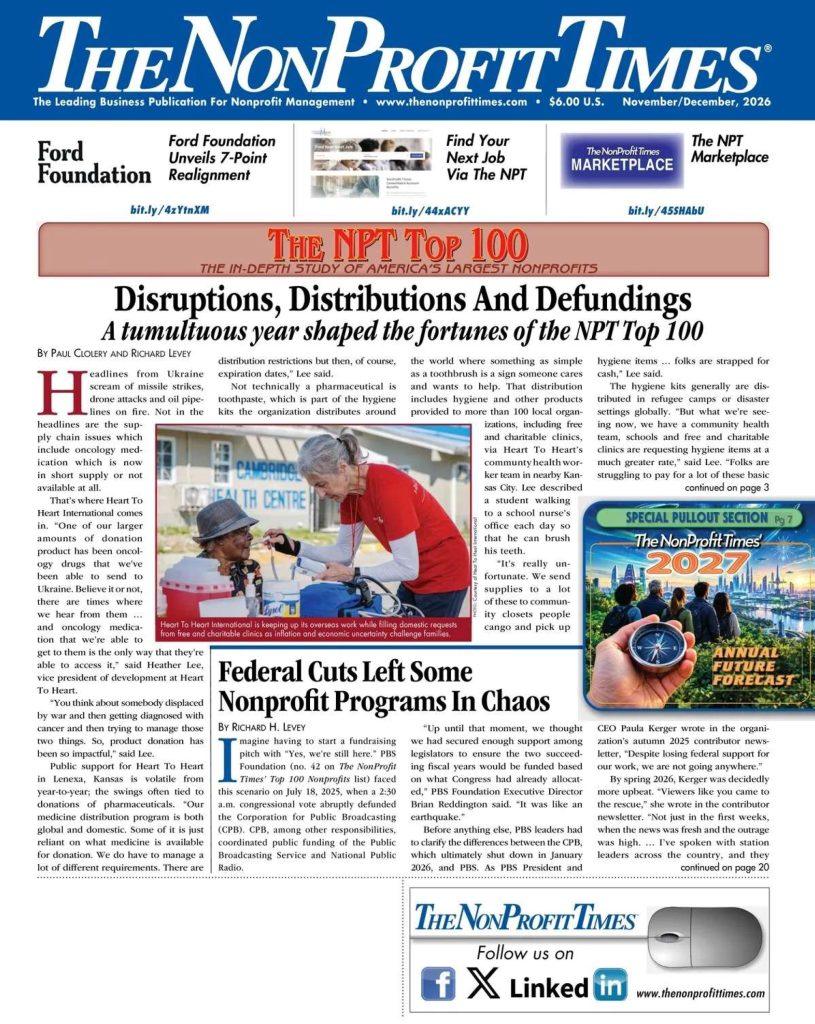
Headlines from Ukraine scream of missile strikes, drone attacks and oil pipelines on fire. Not in the headlines are the supply chain issues which include oncology medication which is now in short supply or not available at all.
That’s where Heart To Heart International comes in. “One of our larger amounts of donation product has been oncology drugs that we’ve been able to send to Ukraine. Believe it or not, there are times where we hear from them … and oncology medication that we’re able to get to them is the only way that they’re able to access it,” said Heather Lee, vice president of development at Heart To Heart.
“You think about somebody displaced by war and then getting diagnosed with cancer and then trying to manage those two things. So, you know, product donation has been so impactful,” said Lee.
Public support of Heart To Heart in Lenexa, Kansas is volatile from year-to-year; the swings often tied to donations of pharmaceuticals. “Product donation has been so impactful. It’s not just hypertension (medications) it can also be cancer as well,” said Lee. “Our medicine distribution program is both global and domestic. Some of it is just reliant on what medicine is available for donation. We do have to manage a lot of different requirements. There are distribution restrictions but then, of course, expiration dates,” she said.
Not technically a pharmaceutical is toothpaste, which is part of the hygiene kits the organization distributes around the world where something as simple as a toothbrush is a sign someone cares and wants to help. That distribution includes hygiene and other products provided to more than 100 local organizations, including free and charitable clinics, via Heart To Heart’s community health worker team in nearby Kansas City. Lee described a student walking to a school nurse’s office each day so that he can brush his teeth.
“It’s really unfortunate. We send supplies to a lot of these to community closets where people can go and pick up hygiene items … folks are strapped for cash,” Lee said.
The hygiene kits generally are distributed in refugee camps or disaster settings globally. “But what we’re seeing now, we have a community health team. Schools and free and charitable clinics are requesting hygiene items at a much greater rate,” said Lee. “Folks are struggling to pay for a lot of these basic necessities and so we’ve been trying to up our hygiene kit distribution.”
Meet The Top 100
Heart To Heart reported a 50% growth in revenue for its fiscal year 2025 to $347.3 million, placing it at number 87 on The NonProfit Times’ Top 100 Nonprofits list. That percentage gain matched its public support percentage increase.
To be part of the annual Top 100 Nonprofits, an organization must have derived at least 10% of income from public support, which could be anything from a check to a truckload of pharmaceuticals.
The 100 organizations brought in $118.5 billion in total revenue, an increase of 4.18% from their combined fiscal 2024 revenue. The public support increase was just shy of 5% at 4.92%. Expenses jumped $3 billion to $109.6 billion. Program expenses hit $94.8 billion, up from just under $90 billion. See the accompanying chart.
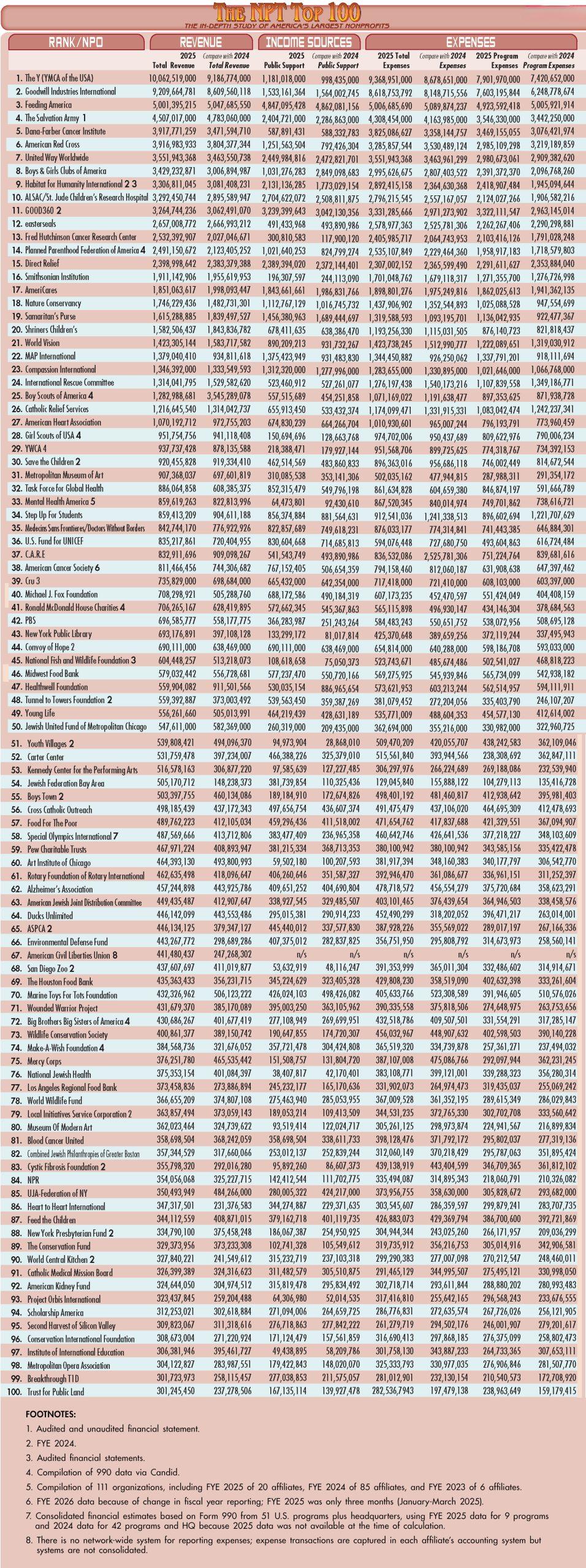
Organizations needed FY 2025 total revenue of at least $300 million – actually $301.2 million – for inclusion in this year’s The NonProfit Times’ Top 100 Nonprofits. Revenue gains from FY 2024 were paced by the Jewish Federation Bay Area (no. 54), where a 240.8% jump resulted in revenue of $505.2 million. At the American Civil Liberties Union (no. 67), $441.5 million in revenue was 78.5% higher than the previous fiscal year.
The New York Public Library (no 43), booked a 74.6% jump that took its revenue to $693.2 million and the likely to be off next year’s list John F. Kennedy Center for the Performing Arts (no. 53) realized a 68.3% jump in revenue to $516.8 million.
Revenue drops among other organizations offset some of those gains. At the Boy Scouts of America (no. 25), a 63.8% drop pulled its revenue down to $1.28 billion. The Healthwell Foundation (no. 47), saw its revenue fall 38.6% to $559.9 million, These were followed by UJA-Federation of NY (no. 85), where a 27.6% drop took its revenue to $350.5 million and the Institute of International Education, which saw a 22.3% drop reduce its take to $306.4 million.
This year’s top organization is The Y (YMCA of the USA) where revenue jumped 9.53% to $10.06 billion boosted by an 18.29% gain in public support to $1.18 billion.
“This is still our traditional major gifts annual campaign, fundraising, grant writing. … A local Y might be doing some small direct mail programs, but there’s not a national direct mail program that is driving that,” Abby Rogers, chief development officer of the Y explained regarding public support numbers.
“Our annual campaigns do get a lot of those lower-dollar donations. What we are seeing is that in this economic situation that there’s a slowing of the lower dollars” and major gifts are what has really kept the revenue growing, said Rogers. The definition of a major gift varies by community and can be anywhere from $1,000 to $50,000 in local markets.
“Those one-on-one personal relationships with people who are contributing at a larger dollar amount are where we’re seeing the opportunity to continue to stabilize our giving and to grow it,” she said.
Community building is tightly tethered to the Y’s fundraising and program revenue. “Part of what we know through our research is that human beings are wired for connection and contribution. And so people, whether that is with their time, with their talent, with their treasure, are looking for an opportunity to give back,” said Rogers.
“Even though we know that maybe the path is narrowing for small donor contributions, we’re never going to give up the opportunity to invite people to join us in this work that we do and to be part of helping support their community in small and large ways,” said Rogers. “We really want to continue to have those open opportunities. That may not be cash anymore. It may be volunteerism. It may be other things that we’re focusing on growing our footprint in as well. We know people are coming around us and that’s an important part about who we are is inviting everyone in to support their communities.”
There have been some upticks in program revenue at the Y. “We are seeing some innovation in different places. When we think about our pickleball program, that has grown dramatically over the last couple of years,” said Rogers. “That’s fun and a kind of a trendy thing but what we’ve seen is that because we’ve engaged in that we’ve been able to grow membership. We’ve been very excited about seeing those two things put together and how our Ys can continue to do their core services but be innovative at the same time.”
One of the things about pickleball is that you can have an intergenerational opportunity, Rogers explained. “Kids and grandparents, parents, people can pick it up more easily than doing something like tennis. And it is social, it is with other people. We have really seen that as a growth opportunity both for our 10-year vision, but also because people are just craving that opportunity to build community and to be doing things out and together, particularly post Covid,” she said.
The Y launched the 10-year vision during 2025 around creating connected communities, which is focused on what she called the national epidemic of social isolation and loneliness.
At Shriners Children’s (no. 21), total revenue was $1.58 billion, down from $1.81 billion during 2024 for a 14.17% decline. However, public support increased 6.27% or roughly $40 million to $678.4 million.
While the organization’s traditional foundation of support – the Shriners – is declining, the dip in revenue is an accounting issue, explained Chief Philanthropy Officer Stuart Sullivan. The revenue dip and subsequent bounce back which will be reported in 2026 numbers are driven by total return fluctuations in the endowment, where strong investment returns in certain years were reported as ordinary income.
While Shriners’ total expenses increased $78 million to $1.11 billion, the hospital system is focusing on is paring expenses by partnering with non-Shriner hospitals and clinics. “We are becoming more efficient as an organization from a clinical perspective and what that means is we’re actually treating, caring for more kids every year than we did the year before. We’re becoming more efficient at that by changing our business model,” said Sullivan.
Shriners at one time had 22 in-patient hospitals. “Now, if you went and got your knee replaced today, you would be back home tonight,” said Sullivan. “Much of orthopedic care in general has moved to being on an out-patient basis. “We have moved to caring for kids in more locations, but more efficient locations in the sense that now only 11 of 20 physical locations are inpatient hospitals,” said Sullivan. The rest are a combination of outpatient surgery centers, rehabilitation clinics and follow-up clinics.”
Shriners is partnering with other health systems to provide care so that “we’re not in the brick and mortar business as much now as we were before, which means our overall capital expenditure actually is going down,” he said. There is some new physical plant. Shriners just broke ground on a new building in Shreveport, Louisiana and have leased 150,000 square feet in Atlanta for a research institute.
Shriners has one of the more aggressive fundraising programs of the Top 100 organizations with direct mail and television. The outreach and use of some of the more sophisticated direct response techniques was ignited because Shriners traditional, planned giving base is shrinking.
“Planned giving, historically, has come from the guys in the red fezzes and their families. They founded us and they were still attached to the hip at the Shriners’ fraternity. Realized bequests were at one time the majority of that money, overwhelming majority, of that money coming from the guys in the red fezzes who had passed on,” said Sullivan. Now it is far less than 20% of planned giving.
“We’ve had to replace that revenue because we depend upon that revenue for operating. Some of it goes to the endowment,” he said “A big chunk of that goes to operating. And so that is less than 20% of our revenue from planned giving is from anybody related to a Shriner.”
Shriners has aggressively marketed planned giving to a broad constituency for more than a decade. Gifts arriving now are from people who initially came in through the direct marketing channel. “You know, they are low-level donors and when they pass on we receive a six- or a seven- or even eight-figure donation from their estate,” he said.
Every toll-free number at the end of an ad is different from the identifier on any other ad. Shriners can trace back all of the phone calls that come from any individual ad that runs. “We try to measure online activity that is related to TV advertising. With the proliferation of television stations, we’re able to be a lot more scalpel approach rather than shotgun approach,” said Sullivan.
The advent of streaming and connected television has make it made it even more of a scientific journey for Shriners. “We’re constantly trying to beam the right commercial to the right person in television. It’s become increasingly reliant upon technology, increasingly reliant upon modeling, to be more effective in the ad spend, which you can imagine is very significant,” said Sullivan. “And now digital marketing is growing significantly.” He called television spray and pay while digital is becoming more precise in locating potential donors.
Welcome To The Majors
Public support for all 100 top nonprofits increased by more than 4.9%, and chances are bumps in major gifts played a part in that. Several leaders cited this source as a significant factor in their organizations’ fortunes.
The Michael J. Fox Foundation (MJFF) (no. 40), which had received 17 gifts in excess of $1 million during 2024, doubled that to 34 during 2025, according to Chief Development Officer Lisa Boudreau. Helping matters was the fact that the foundation was in year two of its five-year, $2.5 billion All Grit, No Quit fundraising campaign. The campaign was still in its quiet period, but quiet fundraising during 2025 allowed the campaign to debut publicly in September 2026 more than halfway toward its financial goal.
That quiet period included a five-year pledge of $10 million per year. “[That gift was] a huge piece of our fundraising, and it raised the eyebrows of other big donors,” who joined longtime contributors such as the Sergey Brin Family Foundation, which during fiscal 2025 made one in a series of nine-figure contributions to MJFF, Boudreau said.
“Peer-to-peer big gifts, that’s the headline,” Boudreau said. “But our community of donors at all levels — a rising tide lifts all boats. Direct mail has increased. Planned giving dollars have increased. Major gifts and principal gifts have increased. We asked more (often), and we asked for more.”
New donors are increasingly making themselves known to MJFF as well. The foundation increased its donor universe from 128,000 in 2024 to 139,000 in 2025. New donors contributed $41 million during 2024 and $44 million the following year. And there is room to grow them, once they have been onboarded: the median gift between the two years was steady at $52.
Recent breakthroughs in treating Parkinson’s Disease — MJFF’s mission — have Boudreau optimistic about continued fundraising growth. In 2023, researchers identified a biomarker underlying Parkinson’s. Doing so opened up new research opportunities, offering the organization several new ways to appeal to funders both in messaging off the discovery as well as how its fundraisers use their time.
“The big difference is we are spending more time face-to-face with the right people, those who have the ability to make large gifts,” Boudreau said. “We are asking them to make us their top philanthropic priority. We were doing so much more of that in 2025 than we did even in 2024, and certainly in 2023.”
The MJFF has not forsaken lower-tier donors. The organization is continuing to use its data analytics team to determine which potential funders are email responsive, which still want direct mail, and which respond to social media posts.
The net result of all of these efforts was a 40.4% jump in public funding between 2024 and 2025, to $688.2 million. That increase reflected the MJFF’s total revenue increase of 40.2%, to $708.3 million. The public support number included $8 million from first-time donors during fourth-quarter 2025. “We’re doubling down on that,” Boudreau said. “Our goal for this Q4 is $10 million in new gifts.”
Major gifts spurred a 51.4% increase in public support for the American Cancer Society (ACS) (no. 38), which jumped to $767.2 million during FY 2025. “We’ve seen an uptick in our major gifts fundraising, led by substantial seven- and eight-figure-level gifts,” said ACS CEO Shane Jacobson.
Many of the ACS’s major gift donors come from the ranks of longstanding donors who were already participating in the organization’s annual giving program. Community events, such as the organization’s Making Strides Against Breast Cancer and the Relay for Life events, are vehicles for maintaining these donors. “The best major gift donor is one who has been regularly committed to giving to your mission,” Jacobson said.
Like the MJFF, the ACS has invested in data-driven research into its donors that seeks to further recognize their maximum giving potential. “We have equipped our major gift staff with better information, more real-time information about a person’s giving history and giving capacity,” Jacobson said. “When those donors who we think have the capability to make a larger gift engage with us, we want to turn around and steward that gift in a very thoughtful way pretty quickly, and begin a conversation about our mission and our dreams and aspirations and the potential interest they may have in making a larger gift to support some of our big initiatives.”
Much of the data was already within the organization: part of the approach Jacobson took immediately upon joining the ACS in July 2025 involved breaking down silos between fundraising staff, event staff, major gift employees and other parties that interact with funders. “It’s not as though our team wasn’t collaborating. It was a matter of adding emphasis to the work and building the performance goals around a more collaborative environment,” Jacobson said.
What Jacobson called an uptick in major gifts is part of an ongoing trend: during the past five years, the organization has increasingly secured gifts in the $25,000-plus space. “That’s an area of growth for us,” Jacobson said.
That seems to be the case, given that the organization’s total revenue increased by a healthy, if less eye-popping, 9%, to $811.5 million. Smaller donors played a part as well: December 2025 saw the ACS’s first $10 million online gifts month, spurred by $2 million during GivingTuesday.
News events spur attention to a cause, and attention often spurs donations. During FY 2025, former President Joe Biden was diagnosed with an aggressive form of prostate cancer. “When there are cancer diagnoses connected to individuals with a public profile, we will often get asked to comment,” Jacobson said. “We’ll be asked to talk about the cancer itself, the cancer journey that person may be on, but we always try to connect the dots to the broader population.”
Leaders at PBS Foundation (no. 42), the national fundraising arm of the Public Broadcasting Service, probably would have just as soon avoided the news focus on their organization. President Donald J. Trump’s Recissions Act of 2025, which was passed into law on July 24, 2025, clawed back $1.1 billion in funding for PBS stations, as well as the separately operated National Public Radio network that was to be released over a two-year period.
Major gifts have helped blunt some of the sting of those cancelled funds. “We have quite a number of new donors who are supporting us at more modest levels of giving,” PBS Foundation Executive Director Brian Reddington said. “But generally, most of our work focuses on securing large grants and large gifts from individuals.”
For FY 2025, that has involved several gifts in the $5 million to $25 million range. One $25 million gift came from a recurring donor, and has emboldened the foundation to make higher asks among its donors. “We started to explore the potential among this group of people, and we found there is a strong potential within a subset of a larger group of donors,” Reddington said.
As a general rule, nonprofits welcome unencumbered gifts which can be applied as the organization sees fit. But of late PBS Foundation has begun soliciting donors to sponsor a given project. Donors have responded especially well to asks specifically set aside for early childhood programming or science and nature shows. The initial success of these efforts has spurred leadership to look for a wider range of support opportunities.
The impact of Trump Administration priorities has spurred some donors to help make up shortfalls however they can. The Carter Center, (no. 52) saw a 33.9% jump in revenue, to $531.8 million, during its FY 2025, and a 43.3% pop in public support, to $466.4 million, during the same period.
A substantial portion of those jumps were due to much-welcome in-kind contributions of pharmaceuticals, including a substantial amount of drugs used in combatting river blindness, as opposed to cash. A kink in the Carter Center’s accounting, which did not count those in-kind contributions as program expenditures until they were distributed to Ethiopia during the following fiscal year, accounts for a seeming lag in program expenses, which fell by 34.3% during FY 2025, to $238.3 million.
There were financial donation gains as well, and those increases did not happen by accident. “We have invested in new channels in peer-to-peer fundraising,” explained Carter Center VP of Development Nicole Kruse. “We have invested more in major giving and leadership giving, and our approaches to the strategy for working with donors who have the capacity to give at those levels.”
The Carter Center was similarly rocked by another major development during its FY 2025: the deaths of its eponymous founder former President Jimmy Carter in December 2024, which had followed the death of his wife, co-founder Rosalynn Carter, a year earlier.
“President Carter’s importance was acknowledged by donors during the year through personal visits, personal communications and increased donations,” Carter Center Treasurer and Vice President of Finance Chris D. Brown said. Both existing and new donors stepped up to make special contributions in acknowledgement of the Carters’ accomplishments in disease eradication and democracy preservation, as well as Rosalynn Carter’s late-in-life focus on mental health and caregiving programs, which was launched late in the organization’s 2025 fiscal year.
Similar to Shriners, legacies played another part in a boost to the Carter Center’s fortunes during the fiscal year. The organization realized a number of legacy gifts, perhaps reflecting increased mortality rates among the enormous Baby Boom generation, the oldest of whom were born in 1946.
“You can’t predict willed gifts or estate gifts,” Brown said. “FY ‘25 happened to be a sizable year for us, and that was one of the factors that enabled us maintain.” During the year, the Carter Center realized $16 million in these awards — a source for which, although the organization is grateful, it does not bank on.