Job satisfaction at nonprofits is continuing a downward trend, dropping every year from 2023 through 2025, with employees rating their “core employee experience” at an approval rating of 90%. That’s down from the high of 95% reached in both 2023 and 2024.
The numbers don’t get better, even at organizations that are included in the annual The NPT’s Best Nonprofits To Work For. Employees are not feeling the love they did just a few years ago. In responding to the statement “My Manager Treats Me Fairly,” 92% of employees approved. That’s down from 98% in 2023 and 97% last year.
Responses to the statement “My Supervisor Handles My Job Related Needs,” plummeted from 97% approval in the 2022 report to 90% this time.
The NonProfit Times invited nonprofits to apply to be evaluated, working with Workforce Research Group to craft the survey and compile the data. While this is the 2026 report, the responses were submitted during late 2025.
“While we have seen employee engagement numbers drop in a variety of industry and regional programs, I feel like they are still very high and are to be celebrated. In other words, going from 97% to 92%, while a decrease, is still really quite good,” said Peter Burke, president of Workforce Research Group.
“Keep in mind that those are numbers from the winning organizations. These are fantastic employers compared to the typical employer,” said Burke. “In general, U.S. employee engagement has fallen from 35% to 31%. That is the average for all U.S. employees. So, falling percentages for the winners in this program might be notable, but the results are still 90% or more, which is still exemplary.”
Staff and managers had to answer questions in nine categories totaling 77 questions. The categories were: Core Employee Experience; Your Job; Communication And Workplace Culture; Relationship With Your Manager; Training, Technology And Professional Development; Diversity And Inclusion; Leadership Of This Organization; Employee Benefits; and, Work-Life Balance.
At least three of the categories can be immediately tied to employee satisfaction. “I went first to the compensation questions on your survey and then in my mind I said ‘I bet there’s a problem with senior leadership. I bet there’s a problem with communication and I bet there’s a problem with professional development,” said Mary Rizzuti, partner at Compensation Resources, an EisnerAmper Company, regarding the decline in job satisfaction.
The scoring of responses was on a 0%-100% scale. While there was a small differential, just five points, between those which are Best Nonprofits To Work For and those which did not make the list, the largest disparities were in Leadership Of This Organization (nine percentage points) and Training, Technology And Professional Development (eight percentage points) In none of the overall categories, or of the 77 questions that made up all the categories, did organizations not making the Best Places to Work list exceed the scores of the nonprofits making the list.
Small organizations tended to score between that of medium and large organizations. Small organizations had a double-digit percentage-point lead over medium and large organizations when it came to leadership.
There were only three questions where response scores from organizations that made the list and those that did not were tied. Those were “I Find Purpose In My Work” at 94%, “I Like What I Do For This Organization” also at 94% and “Generally, Employees Feel Comfortable Representing Themselves Regardless Of Backgrounds, Beliefs Or Identities” at 90%.
The overall satisfaction number might be dragged down by the 73% approval response to the statement “I Don’t Worry About The Security Of My Position” and the 68% approval to the statement “I Am Paid Fairly For The Work I Perform.” Those were the two worst approval responses in the 12 statements in the “Your Job” category. And to the statement “I Am Rewarded For Doing A Good Job” in the Training, Technology And Professional Development category, the approval rating was a thin 73%. The best approval rating in the category was 96% for the statement “I Understand How My Work Impacts Organizational Success.”
Leaders have been trying to find ways to improve the staff’s take-home pay. There was an uptick in the numbers of organizations paying 100% of the employees’ health insurance. The percentage had dropped steadily from 38% providing 100% of the premium for the employees in 2020 down to 31% in 2024 but ticked up to 34% for this report.
“Leadership still matters. And yet, we still aren’t training managers well enough,” said Deb Taft, chief executive officer of global executive search firm Lindauer. “I worry that people think that [organizational culture] is about soft. I think it’s about clear and clarity. People will choose different cultures, but paying attention and putting voice and words around your culture matters.”
Taft is not surprised that staff members at organizations voted as Best Nonprofits To Work For are still concerned when it comes to keeping their positions. “Job insecurity is real,” she said. “Everybody’s concerned in this environment and I’m going to go right back to management. It takes a thoughtful manager to manage the nervousness that actually messes up the workday,” said Taft. “It creates friction in your work quality because the worry is in front of the work you need to do.”
She explained that it is on management to ease the concern by being straight with staff. “That takes real conversations because we can’t promise everybody that they’re going to have a job next month or next year. It’s not that environment anymore,” said Taft. “But you can certainly have conversations about how the organization’s doing and what they control and what they can do. Keep them very focused on the work that actually impacts the bottom line.”
Rizzuti said some organizations reward longevity with continued salary increases that are even above market rates, while others cap salaries based on the value of the position and use alternative incentives such as work-life balance or lump-sum bonuses. She emphasized the importance of clearly communicating compensation philosophy and career pathing opportunities, suggesting that transparency and alignment with the organization’s mission can improve retention and employee satisfaction.
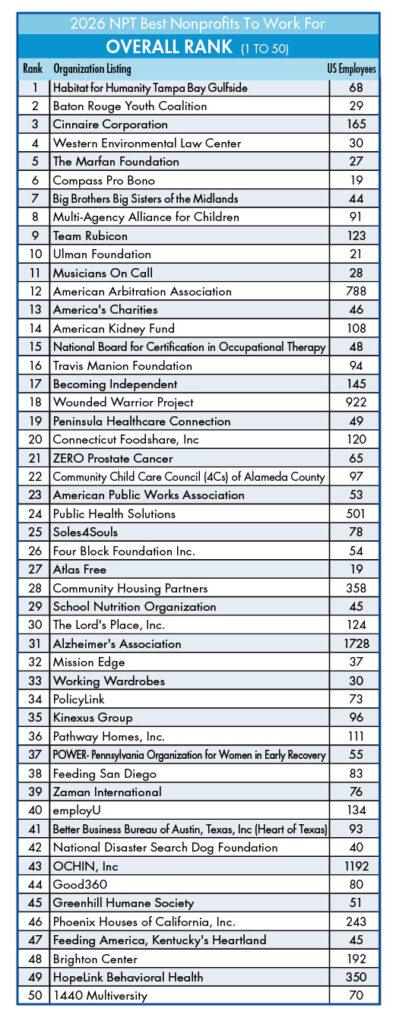
Leaders at winning organizations realize it can be a challenge to keep everyone satisfied but that it needs to be a central focus. Leadership at Community Housing Partners (no. 28) in Christiansburg, Virginia “prioritize employees,” said Laura Croft, SHRM-SCP, vice president of human capital. Leaders there “don’t just give lip service to that [prioritizing employees]. From the top down they do it,” said Croft.
“We found out just by happenstance that there had been a maintenance person who had been on call since she started, for 13 years, which should not have happened. Our executive management gave her a $7,500 bonus and a full week of paid vacation because of what she had done,” said Croft. “That to me is just an example of the way that our executives take care” of issues when discovered, she said.
Professional development is key to an organization’s structure and future, but employees don’t seem to think management really understands. To the statement “This organization assists me in following a well-aligned career path,” the approval was just 74%.
Professional development is taken seriously at HopeLink Behavioral Health (no. 49) in Oakton, Virginia. “We have multiple learning management systems because of the variability in the services and the requirements,” said Joseph Getch, chief executive officer. “We have a learning management system for crisis services. We have a learning management system for behavioral health,” he said.
HopeLink is part of the crisis line network. Being part of the national 988 crisis line requires simulations and training requirements. The organization’s call volume has increased exponentially. HopeLink answered 6,282 Virginia 988 calls during December 2023. In December 2025, HopeLink answered 19,734 Virginia 988 calls. That’s a 214% increase during the past two years. Virginia consistently ranks in the top five states in terms of 988 call volume despite ranking 12th in terms of state population, Getch said.
Another drag on the overall satisfaction rating was the 74% approval to the statement: “I Am Informed Prior To Changes That Will Impact Me.” In some ways “this goes back to real basics around communication,” said Taft. “How is this change going to go? What’s the timing that’s going to happen? So, it doesn’t surprise me a little bit that the small organizations have an edge.”
The era of employee loyalty and believing that their job is going to be there are long gone, said Taft. “There are earlier generations who believed in their organization. They believed that they could continue to grow with an organization. This is not the case anymore. So, people have to take care of the employees and employees have to take care of themselves in that, too.”
To see the complete four-story package of the 2026 Best Nonprofits To Work click here …