(image from pexels.com)
While corporate social responsibility (CSR) has become significantly more complex and cross-functional, it continues to be a measurable, strategic contributor to business success and resilience. However, CSR tension is growing in the communications and decision-making process due to external pressures and complexities.
Data from Benevity’s polling of more than 500 corporate impact leaders shows that 92% said that they are investing in social impact programs because it’s good for business; 88% say their impact strategy is future-proofing their business when it comes to talent acquisition and retention, customers and regulatory requirements; and, 91% say they are making sure their programs support their corporate strategy & values.
The report is Benevity’s fifth annual data compilation. “This year’s data reveals a deep tension in the corporate purpose space — one where CSR leaders are clear on the business value of their investments but are struggling with how to execute it to its maximum potential in a charged environment,” Sona Khosla, chief impact officer of Benevity and head of Benevity Impact Labs said via a statement. “CEOs have a vital role to play in maintaining corporate trust and building business resilience by sustaining investment in purpose or risk declining revenue and loyalty from increasingly discontented employees and customers.”
Companies where leaders scale back their communications and public commitments to social and environmental impact risk eroding trust among both employees and consumers, negatively impacting their brand and bottom line, the data shows. While 52% of leaders said their CEOs will be less vocal this year, more than three quarters (76%) acknowledge they expect employee activism. Balancing that potential gap is a corporate risk factor that is being managed across departments, from impact professionals to communications, HR, and legal teams.
“Leaders across the board are adjusting the way they talk about corporate impact. They are still doing the work but are adapting their narratives to meet the moment and working more cross functionally to do so,” according to Khosla. “In 2025, corporate communications will be a key partner for CSR teams. Two-thirds expect to engage with corporate communications teams more, and 30% expect to do so a lot more.”
Volunteering continues to be a core component of purpose programs, but is changing shape to drive even greater business value. Data in the Benevity’s study shows that 94% of corporate leaders say volunteering helps build a resilient business. Prior Benevity research shows open-choice volunteering demonstrably increases participation.
“More than 23 million volunteer hours were tracked across the Benevity Enterprise Impact Platform in 2024,” said Candace Worley, chief product officer for Benevity. “Volunteering is emerging as a critical component of building more resilient companies and cultures as we continue to experience the increasing pace of both technological and workplace change,” according to Candace Worley.
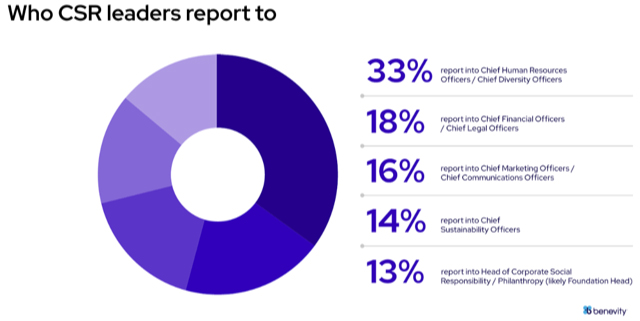
Employee resource groups are a source of trust. The study shows a continued commitment to building inclusive cultures with investments in employee resource groups (ERGs). Earlier Benevity studies have quantified that these groups bring significant value to companies by strengthening the employer value proposition and building employee trust. A majority of CSR leaders (92%) say that ERGs are viewed positively by leadership and the report also shows that those groups are evolving to become a trusted source of information within an organization (87%).
“In an era of distrust and polarization, these numbers represent a real opportunity for companies to lean into ERGs as a powerful and authentic way to sustain inclusion efforts amidst a changing regulatory and legal environment and strengthen business resilience,” according to Khosla.
The data is from an online survey of corporate impact professionals conducted between December 12, 2024, and January 12, 2025 to gather insights into attitudes, beliefs and perceptions across key areas of CSR, social impact and purpose-driven business. Responses were collected from more than 500 respondents including 201 Benevity clients and 324 individuals from a general population panel, representing CSR and purpose professionals from a range of company sizes, industries and regions.