(image from pexels.com)
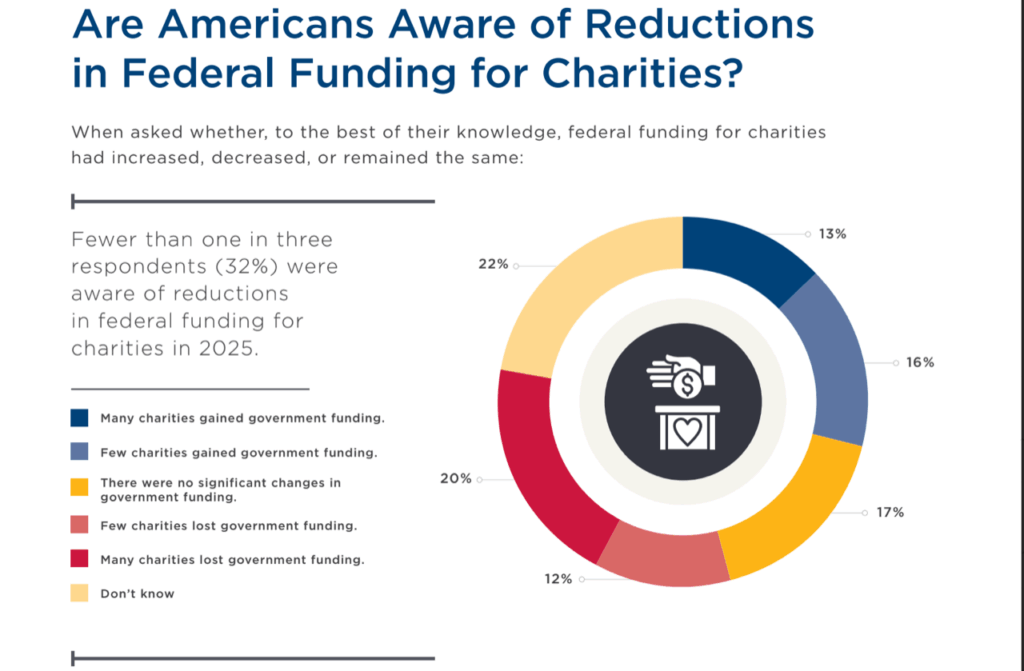
One-third of nonprofits reported having at least one type of government funding disruption during the first four to six months of 2025. Meanwhile fewer than one in three people (32%) were aware of those reductions in federal funding.
On the upside, among those who were aware, 65% viewed the cuts as either somewhat or very negative.
Those responses to survey questions were are some of the data in the new report Give.org Donor Trust Report: Public Awareness of Challenges Facing the Charitable Sector in 2025. The report, based on a survey of more than 1,500 U.S. adults, gauges public awareness of the challenges faced by the charitable sector in 2025. The challenges included federal funding cuts, new federal interpretations of diversity, equity, and inclusion (DEI), and the perceived politicization of the sector.
It seems just about everything has a political spin in the minds of potential donors. Only 9% of respondents disagreed with the statement “charities today are more involved in political issues than they were 10 years ago.” Overall, most respondents viewed charities as primarily promoting social good causes, with 20% strongly aligning with this view and 11% strongly perceiving charities as politically driven.
“Advocacy plays an important role for many charitable causes. Charities, both those aligned with causes that might be viewed as political and those that are not, remain central to civic participation,” said Bennett Weiner, president and CEO, of the Better Business Bureau’s Give.org. “At the same time, the public perception of politicization in the charitable sector may present challenges for organizations striving to unite communities and build bipartisan support for the common good.”
Among those aware of changes in federal diversity, equity and inclusion polices affecting charities, 53% viewed these changes negatively and 44% viewed them positively.
Among those aware of changes in federal Diversity, Equity and Inclusion (DEI) polices affecting charities, 53% viewed these changes negatively and 44% viewed them positively. When asked whether the federal government issued any guidance or interpretation linking federal funding to charity DEI policies, only 32% of respondents said yes. “These differing perspectives highlight the importance of clear, value-based communication from charities,” said Weiner.
Other report highlights include:
- When asked to place themselves on a scale between two statements: on one end “Charities are primarily engaged in promoting social good causes rather than political agendas,” and on the other “Charities are primarily engaged in political agendas rather than promoting social good causes,” 24% of Boomers, compared to only 13% of Gen Alphas, believe charities are primarily focused on promoting social good causes rather than political agendas.
- Among respondents aware of federal funding cuts for charities during 2025, most (65%) viewed these reductions as either somewhat negative (23%) or very negative (43%).
- 62% agreed the significant federal funding cuts for charities impact the most vulnerable populations in the U.S., and 60% agree that these cuts will change the type of causes that can endure or thrive.
For a free copy of the report, go to Give.org/DonorTrust.