(image from martsandlundy.com)
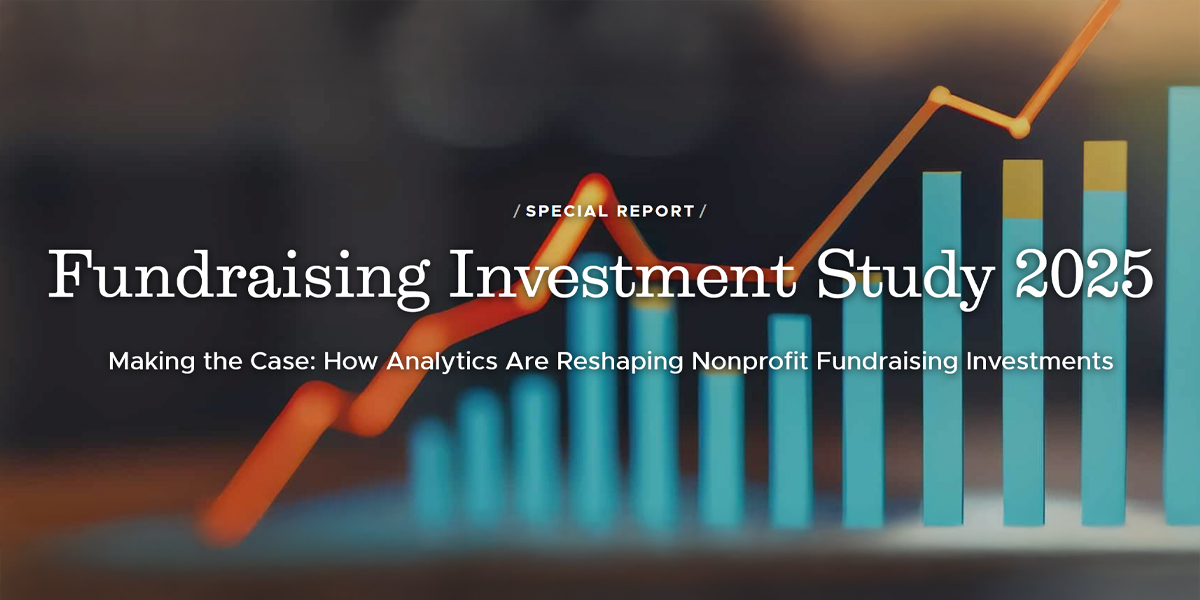
Nonprofit leaders are increasingly recognizing the value of analytics in decision-making, with growing adoption of metrics-based approaches. The opportunity ahead lies in accelerating it by building on these collaborative foundations to create more sophisticated, data-informed budgeting practices that optimize fundraising investment and demonstrate clear impact, according to authors of a new study.
New data in the Marts&Lundy research “Fundraising Investment Study 2025” show organizations still rely on traditional budgeting approaches. Nearly 70% reported collaborative budgeting, and almost half build budgets incrementally from prior years. Only about one-quarter described their process as data-driven — defined in the survey as using internal return on investment (ROI) and cost per dollar raised (CPDR) data or forecasting — underscoring the limited role analytics play in budget setting, according to the authors.
Survey respondents most often cited peer benchmarking, return on investment (ROI) and cost per dollar raised (CPDR) trends, and program-specific returns as the most helpful data for making the case for investment. Case studies and external anecdotes were far less influential. The authors wrote that the pattern held across organizations of all sizes, though smaller and less-resourced institutions were somewhat more likely to reference external validation, suggesting they might rely more on qualitative examples when internal or comparative data are limited.
The most common justifications for additional resources were prior fundraising results, alignment with institutional strategic plans, and internal ROI and CPDR metrics.
Fundraising efficiency varies widely across sectors and scale. Marts&Lundy’s combined dataset show that the typical organization spent about 18 cents to raise $1 (median CPDR, 18 cents) and generated $4.50 for every $1 invested (median ROI, $4.50). Arts and culture and higher education organizations achieved the strongest performance, while health and public and human services organizations reported lower returns. Larger organizations consistently outperformed smaller ones, achieving roughly three to four times higher ROI and about two-thirds lower CPDR.
The findings reveal a central tension, according to the authors. While leaders increasingly acknowledge the importance of data and analytics in shaping fundraising investment, many still rely on traditional practices and face persistent barriers, such as limited infrastructure and competing priorities.
There is a need, according to the authors, to strengthen leadership fluency in fundraising economics. You can access the complete report here … https://martsandlundy.com/fundraising-investment-study-2025/