Given the role the U.S. Department of the Treasury’s Internal Revenue Service (IRS) plays in regulating nonprofits and threats from the administration, it is fair to wonder what policies and programs nonprofit leaders might consider rethinking because they could run counter to the federal policies and agenda.
“The sector is facing a very complicated moment because of the coexistence of ongoing processes that create significant uncertainty,” said Eric Gorovitz, a principal at Adler and Colvin, a nonprofit-focused law firm based in San Francisco, California. The Trump Administration has muddied the waters for nonprofits through litigation, threats and pronouncements based on the administration’s perceptions of what they allege or suspect is illegal activities by nonprofits, according to Gorovitz. Adding to the stress is that IRS has been plagued by significant staffing cuts, resource reductions and questions about its security across the sector.
“All of those things come together to kind of destabilize the sector, and that makes it very difficult to predict what nonprofits should expect in 2026,” Gorovitz continued.
Part of the instability stems from the IRS not having the staff count it had before President Donald J. Trump took office in January 2025. Four months into his second term, the IRS had a 25% drop in employee count. “[D]eferred resignation programs, retirements and other separations,” reduced staff from around 103,000 to an estimated 77,428 people, according to Snapshot Report: IRS Workforce Reductions as of May 2025, a paper issued by the U.S. Treasury Inspector General for Tax Administration.
“A lot more of the agents we interact with don’t have deep expertise in the law they’re supposed to be overseeing, and that creates challenges, confusion and inconsistencies,” Gorovitz said, “I don’t mean to denigrate the service. I think the service has been very aggressively undermined by political interests over a bunch of years. It’s not just the Trump Administration, but it accelerated quite a bit in the past year.”
The reduction in force at the IRS means nonprofits that are possibly crossing legislative or regulatory lines might more easily avoid consequences, a circumstance which could benefit individual nonprofits but adversely impact the overall community. But nonprofit leaders who want to act in accordance with laws or regulations worry they might be missing an essential check regarding the compliance of their organization.
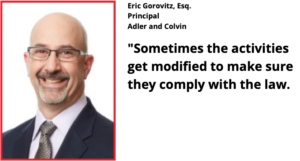
“One of the things the IRS does when it reviews an exemption application is dig into what an organization is doing and sometimes ask good questions,” Gorovitz said. “As a result of that, sometimes the activities get modified to make sure they comply with the law. In a lot of cases, it feels like nobody’s actually paying substantive attention to exemption applications, or when they do pay substantive attention, they don’t understand the law very well.”
The impact of an under-staffed IRS will likely be felt widely by the nonprofit community. For a much smaller range of nonprofits, there are legislative and regulatory changes afoot that could have more severe impacts.
At least one piece of pending federal legislation could be used by the IRS and Treasury Department to make life difficult for nonprofits. H.R. 6800 would modify Section 501(p) of the Internal Revenue Code of 1986 to allow the termination of tax-exempt entities that provide “material support or resources” to a “terrorist supporting organization.” The bill is a new version of H.R. 9495, the Stop Terror-Financing and Tax Penalties on American Hostages Act from the previous Congress. H.R. 9495 passed out of the House in November 2024 but stalled in the Senate.
As of mid-January 2026, H.R. 6800, which had been introduced into the House by Rep. David Kustoff (R-Tennessee) in mid-December, was in the hands of the House Ways and Means Committee.
The legislative approach represented by H.R. 6800 is mirrored by regulatory efforts being undertaken by the administration which would use both the IRS and the U.S. Department of Justice (DOJ) as cudgels. A September 25, 2025 National Security Presidential memorandum titled Countering Domestic Terrorism and Organized Political Violence (aka NSPM-7) provides insight into how the administration might use the IRS against nonprofits, especially in conjunction with the Department of Justice.
According to NSPM-7, “[a] new law enforcement strategy that investigates all participants in these criminal and terroristic conspiracies — including the organized structures, networks, entities, organizations, funding sources, and predicate actions behind them — is required.”
NSPM-7 calls for investigation and prosecution of “potential Federal crimes relating to acts of recruiting or radicalizing persons for the purpose of political violence, terrorism, or conspiracy against rights; or the violent deprivation of any citizen’s rights.”
Since the beginning of its second term, the Trump Administration has sought to broaden the definition of protected groups. Furthermore, members of the Administration have been cavalier in throwing around the term “anti-fa” in regard to any entity opposing its agenda.
“When you hear that kind of rhetoric, exempt orgs that are engaged in dis-favored activities are paying attention to that, and it worries them,” Gorovitz said. “And I think 2026 is likely to bring more of the same.”
Within NSPM-7, the main threat to nonprofits appears in item (j): “The Commissioner of the Internal Revenue Service (Commissioner) shall take action to ensure that no tax- exempt entities are directly or indirectly financing political violence or domestic terrorism. In addition, where applicable, the Commissioner shall ensure that the Internal Revenue Service refers such organizations, and the employees and officers of such organizations, to the Department of Justice for investigation and possible prosecution.”
This threat is expanded in a December 4, 2025 memorandum from Attorney General Pam Bondi to federal prosecutors, law enforcement agencies and Department of Justice grant- making components. In it, Bondi notes “… federal prosecutors should consider any applicable tax crimes in cases in which extremist groups are suspected of defrauding the Internal Revenue Service. As it receives referrals for violations of tax obligations, the DOJ should investigate and, where appropriate, prosecute those responsible.”
The shifting of enforcement duties from the IRS to the Department of Justice is important. “I know exactly what’s involved in litigation, and I know exactly what’s involved in an IRS audit and appeal. The two share virtually no similarity,” said Jeffrey S. Tenenbaum, managing partner at Tenenbaum Law Group, a Washington, D.C.-based firm that primarily serves as outside general counsel for nonprofit organizations and related entities.
“In terms of the IRS, there has been a lot of saber-rattling from the President himself and others in the administration about nonprofit organizations and tax-exempt organizations,” Tenenbaum said. “But from what we can gather there has been no meaningful, if any, kind of IRS crackdown or threats to the tax-exempt status of most tax- exempt organizations.”
Tenenbaum noted there are only three ways tax-exempt status can be disrupted. First, it is automatically revoked if an organization fails to file a federal Form 990 three years in a row. The second reason is through an audit, which has due process protections and appeals processes built into it. But this process is not an effective tactic for an administration that seemingly relies on shows of force. Third, an organization’s status can be suspended if it is deemed as supporting or engaging in terrorism.
“During the pendency of [an audit], which can take months, if not years, all of it remains private,” Tenenbaum said. The IRS, by law, is not allowed to publicly disclose any of that the process publicly. “Of course, the organization always has the right to make it public if they wanted to. Most organization organizations don’t. It can take years, and most audits, frankly, end up with some resolution short of revocation, and so it’s not really a very politically favorable alternative for the administration,” said Tenenbaum.
Even if the administration does use this tactic, the impact on a nonprofit would be inconvenience, but probably not devastating. An IRS audit is probably not going to drain the resources of an organization. Tenenbaum said, “It’s not like you can just issue tons of subpoenas and depose all these people and file all these different motions.”
Audits, Tenenbaum added, offer “plenty of time” to comply. An organization might have to retain an attorney or a certified public accountant (CPA) to help defend it, but it’s nothing like litigation, Tenenbaum said.
“I don’t see the IRS audit process as a tool for trying to wear down and beat down and drain the resources of nonprofit organizations,” Tenenbaum continued. “Plus, these are very manpower intensive [on the part of the IRS], and the IRS wasn’t doing many audits to begin with, even before this administration took office. Since then, the administration has cut the number of IRS auditors significantly, so there are very few auditors left to even engage in this.”
The supporting or engaging in terrorist activities means might be the most insidious. Under Internal Revenue Code Section 501(p), an organization’s tax-exempt status can be immediately suspended if the organization is designated or identified a supporting or engaging in terrorist activity or supporting terrorism. But the law was designed to address support of foreign terrorism. “It’s hard for me to see how Section 501(p) could be utilized, at least in a lawful manner, to suspend the tax-exempt status of an organization that is not supporting foreign terrorists,” he said.
Neither Trump’s nor Bondi’s memorandums mention Section 501(p) in their discussions of combatting domestic terrorism.
This year will also see the changes to giving-related legislation within 2025’s One Big Beautiful Bill Act going into full effect. These changes include:
- Addition of an above-the-line deduction (those made from gross income) for donations and an increase in the standard deduction $15,750 for non-itemizing single filers and $31,500 for non-itemizing joint filers for tax year 2025; a new floor of 0.5% of adjusted gross income for charitable deductions, with any donations below that amount not being deductible;
- Permanent codification of the 60% deduction limit for cash contribution, with non-cash contributions remaining at 50%; and,
- A cap of 35 cents per dollar for itemized deductions made by highest-income taxpayers, down from 37 cents per dollar.
Wealthier taxpayers should have lessened financial imperatives to give. In turn, the above- the-line deduction for non-itemizers provides greater benefit for those who previously did not have a financial incentive to give.
“We are living in an interesting time,” said May L. Harris, CEO and managing attorney for Purpose Law Group, a San Diego, California-based law firm that provides legal guidance to help entrepreneurs, nonprofit leaders and philanthropists maximize their social impact. “Congress enacted the sweeping tax law that in many ways sought to change the incentives for charitable giving, but at the same time, it increased pressure on institutional nonprofit models and endowments. On the other hand, the executive branch is signaling enforcement, compliance, compliance, enforcement, in a way that can often shift much more quickly than nonprofits can adapt to it.
Harris said the general sentiment among fundraisers was that during 2026 we’re likely to experience more resistance from high-income donors as well as corporate philanthropy. That sentiment might be overstated.
“The last time there was a big change like this, everyone said the sky was falling when they put in the standard deduction, and it didn’t pan out the way that everyone thought it was going to,” Harris said. “People still contributed. Philanthropy still was vibrant.”
Harris attempted to find a silver lining amid the administration-related uncertainty. “I think it should prompt organizations to take a good look at their documentation, their governance, their record keeping, their financial controls, conflict of interest, etc.,” she said. “Take the time now to clean house a bit.”
Weiss also recommended nonprofit leaders brush up on their organizations’ good governance hygiene and do training on election-year compliance. For 2026 specifically, that might include what organization spokespeople and social media and other external – communication channels can and can -not say during an election year and the – types of activities they can do around candidates. Harris also recommended leaders create a response plan if they do come under the scrutiny of the Treasury Department or any other federal agency “that all of a sudden is at the whim of the administration,” as she put it.
One area which nonprofit managers should treat especially carefully is international grant making. The Office of Foreign Access Control, a unit within the Treasury Department, issues restrictions and monitors compliance It offers fertile ground for administration officials seeking to question a nonprofit’s activities. According to Harris, nonprofit leaders need to make sure “they have clean, controlled policies, and they’re actively ensuring, at the board level that they’re complying with those regulations.” If the administration determines an organization is supporting international terrorism, the penalties can be significant. “That is, I think, one of the biggest risks that organizations face in 2026,” Harris added.
That also holds for domestic activities. A U.S.-based nonprofit doing work the administration could conceivably frame as domestic terrorism, such as supporting illegal immigration, faces similar penalties, according to Harris. Such nonprofits might lose all federal funding, be investigated by the Office of Foreign Access Control (OFAC) and the United States Immigration and Customs Enforcement agency (ICE) and Treasury or otherwise face significant risks, she added.
There are also mission-based concerns, especially for organizations seeking nonprofit status, even beyond those that run afoul of statute or regulation. “The administration has signaled it would instruct Treasury not to allow organizations focused on DEI (diversity, equity and inclusion) to get through examinations,” Harris said. “I haven’t seen that yet, but an ounce of prevention is worth a pound of cure.
“There are plenty of nonprofits that have a DEI policy just because they thought they needed it, though it wasn’t fundamental to who they were or their exempt purpose,” Harris continued. “If that was the case, perhaps a good risk-avoidance tack would be to remove it, if it’s not fundamental to who they are. But for organizations where it’s central to their exempt purpose, we recommended absolutely they shouldn’t change.”