Fewer than 1 in 5 first-time donors give again the next year. And at most nonprofits, a few staff members still make every ask.
Peer-to-peer fundraising fixes both problems. Your supporters, volunteers, board members and families ask their own networks, and you reach donors you’d never find on your own. You don’t need a big event or a big staff to do it.
Torrey Pines High School Foundation has six staff. Its peer-to-peer campaigns raised $138,700 from about 360 donors. In one of those campaigns, 65% of donors were new to the organization.
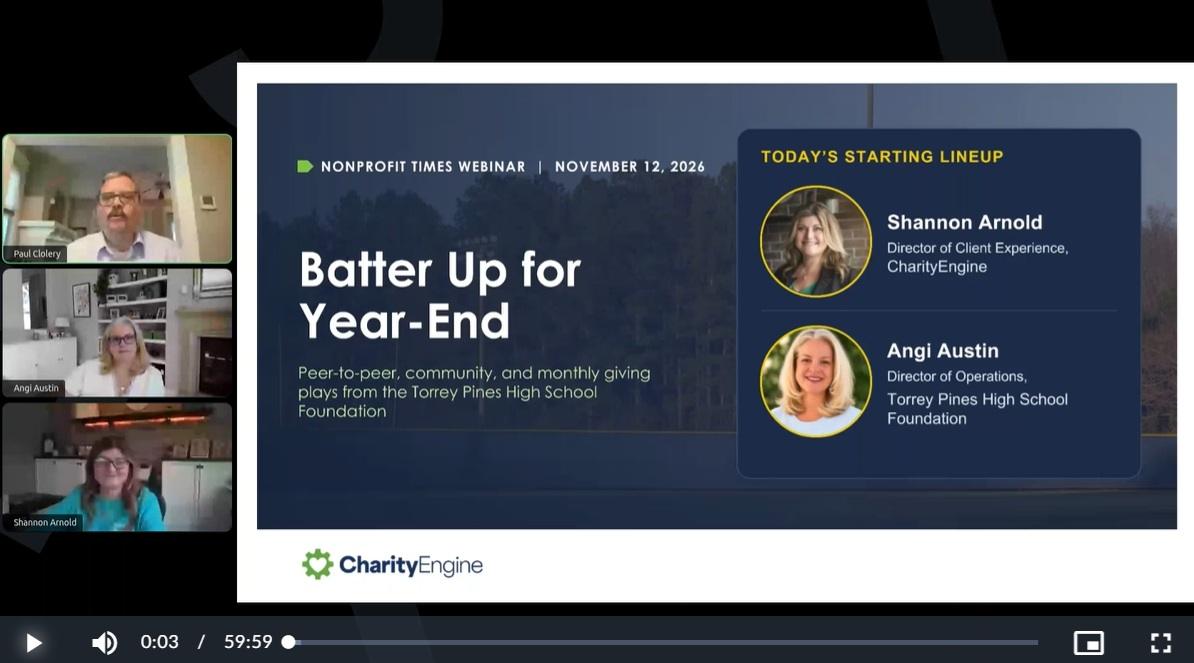
Join Shannon Arnold, Director of Client Experience at CharityEngine, and Angi Austin, Director of Operations at Torrey Pines High School Foundation, to see exactly how they did it. They’ll also show how to adapt it for any cause: animal shelters, food banks, arts groups, human services and more.
You’ll leave with:
• A 5-step peer-to-peer play built around a moment your supporters already show up for, such as a walk, a recital, a game or a birthday
• A fundraiser toolkit: personal pages, small goals and messages people can copy and send
• A follow-up plan so new peer-to-peer donors don’t disappear in January
• A monthly giving plan to turn year-end donors into year-round donors
• A 5-question tools check to run before GivingTuesday, plus quick wins through December 31
• A free Year-End Game Plan worksheet
Learning objectives:
1. Plan a peer-to-peer campaign that gives supporters, volunteers, & participants a clear, manageable way to raise money for any mission.
2. Connect community outreach with donor follow-up, so different groups receive relevant appeals and a clear next step to stay involved.
3. Make monthly giving part of your year-end strategy, so donors keep supporting your work after December 31.
4. Decide whether it is better to outsource peer-to-peer fundraising or manage it through a CRM.