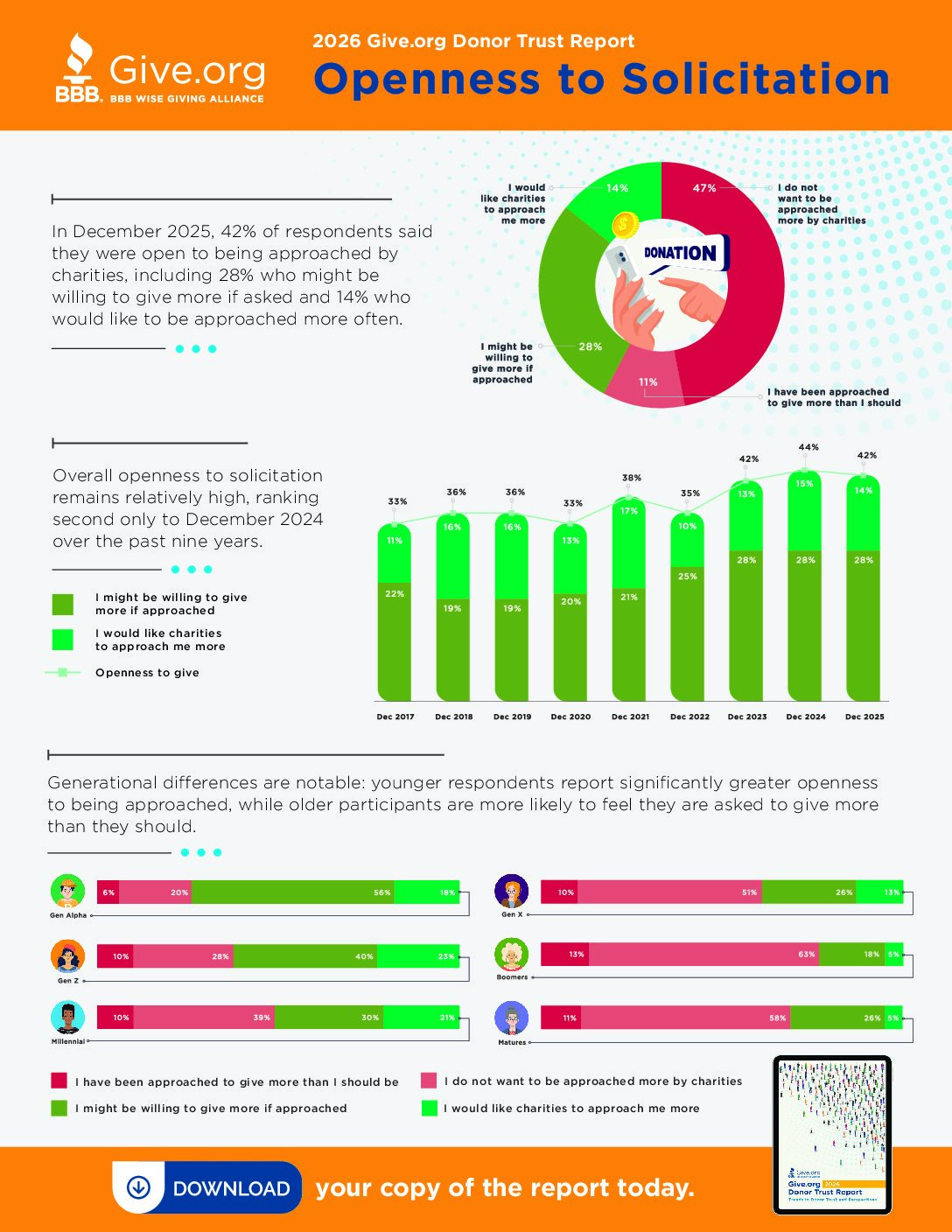
More than one-quarter (27.9%) of Americans would give more to charity if they were asked to do so and 14.1% say they should be approached more often. And while the buzz is all about social media and crowdfunding, 59% of Americans polled say they usually ask questions or look for information before making a contribution.
Artificial intelligence (AI) summaries were considered less influential during the giving process. As of the end of 2025, only 7% of donors responded that AI summaries influenced their choices. More than half of respondents — across all generation — report that they usually ask questions or look for information before giving.
This is some of the data in the new Give.org Donor Trust Report 2026: Trends in Donor Trust and Perspectives. The data is based on a December 2025 survey of more than 1,500 U.S. adults and nine years of trend data. The report’s authors examined donor trust, engagement, and giving preferences. Generational age ranges used in the report were: Generation Alpha (18-20), Generation Z (21-27), Millennial (28-44) Generation X (45-60) Boomers (61-79), Matures (80 and above).
“The sector is well aware that donor participation is declining and that giving is becoming increasingly concentrated among a small group of major donors. Yet openness to giving reached its highest levels in 2024 and 2025 since 2017,” said Bennett Weiner, president and CEO of BBB’s Give.org in Arlington, Virginia. “This increased receptiveness signals potential to re-engage broader support and reduce reliance on fewer contributors.”
Report highlights include:
- High openness to solicitation: The 42.1% of respondents who said that they are open to being approached by charities makes 2025 the second-highest level recorded since 2017. Younger generations are significantly more receptive. For example, 63% of Gen Z say they might give more if asked and would like charities to approach them more.
- Trust gap persists: 67.7% of respondents say trusting a charity is essential before donating, yet only 18.3% report high trust. This gap has been relatively stable since 2017.
- Trust increased across most categories: 12 of 13 charity categories saw increases in high-trust ratings between 2024 and 2025. Between 2017 and 2025, four charity categories experienced fluctuations of at least seven percentage points: civil rights, veterans, religious, and environmental organizations.
- Preferred charity types vary by generation: Health organization and Veterans organizations are most trusted among Matures. Animal welfare and civil rights organizations are most trusted among Gen Alphas.
- Trust still comes from traditional sources. Among those who say they seek information before giving, participants report being most influenced by charities’ websites (54%) and third-party monitors (39%).
“Trust increasingly is tied to a broader challenge in readily identifying trustworthy sources or organizations and acting upon it. People are navigating an environment with overwhelming amounts of information, distractions, and misinformation,” Weiner told The NonProfit Times. “Our findings suggest that disengagement may stem less from lack of interest in giving and more from uncertainty about whom and what to trust. Donors are looking for credible signals of authenticity, clarity, and reliability, but those signals can be harder to identify in today’s environment.”
According to Weiner: “Nearly 70% of survey participants say it is essential to trust a charity before donating, while only about 20% report having high trust in charities. So, trust is highly important and an ongoing challenge for the sector.”
Among those who say they seek information before giving, participants report being most influenced by charities’ websites and third-party evaluators, with personal outreach and general web searches also playing a meaningful role instead of AI-generated summaries.
While recent changes were broadly positive, longer-term trends reveal greater variation. Between December 2017 and December 2025, four categories experienced fluctuations of at least seven percentage points: civil rights and community action, veterans, religious, and environmental organizations.
“Broader news, public discourse, and current events can influence perceptions of specific cause areas,” explained Weiner. “For example, periods of heightened media attention around wars appear to coincide with increased high trust in veterans’ organizations. Similarly, trust in civil rights and community action organizations rose between 2019 and 2022, during a period of especially active public discussion around civil rights issues.”
For a free copy of the report, go to Give.org/DonorTrust.