Reducing carbon emissions and advancing diversity, equity and inclusion practices are among the environmental, social and corporate governance (ESG) priorities that continue to draw interest from social-impact nonprofits committed to deploying the principles in furtherance of their missions.
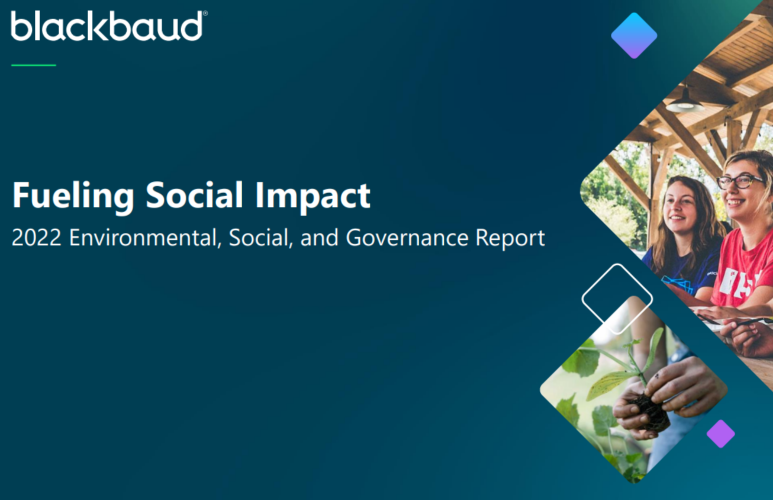
Joining them in this endeavor is software company Blackbaud, which released its own ESG scorecard on last week. Fueling Social Impact: 2022 Environmental, Social, and Governance Report offers a self-assessment of the company’s progress in amplifying its global impact across the four ESG pillars of Social Impact, People and Culture, Driving Climate Solutions, and Internal Governance and Data Responsibility.
“One of Blackbaud’s company values is ‘powered by purpose.’ When we say this, we mean that we’re motivated by more than creating great software… We’re committed to strengthening the impact we make through the way we operate our business, setting high standards, and reporting with transparency the efforts we are making (across these areas),” according to Blackbaud CEO Mike Gianoni.
The report highlights include a 90% reduction in the company’s greenhouse gas emissions enabled by energy efficiency upgrades at its Charleston, South Carolina headquarters and remote work policies that have reduced employees’ fuel consumption. These practices combined with the purchase of carbon credits and offsets enabled it to achieve 100% carbon neutrality last year, according to the report. While pursuing a complete transition to renewable energy, the company will continue investing in credits and offsets “not for the sole purpose of claiming ‘carbon neutral’ but to help fuel projects, organizations, and initiatives that are making real impact,” according to the authors.
The company has also undertaken diversity, equity, and inclusion (DEI) initiatives including a Supplier Diversity Program with metrics for increasing its share of vendors owned by women, minorities, veterans, disabled and LGBTQ individuals. Other DEI highlights in the report include the following:
- 1 in 3 Blackbaud employees now belong to an affinity group for various categories of individuals such as those noted above
- A pay equity program has been established to identify employees requiring adjustments to bring them to parity, both internally with their peers and with external market conditions
- A five-year gift program and partnership has been established with five diversity-focused organizations, which will provide in-service training to employees in the five countries where Blackbaud’s principal operations are located. Partner organizations include Braven (U.S.), Indspire (Canada), Action for Race Equality (United Kingdom), The Ladder Project Foundation (Australia), and Omar Dengo Foundation (Costa Rica).
Blackbaud’s commitment to social impact and to engaging its employees through philanthropy was reflected by the 1 in 4 who participated in a matching gift program last year, the 1 in 7 who served on a nonprofit board, and the 70% who volunteered their time, according to the authors.
Blackbaud has also appointed United Airlines’ chief information security officer to its board of directors and added its own chief information security officer to a “disclosure committee” to ensure it “has the right level of visibility and expertise represented in the event of a security incident,” wrote the authors. The announcements underscore the company’s commitment to sound governance and data responsibility following a recent $3 million fine levied on it by the Securities and Exchange Commission for concealing the extent of a 2020 ransomware attack in which cybercriminals obtained donors’ bank account, credit card, and social security numbers from its servers.
The company did not seek independent verification of the data in the report but will consider doing so in the future, according to the authors.