Two years into Lifeline Children’s Services’ tenancy within a 14,000-foot leased space, the nonprofit’s management realized the organization had to move. The Birmingham, Ala.-based nonprofit had outgrown its location. Demand for its direct onsite services was booming.
Unfortunately for Lifeline, in late 2019 the Birmingham real estate market was also booming. “It was saturated,” Lifeline Executive Director and President Herbie Newell said. “The spaces we could find either needed a lot of work or were well out of our price range.”
Lifeline’s situation changed – as did the rest of the world — when the coronavirus pandemic started in 2020. Lifeline managers began putting increased emphasis on telework. But both the organization’s team and its clients were used to meeting face to face, and the organization’s leadership found the distanced approach less effective.
“While everybody else was abandoning office work, we were looking for more space to serve our clients,” Newell said.
While Newell was willing to look anywhere in the Birmingham area, he acknowledged many of his staff members had arranged their commutes to accommodate the area where the office was located. “We rely on people coming physically to an office,” he said. “We didn’t want to move them across town.” Lifeline staff also meet their constituents in other locations within the community.
Leadership looked at one new location that had some promise. Two and a half miles from its headquarters was a small university that had been put out of business by the coronavirus pandemic.
“The administrative office buildings would have been something we could use, but the space that would have been the best for us were the dormitories,” Newell said. But it had some “wonky” zoning restrictions. “We would have gone through a fight because the neighbors were hoping the space would be developed for private residential use,” Newell said.
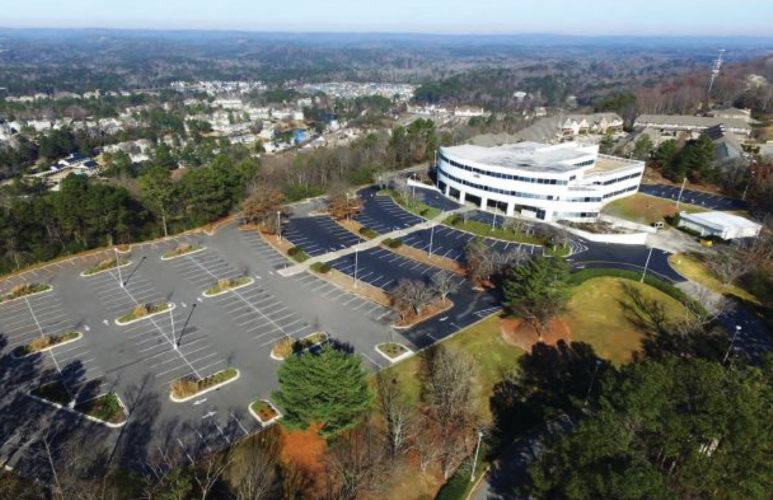
There was an appropriate space for Lifeline: 66,000 square feet in a 120,000- square-foot building across a parking lot from the nonprofit’s then location. The price was prohibitive. It had been listed in mid-2019 at $6.5 million.
That would change. In 2019, the work-from-home/telecommuting trend was starting to take root. The onset of the pandemic in 2020 caused that trend to explode. Both commercial enterprises and nonprofits sent their workers home — sometimes willingly, sometimes because of government requirements. Some nonprofits gave up their office space entirely, and others downscaled, taking smaller spaces that offered meeting areas but that did not have as many private offices.

This trend proved a boon for any organization that provides direct, onsite services. In early 2022, due in part to a generous financial donation, Lifeline was able to purchase the space across the parking lot for $3.1 million — less than half the original asking price.
Lifeline has expanded its operations to fill 22,000 square feet, or roughly one-third of its newly-acquired property. Another 8,000 square feet has been set aside as a co-working space, a revenue-generating venture in which individuals working remotely can use as needed. The remainder of the space is being leased out. Roughly 10,000 square feet has already been grabbed by a commercial concern Newell declined to identify that had downsized, and another 20,000 feet has tenants in various stages of commitment, some of whom are doing improvements to their space before moving in.
There is one more factor that aids direct service nonprofits in the ability to expand office space. “What we have seen in the last two years is unprecedented generosity,” Newell said about the nonprofit community in general. “That gives nonprofits much more ability to be able to make a move like this.”

“While everybody else was abandoning office work, we were looking for more space to serve our clients.”
Lifeline’s case is extreme. A half-off deal for office space is an exception. But the loosening of the real estate market has offered nonprofits a variety of opportunities, whether financial benefits, access to more desirable spaces or a wider range of amenities.
“The reduction in the need for space has opened opportunities to groups that have been thought of as less attractive, such as those with children coming in or special needs populations,” said Carri Lyon, executive managing director and co-chair of Chicago-based real estate services firm Cushman and Wakefield’s national not for profit practice group.

“We’re seeing a lot of landlords being very good about downsizing tenants within their portfolio, not wanting to lose tenants.”
“In the last 10 years, it had gotten harder, especially if you have a group with a mental health component, to find buildings open to your use,” Lyon continued. “Some landlords would say ‘you have to sign a lease that it will be office use only’ [as opposed to direct services]. They would put in all kinds of penalties because of bad experiences they have had. That’s something we have seen loosened up.”
Landlords might also discover that some nonprofits are more desirable than commercial tenants. “A landlord can look at an old line nonprofit and see it has private funders, government funders, corporate funding or an endowment,” Lyon said. “They would take those over a startup or a group that was thought to be shaky. This stability with many nonprofits is extremely appealing right now.”
The real loosening up, according to Lyon, is in the type of properties available to nonprofits. In some markets where retail rents have come down, organizations such as theater or dance companies or children’s day camps or learning centers might be able to afford better spaces.
“Many landlords feel ‘let me just get somebody in there so I don’t have the ground floor empty,” Lyon said. “Maybe it’s a shorter-term lease, or maybe it’s an organization which, if the landlord gives them a sweet deal on a ground floor space for their visitors’ center, will put their organizational headquarters on higher floors.”

“A lot of our clients are migrating toward shorter-term leases now.”
Some landlords might be unwilling to give substantial discounts, especially those mindful of how their balance sheets look to the institutions that hold the buildings’ mortgages. But the tenant-friendly market means nonprofits can ask for other concessions, such as furniture, or allowing a nonprofit to lease out unused footage or building out a space to make it more appropriate to the nonprofit, thereby saving the organization the construction costs.
Other landlords might be willing to forego what are known as “good guy guarantees,” in which an individual within an organization agrees, no matter what, to pay rent through the end of the lease, regardless of what happens to the organization.
“A nonprofit is not able to sign those, because there’s no individual [who can shoulder that responsibility],” Lyon said. “Landlords who understand nonprofits know they’re not going to get that, but they’re able to get their comfort in other ways, such as doing a deposit with a burn-down [a security deposit that reduces over time].”
Even nonprofits locked into pre-pandemic leases can have some wiggle room. “We’re seeing a lot of landlords being very good about downsizing tenants within their portfolio, not wanting to lose tenants,” Lyon said. “They can put their space on the market for sublease and downsize. The owners don’t want to lose them and their prestige name.”
Lyon speculated that the nonprofit real estate segment, despite being around 2% of the total market, has been hot and will continue to be so. “I did more sales and purchases in the past two years than I have in any other two-year period,” she said. That was true even in areas where lockdown regulations prevented brokers from showing spaces. “People didn’t necessarily know the exact square footage they wanted, but they knew they wanted to be out. There were a lot of Band-Aid leases signed in March and April 2020 for a year or 18 months as nonprofits kicked their real estate decisions down the road until they were more comfortable.”
The increase in real estate opportunities has some nonprofit leaders examining local laws for advantages. In New York City, nonprofits that own property are eligible for exemptions on their real estate taxes, provided the space is used for non-residential purposes. While renters or leasers usually cannot take advantage of these exemptions, 30-year leases might be viewed as ownerships.

“We’re seeing, at least in New York, much more interest in doing that, because the savings are remarkable,” Lyon said. “It can be about $11 a foot less on the rent. We’re getting asked about that more and more by nonprofit boards.”
Other brokers see fewer opportunities for rent reduction, but more opportunities for nonprofits to improve their environments. “The 501(c) (3) nonprofits, the charitable ones that depend on donations from their donors and grants from institutions, are very cost conscious,” said Emanuel “Manny” Fitzgerald, executive vice president and national leader of the nonprofit practice at Dallas-based real estate and investment services firm CBRE. “If the 501(c)(3) nonprofits are going to be in a major city, typically they’d be in a lower-class building that’s more affordable. But as a result of the high vacancy rates in major markets, some of those nonprofits have been able to improve the quality of their space for the same cost they were paying pre-pandemic. We refer to it as a flight to quality.”
As Lyon indicated, foot traffic concerns might be abating. “Historically we’ve had challenges finding space, and finding landlords, who would support this type of use,” Fitzgerald said. “But now there are one or two saying ‘please bring them by and I’ll accept them.’”
Fitzgerald’s advice for nonprofit tenants able to secure better-than-usual accommodations is to take a long-term lease, if the organization’s strategic plans allow. “A lot of our clients are migrating toward shorter-term leases now, primarily because they’re not sure what the future holds in terms of remote work. But if the market does rebound, they could find that could be a more costly option for them, if they are going to wait two or three years to lock in a longer-term rental rate.”
Fitzgerald has some skepticism about nonprofits taking over ground-floor retail spaces. “In some instances, you’ll have zoning laws that require retail and do not allow any other type of use other than retail,” he said. In those instances, a nonprofit may be required to negotiate with a zoning authority to have it rule that its service is a retail service, a process that would likely be settled on a case-by-case basis.
Nonprofits that continue to provide direct onsite services will always need office space. Fitzgerald cautions others which may be contemplating going to a completely remote model to reconsider.
“We are seeing that happen with some of our clients who are national nonprofits,” he said. “I think organizations deciding to do that will change their minds over the next two to three years, primarily as a result of the effect it will have on their culture, which is a very important glue that helps hold an organization together. Over time, they’re going to change their minds and understand the importance of having a bricks-and-mortar location.”