Instore and online sales boosts rebounding revenue streams
A $6 dress from a Goodwill thrift store was the outfit worn by a young up-and-coming actress, Eva Mendes, to her first Hollywood red-carpet event, a premiere of the film The Others held in 2001.
Mendes, who even did her own hair and makeup for the event, fondly recalled the experience on Instagram after her own career took off several years later: “I’ve always loved a cheap find. Viva thrift shops!” she wrote.
Other A-list celebrities, including Drew Barrymore, Janelle Monae, Julia Roberts, and Sarah Jessica Parker, have since hopped aboard the thrifting bandwagon, joining cost-conscious consumers as inflationary pressures and concern for the sustainability and environmental impact of fast fashion combine to boost the apparel resale market.
Total U.S. sales of secondhand apparel have more than quadrupled during the past decade, rising from $13 billion in 2013 to a total that is expected to surpass $53 billion this year, according to an analysis published by online resale marketplace ThredUp. Charity thrift shops are expected to account for about half ($26 billion) of the projected total with the balance going to privately owned consignment stores and other resale businesses.
A deeper dive into the numbers shows the trend not only has held steady but has accelerated with annual growth outpacing the previous year’s progression every year except during the pandemic- induced blip of 2020. That’s when secondhand apparel sales took a slight but temporary step backward before posting record gains again in 2021.
Overall resale totals, a category that includes everything from books and artwork to furniture, jewelry, and musical instruments (except auto sales, which are treated as a separate category), has more than doubled during the past decade and will likely approach $200 billion this year, according to retail analytics firm Global- Data.

The growth in resale is an especially welcome development for charities that receive revenue from the sale of secondhand goods. Precise revenue totals for some of the well-known national charities are a bit hard to pin down since much of it is self-reported from data provided voluntarily by local affiliates which typically number in the hundreds. The affiliate reporting varies in the reliability and timeliness with which they report data to their national offices. Charities also vary in how they collect and tabulate the data. For example, some have a separate category for thrift store revenue while others comingle it with sales from other retail operations and report the total under a generalized heading such as “sales to the public” (The Salvation Army) or “donated goods retail” (Goodwill). However, the trend shows an unmistakable rise that not even the pandemic was able to hold back for very long.

The Salvation Army is one of the very few charities where resale totals have yet to fully recover from the pandemic. Many of The Salvation Army’s 860 thrift stores across the United States closed during the health crisis, often for several weeks to several months, resulting in a 29% decline in sales revenue from $598 million (2019) to $424.5 million (2020). The decline was followed by a 22% bounce to $519 million during 2021, which amounted to just under one-tenth of the organization’s total U.S. income for that year.
“Salvation Army Family and Thrift Store revenue has not yet returned to pre-pandemic levels, but we will need to wait for 2022 audited financials to definitively say so,” according to spokesperson Bishop Wash.
The Society of St. Vincent de Paul (SSVDP), by contrast, has already rebounded and surpassed its pre-pandemic resale totals after many of its 386 thrift stores across the United States closed for two months or more during 2020. Staffing also took a hit that year, most notably at the organization’s national store in Phoenix, which lost 90% of its employees at one point. Thrift store revenue predictably declined as a result, falling nearly 7% from $167 million (2019) to $156 million (2020). However, thrift store revenue surged 71% to $220 million during 2021, amounting to 28% of total income for the year, and is now greater than it was before the pandemic, according to SSVDP spokesperson Jill Pioter.
The growth of resale has boosted support for the mission of Goodwill Industries International, whose name is perhaps more synonymous with the thrift store model than that of any other charity. The organization received 78% of total revenue from the sale of donated goods last year, generated from sales at more than 3,300 thrift stores in the United States and Canada and online purchases. There are two online sites, ShopGoodwill.com where visitors can bid for secondhand goods online and Goodwillfinds.com which went live this past October.
More than 85% of Goodwill stores closed during April and May 2020 with most reopening by mid-June. Nonetheless, more than 80% of Goodwill affiliates had to furlough or lay off at least 60% of the retail staff during 2020, which seriously crimped operations. This was reflected in a 19% falloff in revenue from the sale of donated goods that year, from $4.8 billion in 2019 to $3.9 billion in 2020.
Goodwill has more than made up for it, as retail revenue jumped 41% to $5.5 billion for 2021. Preliminary results show Goodwill continuing to build on those gains with a 9% increase in resale revenue for 2022, according to Rick Hill, vice president of donated goods retail operations.
For all its privations, the pandemic did have at least one silver lining in the form of a dramatic increase in charitable donations of used clothing and other household goods during 2020-21. People stuck at home began cleaning out their closets and garages and downsizing wardrobes, often for the first time in years. The donations were almost too much of a good thing for some charities. Closures and limited hours put a crimp in the ability of their thrift stores to do business, leaving some with more items than they could sell.
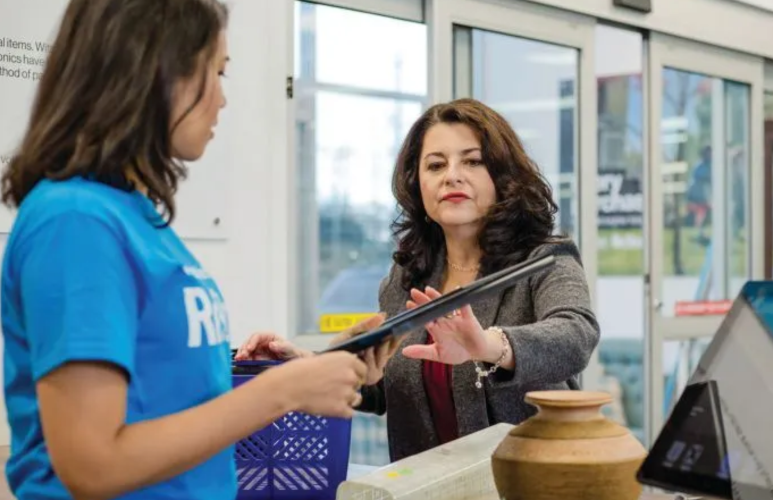
Such was the case for a number of Habitat for Humanity affiliates, whose more than 1,000 ReStore outlets across North America sell secondhand furniture, appliances and building materials. The stores, the first of which opened in Winnipeg, Manitoba in 1991, are intended to keep home building materials out of the waste stream while funding Habitat’s community and homebuilding work. Up to 90% of the inventory is from people remodeling their homes and donating items they no longer need, with the balance typically coming from homes the Habitat renovates before turning them over to new owners.
ReStore sales now account for nearly one-third of annual revenue at Habitat for Humanity of Greater Los Angeles. “We were fortunate enough to be closed for only five days during the pandemic and then were able to be deemed as an essential business, which allowed us to reopen pretty quickly,” said Erin Rank, president and CEO of Habitat for Humanity of Greater Los Angeles. “But we had limited hours and limited people who could be in our stores at any one time. And up to 30% of our staff were also out at any given time due to being sick or quarantining or caring for children or older adults in their household, which further limited in-person operations.”
The Habitat affiliate’s three ReStore locations in Southern California had been open seven days a week but scaled back during 2020 to having only two stores open five days a week. What followed was something no one saw coming.

“We started seeing people lined up outside every day, 30 to 40 people deep, waiting to get in when we opened,” Rank recalled. “And it would stay that way throughout the day. We never expected so much business, but it turned out that there was a high bump in people wanting to refurnish or remodel their homes, which makes sense since so many of them were staying home.”
The situation created a perfect storm of mushrooming demand and equally escalating supply from all the donations that poured in, even as staffing shortages and COVID occupancy restrictions combined to limit instore operations. Leaders at the Los Angeles- based affiliate responded by opening an online sales portal, moving inventory at a time when reduced in-person hours would otherwise have precluded it from doing so. “It started during the pandemic as a way for us to sell donated items online, which caused our revenue to go up even with the limited hours and limited staff we had,” Rank said.
Demand and donations remained exceptionally brisk through about April 2022, she said. “The timing of when things started to calm down interestingly coincided with when some of the pandemic restrictions in Southern California began to ease and people started to be able to travel and go out again and were done with staying at home,” said Rank.
The online ReStore site has been a boon to the Habitat affiliate’s bottom line and given it a supplemental revenue stream that is likely to provide a future cushion against the typically volatile business cycle of home buying and selling. The results are reflected in the affiliate’s ReStore revenue, which has gone up steadily from approximately $8 million in 2019 to $9 million in 2020, $9.5 million in 2021, and just more than $10 million last year with about $800,000 of that from online sales, according to Rank.
Habitat for Humanity’s other affiliates have taken notice and started going virtual. At last count, the organization had 1,055 ReStore locations in eight countries (912 in the United States) and another 119 virtual stores. The online and retail operations combined to lift total Re- Store revenue across all Habitat affiliates from $160 million in 2021 to $173 million last year, according to data provided by the national office.
Thrift stores like these are likely to play a growing role in funding the mission of nonprofits. Secondarily, they also play a role in diverting reusable material from landfills and conserving resources that otherwise would go toward new purchases, an important consideration for ecologically minded Gen Z and Millennial consumers. This growing movement around reducing waste and conserving resources underscores the strength of a resale market that is forecasted to continue growing three to four times faster than the overall retail market during the next five years and up to eight times faster in the case of fashion and clothing resale, according to GlobalData projections.
Much of this growth will be driven by Gen Z and Millennial shoppers, who not only are spending a larger portion of their budgets on secondhand purchases compared to five years ago but also constitute a significant number of first-time thrifters. And 81% of these first-time thrifters plan to spend the same amount or more on secondhand goods in the next five years, according to ThredUp.
This growing popularity among consumers to shop for secondhand goods is further driven by practical considerations of saving money and a desire to shop for trendy, higher-end, and vintage one-of-a-kind items that won’t break the bank. The growth in their ranks will almost certainly continue to increase the 16% to 18% of Americans who currently shop at a thrift store at least once during the year, according to America’s Research Group, a consumer research firm.
This transition from a disposable society to a conserving and recycling society has enormous market implications, giving charities an opportunity to harness growth to power their missions.