By Salvatore Salpietro
The choice between AI-native and AI-enabled tech isn’t a technical debate. It’s a choice between incremental efficiency and transformative capacity for your mission.
Artificial intelligence (AI) is being added to everything these days, kind of like avocados, hot honey, or protein. This doesn’t mean only online like your constituent relationship management (CRM), email writing, and search results. It’s being added to cars, kitchen appliances, and toothbrushes.
There are loads of applications of AI that were born as AI developed: robots making french fries, video creators, and a digital version of yourself.
These two groups are AI-enabled tools and products, and those that are AI-native. It’s important to know that these two are not the same, where they have downfalls, and where they have benefits.
The Core Difference
AI-enabled is additive (like protein in a smoothie), often limited by legacy architecture that wasn’t designed for machine learning. AI-native is integral (like the fruit in a smoothie), built from the ground up for real-time data feedback loops.
AI enabled software, platforms, and tools that have existed for years, predating the advent of AI. Quite literally, AI was an afterthought because AI wasn’t at a point of mass adoption and utility when the tool was born. It just wasn’t ready.
AI native tools and software are those that were created with AI at the core of the application. Essentially meaning that without AI, the tool either wouldn’t exist, or it would lose its value proposition and differentiator altogether.
Let’s look at a few concrete examples.
Microsoft and Google. Two giants. Neither of them is AI native. Microsoft has added AI to Microsoft Word, Excel, and other products by adding their Copilot technology. Google has added AI summaries to search results. These are products, and companies, that existed well before AI but now have enabled many of their products to leverage AI. At the same time, they’ve developed new AI native products such as Gemini and Veo that wouldn’t have been possible without AI. Search and Word? Completely possible without AI.
Looking at the nonprofit sector specifically, Virtuous CRM now has added AI to it. Bloomerang also has added AI assistants to write content. These are AI-enabled tools that have existed for years, and if you removed AI from the platform it would still be useful, albeit some features and performance removed.
When you look at platforms that were born with AI in the very first version, technology made possible because of AI, you’re looking at things like ChatGPT, Sora, DALL-E, Copilot, and so on. For the nonprofit sector, platforms like Fundraise Up, Dataro, and AVID AI are all AI-native. You can’t remove the AI without removing the utility and performance of the platform altogether.
The Doer vs. The Helper
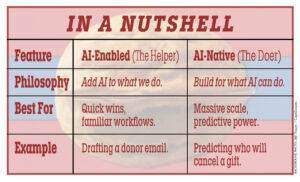
With AI-native technologies and tools, you’re getting experts. You’re getting a team that dreamed big, took a chance, and love it for what it is (the good and the bad) and are dealing with the challenges (as there is still a lot of learning to be done). These are tools that know how AI works and how to build workflows that start with AI, versus adding it to pre-existing workflows. In this role, AI is a doer. They can take action independently. This is Agentic AI.
AI-enabled tools, on the other hand, typically are tools that are either jumping onto the hype-wagon or were simply born before AI was available and are working to leverage it where it can help. Or both. You can usually sniff out which are hype, and which are true value-add. These are tools that have familiar interfaces, pre-existing ways of doing things, and AI was added to assist in various points of that workflow. Here, AI is a helper. They improve efficiency but don’t change the nature of the work.
Looking at a real-world application, authors of the “2025 Digital Outlook Report” (https://digitaloutlookreport.org/) wrote that 71% of nonprofits are now mapping donor journeys. An AI “helper” can help you draw the map. An AI “doer” can drive the donor through it. More specifically, an AI “helper” can summarize 40 donations and other donor engagements on a particular donor record into a short paragraph, maybe stating: “This donor typically donors quarterly, and has an average gift of $430. This donor also has one small monthly donation that has been excluded from the average.”
To draw the distinction, an AI “doer” constantly monitors the entire donor database, identifies the 5% of donors most likely to cancel their monthly donation in the next 60 days and automatically queues a personalized outreach. (See the accompanying chart.)
Mindset, Experience And Time: Why It Matters
Does it matter into which one you lean? The ever elusive answer of “yes and no” applies here.
Adding an electric engine to a Chevy Blazer is quite different from Tesla building an entire automobile company around the electric engine. The principal differences are mindset, and experience.
Starting with experience, it’s undeniable that a company that starts its journey with AI is going to have a bit of head start in how comfortable it is working with AI. But that’s not the experience you’re interested in.
If AI itself is a fluid digital being, it’s important to understand that AI models that have existed longer, and therefore have been learning longer, will have a better knowledge of whatever it is that it’s been tasked to accomplish (think: predict donor outcomes, create fundraising copy, forecast possible donor lapsing, etc). This is called Compounding Data Accuracy. This is because they’re built on “feedback loops” where every interaction trains the model, strengthening it every time. AI-enabled tools often struggle with “dirty data” from legacy silos because they’re essentially working backwards.
An AI-native fundraising platform that has been measuring and predicting outcomes for five years will be significantly better at predicting than an AI-platform that added AI recently to look at an existing data set. Because: time.
However, often when a platform (e.g. a CRM, etc.) touts new AI-powered functionality, you’re either getting the tech from another company that was plugged into an existing platform, or it’s something completely new. You can usually tell. This isn’t to say that it’s not viable or valuable. It’s only to say that both the company, and it’s AI learning models, are new at it.
AI Native doesn’t necessarily mean better for you and your teams. Sometimes the stability and familiar interfaces of an AI-enabled tool (like Microsoft or Google) are exactly what a stretched nonprofit needs to ensure continuity while taking steps forward.
Organizations that are looking for step-change and the next version of themselves would do well to explore AI native tools. It’s less about which is better than it is about what is better for your organization.
The Native or Enabled Quiz
Words are words. Here’s an actionable framework you can use to vet any new technology you’re considering adopting at your organization.
Ask these 8-questions when vetting any new technology. Answer YES or NO for each:
- Core Purpose: If we removed the AI features, would the tool lose its primary value?
- Workflow: Does this tool require us to build an entirely new way of working rather than fixing an old one?
- Data Maturity: Is our data structured and ready for a “doer” to run predictive modeling?
- Staff Capacity: Do we have the bandwidth for a “mindset shift” rather than just a software update?
- Integration: Does this tool need to be the “bloodstream” of our organization, connecting marketing, IT, and programs?
- Human Factor: Is a “helper” sufficient to fix our current administrative bottlenecks?
- Urgency: Do we need an immediate “quick win” (Enabled) or a long-term “resilient system” (Native)?
- Risk: Are we prepared to manage the governance of an autonomous “doer?”
Mostly YES: Lean AI-Native. You are looking for significant change and a “teammate” that can scale your mission through transformative capabilities.
Mostly NO: Lean AI-Enabled. You need a reliable “helper” to increase efficiency within your current, familiar structures.
The Governance Guardrail: Who’s Supervising The “Doer?”
If you lean toward an AI-native “doer,” you have to realize that you aren’t just buying software; you’re hiring a digital teammate that can act on its own. There is a catch. Even the smartest teammate needs a supervisor. Right now, about 82% of nonprofits are using some form of AI, yet only 10% have a formal policy in place to manage it, according to authors of “TechSoup State of AI 2025” (https://page.techsoup.org/ai-benchmark-report-2025).
When a “helper” makes a mistake, it’s a typo in an email. When an autonomous “doer” makes a mistake, like hallucinating a donor’s history or applying bias to a predictive model, it’s a threat to your organization’s most valuable asset: trust. Moving forward with native tools means moving forward with governance. It means being the “human-in-the-loop” to ensure your autonomous tools are reflecting your mission’s values, not just their own algorithms. It’s also important to look for certifications and compliances in the tools you use.
AI As A Capacity Builder: Solving the Staffing Crisis
This is also a pathway to address the staffing crisis: According to data in the “Sage 2025 Nonprofit Impact Report” (https://bit.ly/4965hhU), 58% of nonprofit leaders rank staffing and retention as a top priority. Even higher than funding challenges. Whether you choose a “helper” or a “doer,” automation is the only way to meet staffing issues and rising program costs, which are reaching record highs.
This is where the distinction between “helper” and “doer” becomes a survival strategy. If you’re one of the 95% of leaders worried about staff burnout, a “helper” AI can act as a pressure valve, shaving hours off manual reporting and administrative drudgery so your team can actually go home on time.
But if you’re looking to scale your mission without adding to your headcount, you need a “doer.” AI-native tools aren’t just assisting your staff. They are acting as a “force multiplier,” allowing you to handle a 48% increase in program demand without your team hitting a breaking point.
Whether you choose to empower your current people with a helper or expand your capacity with a doer, the goal is the same: making the work more human again by letting the machines handle the rest.
The Point
What’s most important here is that the sector is evolving. That it’s changing and your organization is moving in this direction. Nonprofit organizations are the counter-balance to problems that a capitalist society has created for itself. The institutions that are creating the problems you are solving for are leveraging AI tools, both native and enabled, every day and in big ways. The longer we wait to create policies, to resolve our trust issues, or to enable our teams, the farther behind we fall.
It’s not about which you choose at this stage. It’s about embracing and adopting.
The rest will follow.
And yes, AI helped write this article.
*****
Salvatore Salpietro is chief growth officer of Dataro, an AI-native fundraising prediction and audience building platform. He’s also held leadership roles at Fundraise Up, Child Mind Institute. His email is salvatore@dataro.io