The more than $19 billion in unrestricted support by MacKenzie Scott to in excess of 2,000 nonprofits has transformed recipient organizations and influenced many of the communities these organizations serve. Scott’s very large, unrestricted gifts with few to no restrictions on the time in which they must be spent have stabilized nonprofits’ futures and missions.
That doesn’t mean there hasn’t been some conversation among foundation leaders with mixed views of her giving.
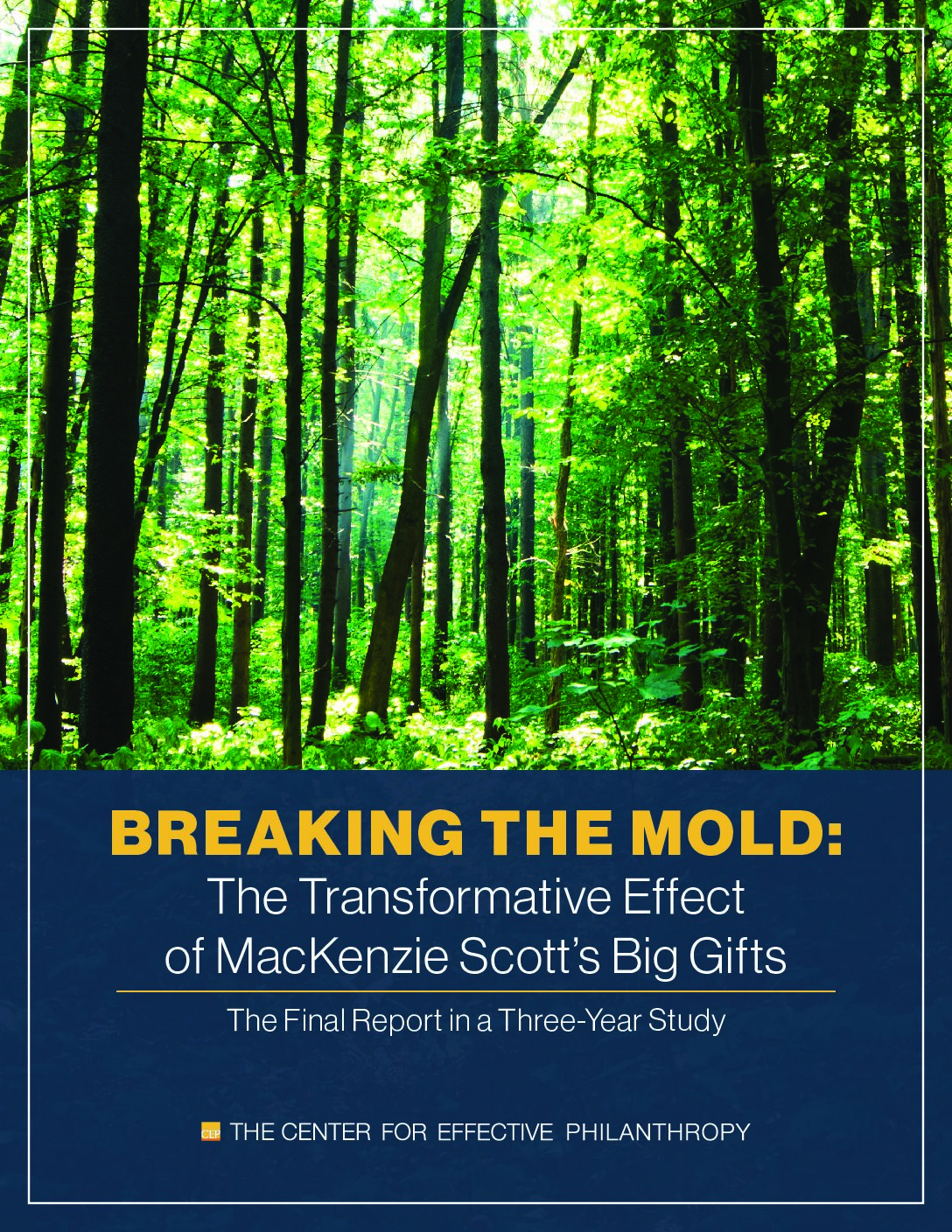
That’s part new data from the Center for Effective Philanthropy in Cambridge, Massachusetts, that spanned three years of research into the billionaire’s philanthropy and community impact. The 60-page report – “Breaking The Mold: The Transformative Effect of MacKenzie Scott’s Big Gifts” was authored by Elisha Smith Arrillaga, Ph.D.; Ellie Buteau, Ph.D.; Christina Im; and, Seara Grundhoefer. It was funded by a dozen foundations and had a 29-member advisory group.
A companion report goes into greater depth and profiles seven organizations to which Scott donated.
The four top findings in the report are:
* Most leaders report managing grant funds to ensure their organization’s long-term financial sustainability, and few anticipate a financial cliff.
* Many organizations are collecting information about the impact of this gift and are observing meaningful change created for communities.
* Leaders report Scott’s gifts increased their confidence in their own leadership, reduced their burnout, and sparked innovations in their programs and improvements in fundraising.
* Over the past three years, nonprofits have consistently reported positive effects of these large, unrestricted gifts, but foundation CEOs have mixed perspectives on the approach.
“It’s tempting for funders to say, ‘well but that’s MacKenzie Scott and she’s got tens of billions of dollars so there’s nothing we can learn from her giving. We don’t have anything close to those kind of resources.’ but I think that would be a mistake,” said Phil Buchanan, president of the Center on Effective Philanthropy.
“Every donor and foundation can learn from the way these nonprofits have, in general, carefully stewarded these resources. Funders can question some of their default assumptions about the way they give and push themselves to give carefully vetted organizations gifts that are as large as possible and as unrestricted as possible,” said Buchanan. “This is especially crucial now, in a volatile and unpredictable context in which nonprofits need to be able to shift on a dime to do what the moment requires of them,” Buchanan told The NonProfit Times.
While Scott’s grants are significantly larger when compared to those of other funders, they have, at the median, decreased in size since 2020. The sizes of recipient organizations have varied over time. For example, Scott’s median grant in 2020 was $8 million with the median organizational budget of the recipients being $9 million. It declined to $5 million in 2021 to organizations with median budget size also of $5 million. Her most recent gifts had a median of $4 million with organizational budgets at $7.2 million.
More than half of the grants (54%) went to direct service organizations and nearly one-third (30%) to advocacy organizations, the research showed.
The authors wrote that results from their 2022 and 2023 research on the effects of Scott’s gifts are similar to those of research on efforts from the Ford Foundation’s Building Institutions and Networks (BUILD) program and the Ballmer Group’s giving. Both efforts provided large, unrestricted gifts to vetted organizations, though they do not share the lack of time restriction that characterizes Scott’s gifts.
Almost all organizations have determined specific uses for some or all of the grant funds from Scott. Leaders said that they are intentionally spending the funds over time. Even for those organizations that received a grant in 2020, leaders reported that, at the median, they have spent just more than half of the grant funds to date, according to the authors. Just 15% have spent all of the grant.
Leaders overwhelmingly indicated that they plan to stretch grant funds over multiple years, to sustain their organizations in the long term. Nearly 60% of leaders report that their organization intends to spend down its Scott grant over two to five years.
Nearly two thirds of leaders report spending grant funds across all three of the following use types: programs, operations, and finances. About half of nonprofit leaders report spending the largest portion of their grant on programmatic work.
Some leaders expressed concern smaller organizations “can’t metabolize large gifts,” especially if they are a surprised and had no previous contact with Scott.