Recruiting and retaining employees gets tougher every day. The reason could be that employees aren’t as enthusiastic about their jobs as they were just a year ago. Even at nonprofits considered best in breed, employee satisfaction declined during 2024 compared to 2023. The drop was significant in some cases.
New data compiled for the annual The NonProfit Times’ Best Nonprofits To Work For showed employee satisfaction down in two of the three size categories, with only small organizations (15-49 employees) having scores matching the 2024 list at a 92% positive rating from staff. To qualify, organizations needed at least 15 employees.
Satisfaction dropped three points year-over-year in medium-sized organizations (50-249 employees) and two points for large nonprofits (250 or more employees). Satisfaction at organizations that competed but were not included in this year’s honorees was 11 points less than those included on the list.
This discontent comes even as leaders at nonprofits say they are being more employee focused, such as by involving staff in most policy decisions and finding ways to offer more and better benefits. Those benefits often include wellness, with mindfulness that remote workers also need attention.
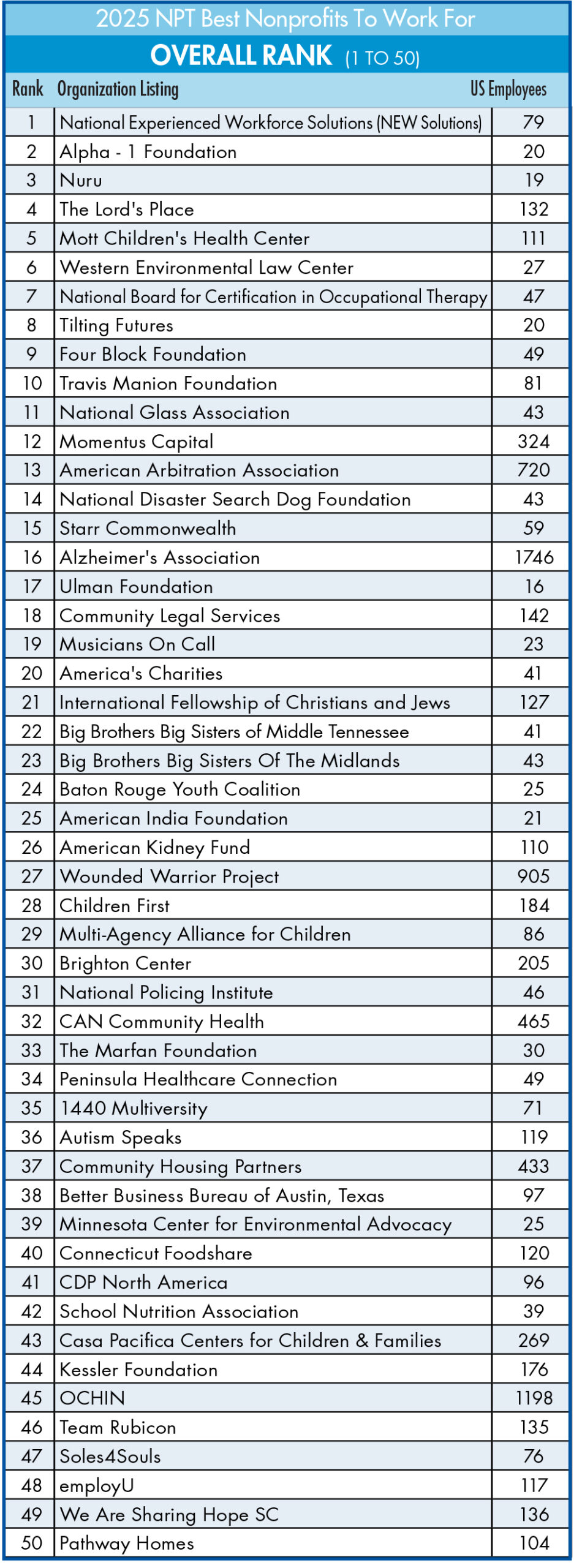
At the OCHIN in Portland, Oregon, that wellness attention includes chair yoga. “We are remote. Many people sit a lot so you can sit in your chair and do moves that help you relax and stretch your body while you’re in meetings,” said LisaMarie May, chief of people and culture. OCHIN placed number 45 on the overall list and eighth among large nonprofits.
Staff at Momentus Capital in Arlington, Virginia, are provided virtual mindfulness webinars and access to the online platform Burnalong, which offers more than 50,000 live and on-demand wellness programs. Staff can add up to four family members for free. There is also access to discounted gym memberships to support continual health and wellness. Momentus Capital finished number 12 overall and first among large nonprofits.
Many organizations offer childcare assistance. The Alzheimer’s Association in Chicago offers eldercare. “We know about the day in the life of a caregiver,” said Mary Grisby, vice president of human resources. “There are a couple of aspects of the eldercare assistance program, a paid family leave aspect to that,” she said. Staff can qualify on an intermittent basis or continuous basis. There’s up to six weeks of paid time off “to help with eldercare stints,” Grisby said. Employees can link that to other benefit plans, such as assistance through the employee assistance program and other channels to get help with caregiving.
Keeping staff physically active is important. “We’ve elevated it a little more and redefined what wellness means,” said OCHIN’s May. “It doesn’t necessarily mean you have to run a 10-mile race. It is something as simple as reading a book, or taking time to just breathe, or reaching out to one another. That’s our definition of wellness for our staff,” said May.
The attention expands to OCHIN’s members. “We provide our members with onsite support for their electronic health records implementations, as well as ongoing virtual support led by regional teams in our members’ time zones,” May said. “Our network includes ambulatory and acute health care organizations, including rural hospitals, rural health clinics, Indigenous and tribal health organizations, school based clinics, correctional facilities, behavioral health providers, dental clinics, public health departments and PACE [Program of All-Inclusive Care for the Elderly] and HIV/AIDS care organizations.”
At the Western Environmental Law Center in Taos, New Mexico, staff can work adjusted hours, a compressed schedule and from basically any geographic location as long as the work gets done. “We have ‘Flex Fridays’,” said Brian Sweeney, communications director. That allows for a schedule clear of internal meetings, and the flexibility to get out of the office if that is what employees need to clear their heads and/or take care of personal needs such as pets, health care or anything else, he said.
Employee bonding is important. “One of the things we put more of an emphasis on within the last year is workplace affinity groups. We allow our employees the space to coalesce with each other around topics,” said Jason Jakubowski, president and CEO of Connecticut Foodshare in Wallingford, Connecticut. The organization has various affinity groups run by the employees. “For example, we have a Latino affinity group. We have a Black affinity group, a female affinity group and LGBTPQ. We have a Bible study group,” said Jakubowski. “All are completely optional and completely run by the employees, but we give them the space by which to run programs. We figured giving people the room to be who they are is important,” he said.
Only one of eight categories measured showed improvement. Overall, statements within the Work Environment category went from 88% positive responses to 90%. The statement “I feel physically safe in my work environment” topped positive answers in the category at 96%. The category with the highest overall score was Relationship With Supervisor, with all nine statements receiving scores of 90% or greater, but overall the category was still one point down from last year. The statement “My supervisor treats me with respect” had 94% positive responses, as did “My supervisor acknowledges when I do my work well.”
The cumulative positive reactions to leadership statements dropped two points to 88%. Only one of the five statements in the section got out of the 80s, with “I understand the long-term strategy of the organization” hitting 90%. The largest dip was in the Corporate Culture And Communications category, which was down three points from last year at 88% positive responses. The worst score in the section was 76% positive responses to the statement “Changes that may affect me are communicated to me prior to implementation.” Just three of the 17 statements cracked into the 90s for positive responses.
Role Satisfaction dipped two points to 88%, with “I like the type of work that I do” topping the positive responses at 93%. The statement “Deadlines at this organization are realistic” had the worst of the positive reactions at just 83%.
Training, Development And Resources declined two points to 86% with the worst reaction to the 10 statements being “If I do good work I will be rewarded” at just 75%. The reaction was 91% positive to the statement “This organization provides the technology, equipment and resources I need to do my job well.”
At OCHIN, professional development includes hands-on experience. “Part of their growth is matching them up with someone who has more skills in an area,” said May. OCHIN has a business intelligence team, for example, and a staffer can spend some time on a team to build their skills in another department.
Satisfaction With Pay And Benefits declined two points to 85%. The lowest of the 11 scores in the category were both just 75% for “I’m satisfied with the tuition reimbursement benefits” and “My pay is fair for the work I perform.” The best reaction was 90% positive responses to the statement “Overall, I’m satisfied with this organization’s benefits package.”
The Overall Engagement category also dropped two points, to 90% positive responses, and the survey average for positive responses in all categories was 88%, down from 90% last year.
The best scores in the employer benchmarks section were 98% for “flexible hours to accommodate school events, taking a family member to a doctor, etc.,”and for offering 401(k), 403(b) and 457 retirement plans. The next-best employer benchmark was 94% for having telecommuting options.
In-person work has its place. Usually when you’re told the boss wants to see you for 15 minutes and it’s a Friday afternoon, that’s not a good thing. But it’s fine if you’re on staff at the National Policing Institute in Arlington, Virginia.
“For us, after the first time that people have been through it, people look forward to these meetings because of the way we do them,” explained CEO Jim Burch. There is little or no talk at all about work during the chat. “It’s how are you feeling? How you’re doing? What’s happening in your life?” he said.
The nonprofit sector is a people business, even when it’s a remote workforce. “One of the things we have recognized as an organization is people miss those individual connections, personal connections to their true self, not just who they are at work,” said Burch.
“When you’re remote, people just don’t get the chance, like when you’re walking in from the parking lot into the office and having a conversation about what you did the night before,” said Burch. “We miss that and so we try to create those opportunities in a virtual environment, where people can come together and there’s no expectation, really just an open conversation,” said Burch. “What matters is people, not workers, people.”
See the complete package of stories here … https://npt.mydigitalpublication.com/publication/?i=845112