By Richard H. Levey
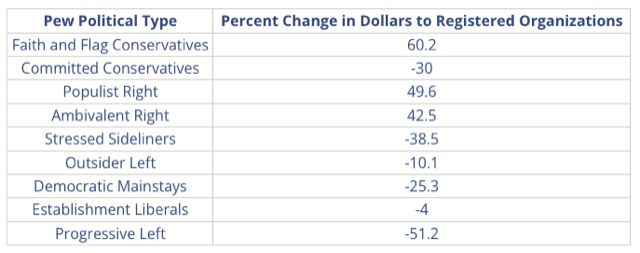
Overall giving levels remained constant during first-quarter 2025, but the political bent of who is giving shifted. During the quarter, people identified as right leaning contributed more money to formal nonprofits (as opposed to unstructured or individual assistance) than those expressing centrist or left-leaning tendencies, according to Generosity and Civic Intent in Early 2025, a new report from GivingTuesday.
The difference is significant: Within the quarter, right leaning people reported giving approximately 75% more, specifically cash, than left- or center-leaning respondents, according to Woodrow Rosenbaum, chief data officer at GivingTuesday. The report did not measure volunteerism, goods in kind or amplification contributions.
In fact, the overall number of individual donations to nonprofits during first-quarter 2025 was higher than first-quarter 2024, potentially indicating that nonprofits that made an ask were rewarded.
The splits are a new phenomenon. “This is the first time we’ve seen a difference in giving behavior across the political spectrum,” Rosenbaum told The NonProfit Times. He speculated that the change in federal government influenced confidence in the economy among right-leaning individuals, and therefore their willingness to contribute cash.
There is another possible factor at work. The calendar first quarter is typically a down time for nonprofit solicitation, although response rates to what solicitations were made during first-quarter 2025 remained steady. One might speculate that nonprofits with broader appeal to left-leaning donors pulled back their solicitation efforts during first-quarter 2025 for whatever reason, while those traditionally appealing to right-leaning donors did not.
The overall donation level rose despite another finding from the report: trust in nonprofits and the services they provide not only remains strong but was even stronger among individuals identified as left-leaning.
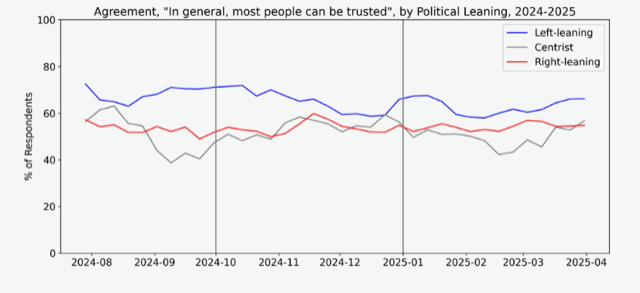
“Here’s why you shouldn’t be surprised,” Rosenbaum said. “First, (it’s) because most people trust nonprofits. Second, (it’s) because trust does not drive donations. You need to have trust in an organization to give to it. But that trust in that organization does not drive your motivation to do so,” he said. Furthermore, distrust in nonprofits in general will likely not be applied to a specific nonprofit for which a donor has an affinity.
“We should think about trust the other way around,” Rosenbaum said. “Lack of trust is an obstacle to giving, but trust doesn’t drive the donation.”
One mistrust of nonprofits is eliminated, analysts would naturally look for other correlating factors for the giving shifts among the political groupings. One jumped out: Overall, around three-quarters of respondents believe they are welcomed and included in activities with others in their communities, and a similar amount said they are helping to make their communities better, more civil places. And 80% were willing to help others whose beliefs and politics differ from theirs.
However, there were some splits beneath the overall levels that may explain the differences in donation behaviors. Individuals identified as being the political center were much more likely to agree with the statement “I am treated as ‘less than’ other residents in my community.” Among this group affinity for this sentiment has doubled since fourth-quarter 2024 to 36%.
“It might be that this sense of belonging is an important factor in people’s sense of their ability to contribute in their community,” Rosenbaum hypothesized. “One of the ways belonging and a sense of connection gets built is through generous action. This [insight] presents an opportunity for nonprofits and other and other social sector groups to alleviate or mitigate that issue by furnishing people with an opportunity to have agency and feel like they are contributing and have a connection to their community.”
If part of the reason for a drop in nonprofit contributions among individuals aligned with the political center and left is a lack of solicitation, the phenomenon has an easy fix. “We estimate that at least $23 billion a year could be raised if organizations were more active through middle of the year,” he said, adding that a lack of focus on recurring giving in solicitations as well as internal systems that focus more on one-off gifts than sustaining gifts could contribute to what he sees as a $52 billion annual contribution shortfall.
GivingTuesday based its political typography on a sample of respondents to its weekly online survey of GivingPulse respondents. Respondents were asked a series of primarily psychographic question about their “civic intent,” and based on their answers were separated into groups based on modeled political affinity that were constructed by the Pew Research Center.