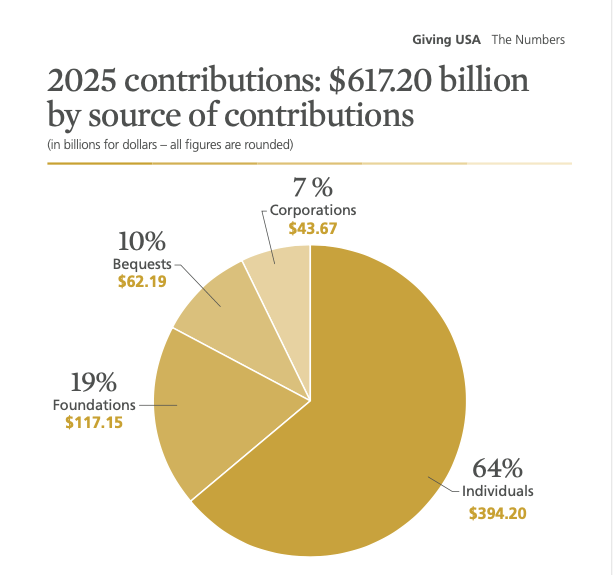
Americans helped charities beat inflation during 2025, donating an estimated $617.2 billion, which was a 5.7% increase compared to 2024’s total. The U.S. inflation rate for 2025 was 2.6%. Individuals again led all funders with an estimated $394.2 billion, which was 64% of all giving.
Total charitable giving reached a new high in current dollars and the second-highest amount on record in inflation-adjusted dollars.
Giving USA 2026: The Annual Report on Philanthropy for the Year 2025 is published by the Giving USA Foundation and researched and written by the Indiana University Lilly Family School of Philanthropy. The report slices overall giving into four pieces – individuals, foundations (19% of giving), bequests (10% of giving) and corporations (7% of giving).
The largest year-over-year jump was in bequests, which increased 19.7% in raw dollars, a boost of 16.6% when inflation is factored in. The increase is despite the number of deaths declining each year from a high of 879.7 deaths per 100,000 people in 2021 to 722.1 deaths per 100,000 people for 2024. Provisional data from the U.S. Centers For Disease Control have preliminary numbers for 2025 also declining.
Part of this seeming anomaly might be that the mortality rates for 2021 and beyond were boosted by COVID-19 deaths, the unexpected nature of which might have prevented potential legacy donors from codifying their wishes.
Bequests are a challenge to estimate because estates might take years to settle. Jonathan Bergdoll, interim director of Data and Research Partnerships at the Indiana University Lilly Family School of Philanthropy, explained that in 2025 the “third-largest gift we have is a $3.1 billion bequest from Microsoft co-founder Paul Allen who passed in 2018. The estate took seven years to clear.”
Planned giving is a major part of bequests. “I’m not an economist. I’m not a researcher. I’m a little more willing to go out on the limb. We may be finally seeing the great wealth transfer in action,” said Wendy McGrady, a veteran fundraiser who is president and chief operating officer of The Curtis Group and chair of the Giving USA Foundation. “And because I’m a practitioner working with nonprofits … my message would be you better be in the game, the planned giving game, if you’re not. … I was pleasantly surprised to see at the end of the year that the market was still so strong.”
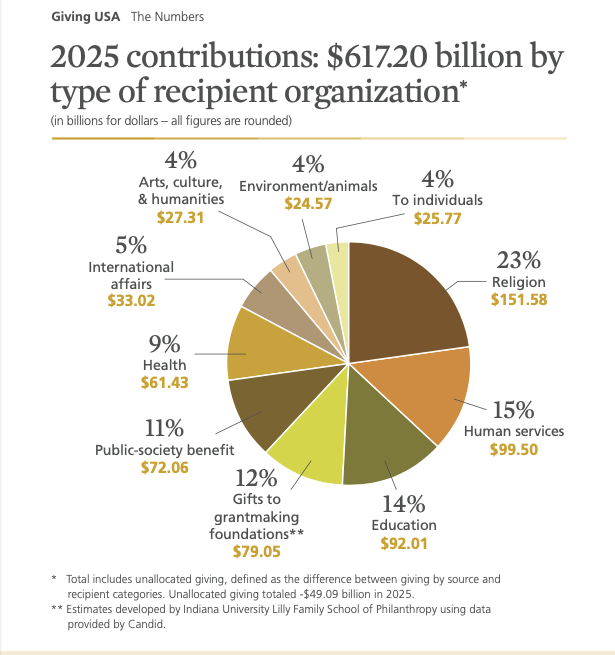
The top recipient categories by percentage growth for 2025 were education, up 11.7% to $92.01 billion, public-society benefit, up 11% to $72.06 billion and environmental and animals, up 11% to $24.57 billion. These three silos have seen the largest annualized rates of change during the past five years, the data shows. In fact, giving to eight of the nine subsectors showed gains, except for giving to foundations, down 16.2%.
Big gifts were the fuel for the education sector’s gain. Philanthropist MacKenzie Scott gifted a reported $1.1 billion of her Amazon fortune to education during 2025, much of it to historically Black colleges and universities, tribal colleges and organizations supporting underserved students, including $63 million each to Howard University, Morgan State University and Prairie View A&M University.
Nike Co-founder Phil Knight and his wife, Penny, made a record-breaking $2 billion pledge to the Oregon Health & Science University (OHSU), a donation also recorded in the Giving USA education numbers.
Experts have attributed a good percentage of the increases to the stock market consistently hitting all-time highs. “Giving through bequests and by foundations were among the most robust areas for generosity, a continuation of the trends seen in recent years,” said Amir Pasic, Ph.D., the Eugene R. Tempel Dean of the Indiana University Lilly Family School of Philanthropy. “This likely is in part a reflection of growing asset values due to the strong performance of financial markets in recent years.”
Asset growth can be seen in more than just equities. “Bequests are really up and down in that way each year. We typically don’t put a lot of stock in an increase or a decrease,” explained McGrady. “This year, I’m saying three out of four years, you’ve seen a 20% growth. You’ve heard other people say that the great wealth transfer was probably delayed from the original estimates. I do think there’s going to be more and more of this activity.”
It isn’t all wine and roses, though. “While Giving USA reports in aggregate dollars, a lot of nonprofits’ realities were very different than what the Giving USA numbers show. Probably a third of nonprofits received federal funding prior to last year and the majority of those in some way were impacted,” said McGrady. “Not everybody lost it all at once, but there were delays. There was a lot of uncertainty last year,” she said.
Giving to religion led all areas of giving for 2025 at 23%, up 2.4%, but the category continued its decades long downward trend as a percentage of overall giving. Granted 2025’s $151.58 billion is a lot of money, but donations to religious entities made up 62% of total giving during 1984, for example.
“In real terms it [giving] was basically flat. That’s been the norm now for religious giving for a while. If you look at how much in real terms religious giving has grown since 2005, it’s gone up 1%,” said Bergdoll. “In comparison, the next-lowest subsector for that that time period is arts and culture, which has gone up 33%. In real terms, religious giving is exactly where it was two decades ago.”
Giving USA estimates primarily rely on econometric methods developed by leading researchers in philanthropy and the nonprofit sector and are reviewed and approved by members of the Giving USA External Review Panel, according to information from the Lilly School of Philanthropy. Members of its External Review Panel include research directors from national nonprofits, as well as scholars from such disciplines as economics and public affairs, all of whom are involved in studying philanthropy and the nonprofit sector.
Gifts made directly to individuals amounted to 4% of total giving in 2025. Bergdoll explained that the category name giving to individuals “predates my time on this project and it predates almost all crowdfunding websites.” What that category tracks “are in-kind pharmaceutical donations that are being made directly to individuals through patient assistance plans,” he said. “This used to be a much more trivial adjustment that we made to account for gifts on both sides on the sources and the uses.”
The category has grown considerably during the past few years. “It’s right there with environmental giving in terms of size. … It is just reflecting those pharmaceutical patient assistance plans. We do not track charitable crowdfunding that’s going directly to individuals,” said Bergdoll.
“Despite all of the hubbub in the world, people are still generous,” said Gabe Cooper, vice chair of the Giving USA Foundation and founder and CEO of technology firm Virtuous. “If I’m a fundraiser, there’s still plenty of folks to go out to and have a conversation with – the sky isn’t falling, right? If I’m a fundraiser, it gives me conviction to sort of lean in and go after it.”
A challenge Cooper spoke of is the declining number of donor households. There is concern for the current gifts but also the next generation of donors. “If these younger generations are giving less frequently or there’s less households giving as that wealth transfers, what happens? How are those kids, the next generation thinking about generosity? And so my concern, it’s less the near-term great wealth transfer and it’s more what’s happening with everyday donors in this country.”
For Cooper, “hope” is the takeaway from the numbers. “There’s a lot of hope in this year’s numbers. In a year where consumer confidence is not great, there’s uncertainty in the air in some parts of society,” to see “this number and to see a 5.7% increase, there’s a lot of hope in that.”
You can access more of the data at www.givingusa.org