(image from (https://johnsoncenter.org)
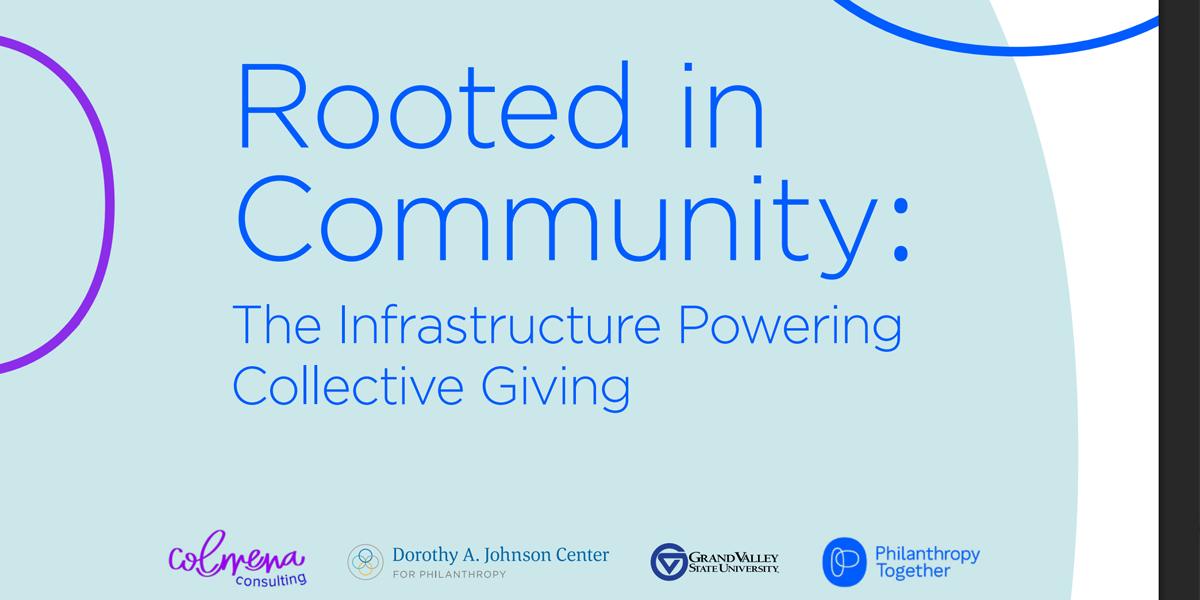
Strength in collective giving efforts such as giving circles, identity-based groups or cause-focused entities stems from structures. These structures include the systems, assigned duties, and management of resources ranging from volunteers to knowledge to allotting contributions. The stronger these systems, the more likely a collective giving operation is to be successful, according to Rooted in Community: The Infrastructure Powering Collective Giving, a new report from the Dorothy A. Johnson Center for Philanthropy at Grand Valley State University and Philanthropy Together.
Collective giving infrastructure encompasses the hosts – individual and organizational – who provide fiscal and operational stability for ongoing philanthropic work; the networks that connect entities and promote shared wisdom; the platforms that simplify participation and enable scaling of access; the researchers who provide evidence and guidance; and the on-the-ground entities that coordinate tools, narratives and other resources in support of the philanthropic goal.
Recent years have seen rapid expansion of collective giving efforts. In 2017, an estimated 1,600 groups encompassed roughly 150,000 individuals who had mobilized a cumulative $1.29 billion since their inception. Six years later, after the COVID-19 pandemic placed a premium on at-a-distance connectivity, the number of groups or circles reached around 4,000 entities, with 370,000 participants. In the six years since 2017, these groups mobilized $3.1 billion.
In practical terms, giving circles remain among the most powerful sources of collective giving. The structure of giving circles varies. More than four in 10 – 42% — are hosted by community foundations, with another 24% primarily the result of entities being brought together through platforms such as Grapevine. On the smaller end of the scale, 7% are housed within nonprofit organizations and 3% stem from women’s funds.
Most of these efforts rely on volunteers. Fewer than half of collective giving entities (47%) of all such groups are staffed by paid employees, and among those that are, many draw that staff from host or sponsoring organizations. Just under one quarter (24%) operate independently of an outside financial sponsor. As one collective giving leader noted to the report authors, “Without a host, circles would burn out fast. Volunteers can only carry compliance and administration for so long. Hosts keep us stable so the energy can go toward impact.”
Hosting technology platforms such as Grapevine can provide structure up to a point. More than four in 10 (42%) of giving circles hosted on Grapevine, which provides infrastructure capabilities, boast more than 100 members, compared with 38% of all giving circles, regardless of the source of their structure.
Collective giving infrastructure does more than enabling fundraising and distribution mechanisms. Well-run collective giving groups grow more quickly and gain legitimacy from their consistency, visibility and demonstrated influence. They also are more likely to be welcomed into larger structures aligned with their goals, be more attractive to community practice leaders within their areas of focus and enable shared learning among donors, institutions and potential and actual partners.
These structures also provide entry into philanthropic efforts for traditionally underrepresented donors. Their community-focused nature gives access to individuals, and amplifies the impact of these individuals. As the report authors note, “For many identity-based circles and smaller community groups, these supports make participation feasible for the first time.” That participation goes beyond giving to include opportunities for leadership and decision making among these supporters.
Collective giving efforts address a rising concern among fundraisers: the current top-heavy trend among individual philanthropy, in which a relatively small number of donors are making up a significant percentage of funding. Fundraisers with limited resources may not be able to introduce or nurture lower-level donors due to limited resources, meaning that in pursuit of short-term goals they are sacrificing the next generation of funders. As the authors note, this moment reflects “both challenge and possibility for philanthropy. Cuts in U.S. funding for nonprofits and international aid, coupled with mounting criticism of the sector, have heightened attention to the role of everyday givers and the systems that facilitate their engagement.”
The report is based on survey data from 1,406 individual members of 543 collective giving groups, in-depth interviews with infrastructure leaders and funders, field studies and published reports. A full copy of the report is available here: https://johnsoncenter.org/wp-content/uploads/2026/02/rooted-in-community-the-infrastructure-powering-collective-giving.pdf